

Repository-to-documentation generation
Converts a GitHub repository into documentation pages with an AI-generated structure rather than a plain code listing.
GitSummarize is a web app that turns GitHub repositories into generated documentation pages. It is aimed at people who want a faster way to understand a codebase structure or share a readable project overview.
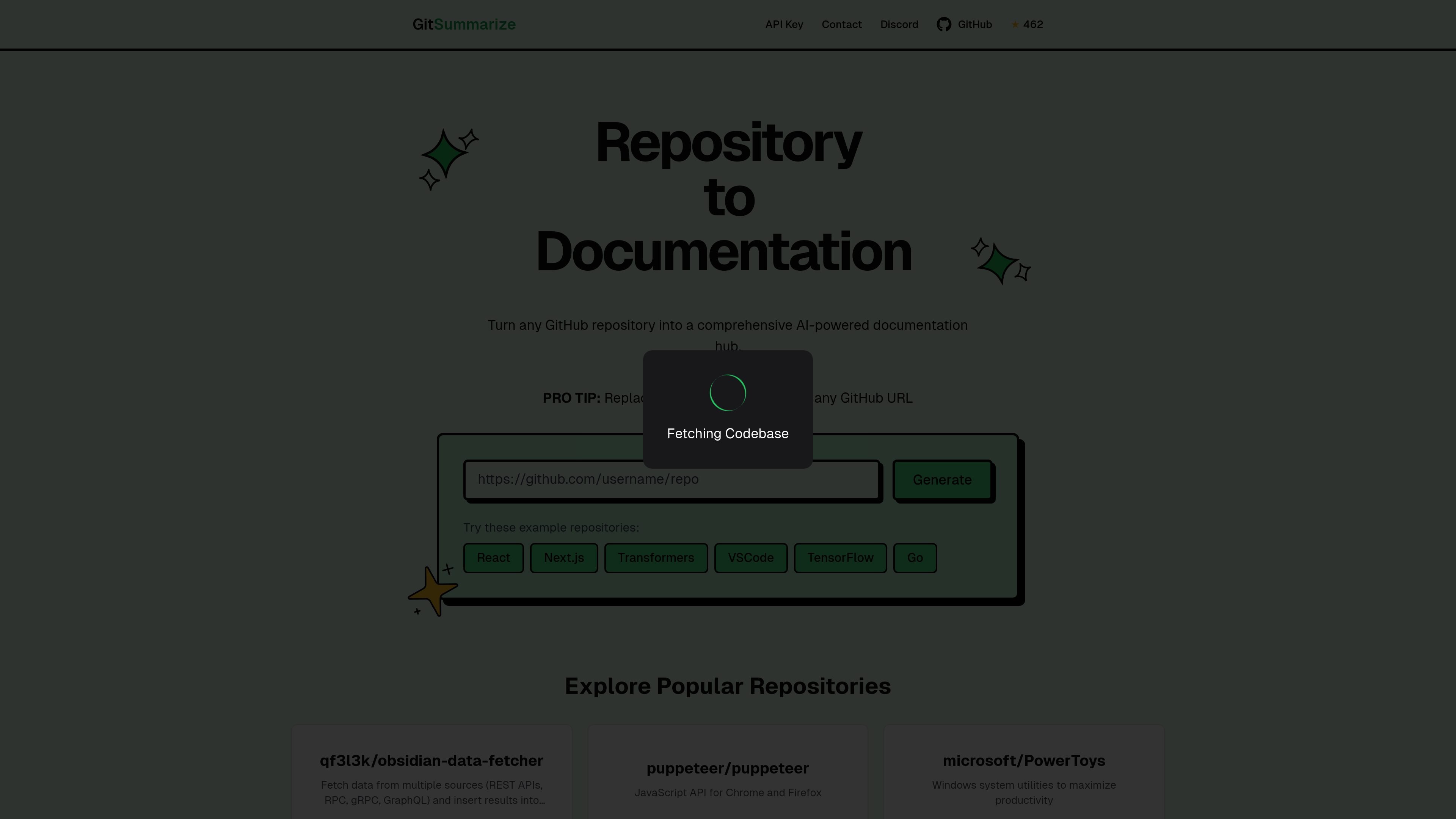
GitSummarize is a web tool that turns GitHub repositories into generated documentation pages. Its homepage positions the product as a way to create comprehensive, AI-powered documentation hubs from a repository URL, with the promise of doing it instantly.
The site shows live examples for repositories such as Obsidian Data Fetcher, Puppeteer, and Microsoft PowerToys, indicating that the product is meant for quickly understanding project structure, codebase areas, and project documentation without manually reading the whole repository. The available evidence supports a GitHub-focused documentation workflow, but not broader integrations or export options.
Converts a GitHub repository into documentation pages with an AI-generated structure rather than a plain code listing.
Presents generated output with sections such as overview, architecture, codebase, configuration, and business logic when the repository content supports it.
Provides example repository pages so users can inspect how different projects are summarized before using the product.
Shows a simple workflow built around entering a repository path or replacing part of a GitHub URL, then generating documentation.
Displays live documentation pages for real repositories like Obsidian Data Fetcher, Puppeteer, and PowerToys.
A maintainer can point GitSummarize at a GitHub repository to produce a documentation page that is easier to scan than the raw repository tree.
Someone joining a project can use the generated docs to understand architecture, key folders, and core responsibilities before reading source files in depth.
An open-source maintainer can share the generated documentation as a companion view that helps contributors understand the project structure faster.
A team can review the example pages to gauge whether the generated structure fits the kind of repository they maintain, such as libraries, utilities, or apps.
GitSummarize generates documentation from GitHub repositories by turning a repository URL into a documentation page. The homepage frames it as "Repository to Documentation Instantly" and shows example repositories rendered as generated docs.
The pricing page is not available as a standard pricing table; it returns a not-found page and shows links for an API key, contact, Discord, and GitHub. That suggests the product may use a direct-access or contact-based model, but the sources do not confirm specific plans or prices.
The site examples are all GitHub repositories, and the main call to action says "Turn any GitHub repository into a comprehensive AI-powered documentation hub." The source does not confirm support for non-GitHub inputs.
The rendered examples present generated documentation pages with sections like overview, repository structure, codebase details, and business logic. The sources do not specify export formats or download options.
The source text does not show an authenticated team workflow, collaboration features, or API documentation beyond the presence of an API key link on the pricing page. Those capabilities may exist, but they are not confirmed by the collected evidence.

Docuopia is an AI document assistant for drafting and editing PRDs, help docs, wiki pages, and diagrams, with collaboration, version history, and a free version.

Anara is an AI research workspace that searches your library and the web, then helps you write with cited claims and source-backed answers.

Quenti is an online learning platform for flashcards, practice tests, matching games, and AI-assisted grading for students, teachers, schools, and organizations.

Prompt Genie is a prompt management and optimization tool for AI workflows, plus Claude Code memory to reduce repeat reads and token spend.

Dokkio is a cloud content organization and search platform for teams and individuals working across services like Google Drive, Dropbox, Gmail, Box, Slack, and OneDrive. It helps users search, tag, organize, and understand files, attachments, pages, and screenshots from one place.

Obsidian is a private note-taking and knowledge management app with local Markdown notes, links, graph view, Canvas, plugins, themes, sync and publishing.