

Agentic long-horizon models
The homepage highlights MiMo-V2.5-Pro as a model focused on agentic behavior and long-horizon coherence, which suggests support for sustained multi-step tasks.

MiMo is Xiaomi’s AI model family with a web demo, API access, and blog content on MiMo Code, ASR, and TTS for agentic and multimodal AI work.
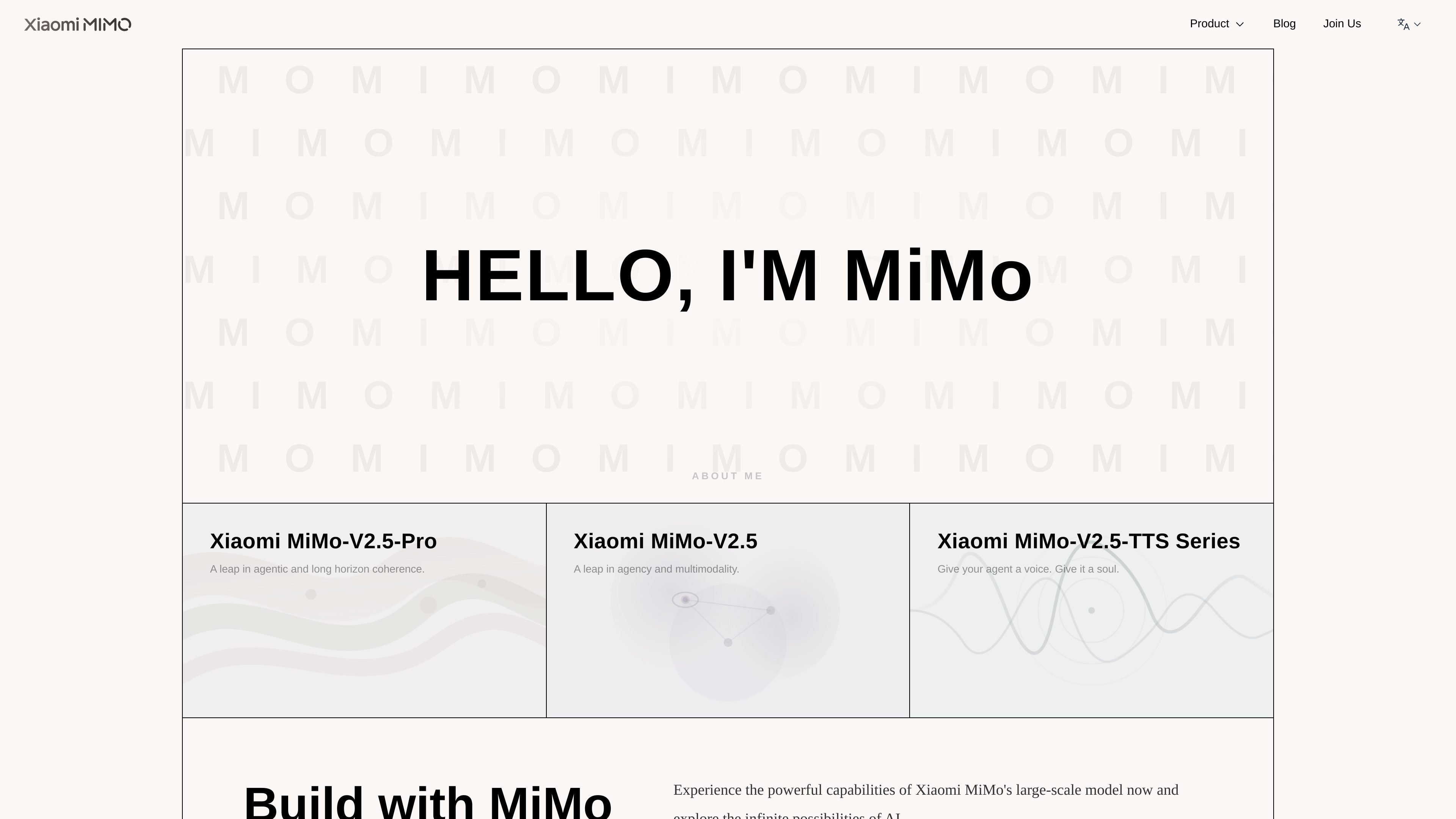
MiMo is Xiaomi’s AI model family and product site for its general intelligence work. The public homepage introduces MiMo as a companion-style system built around language, prediction, compression, and interaction with the physical world, while the navigation points to product pages, a blog, and developer access.
The site presents MiMo as a platform with multiple model lines rather than a single product. Visible entries include MiMo-V2.5-Pro, MiMo-V2.5, and MiMo-V2.5-TTS Series, plus a web demo and API access for hands-on use. Blog posts also reference MiMo Code, speech recognition, and model-system optimization, showing that the project spans coding agents, multimodal modeling, and speech capabilities.
The homepage highlights MiMo-V2.5-Pro as a model focused on agentic behavior and long-horizon coherence, which suggests support for sustained multi-step tasks.
MiMo-V2.5 is presented as a step forward in agency and multimodality, indicating a model line that spans both reasoning and multimodal inputs.
The MiMo-V2.5-TTS Series is described as giving an agent a voice, pointing to text-to-speech capabilities for spoken output.
The blog links include MiMo-V2.5-ASR, described as an open-source speech recognition model supporting Chinese, English, dialects, and lyrics, which indicates speech-to-text coverage in the broader MiMo ecosystem.
The site offers both a web demo and API access, so people can try the model interactively or integrate it into their own applications.
The blog includes MiMo Code, described as scaling coding agents to long-horizon tasks, indicating a focus on developer-oriented agent workflows.
Try the model in a browser before integrating it into a workflow. The homepage’s web demo entry point supports quick evaluation without a local setup.
Connect MiMo through the developer portal when you want to use its capabilities inside an application or service.
Use the MiMo-V2.5-Pro and MiMo Code materials as references when building long-horizon agents that must preserve coherence across extended tasks.
Explore the broader MiMo model line when you need both language and multimodal capabilities in the same product family.
Review the speech-related model entries when your use case includes recognition or voice output, such as ASR or TTS workflows.
MiMo is presented as a Xiaomi AI model family and developer platform rather than a standalone consumer app. The homepage highlights web demo access, API access, and a blog, which suggests it is meant for experimentation, integration, and research-style use.
The homepage points to a web demo and an API access path. That means users can try MiMo in the browser and developers can connect to it through Xiaomi’s developer portal.
The site does not provide pricing details on the main pages, and the pricing URL currently returns a 404 page. Based on the available evidence, pricing is not published on the captured pages.
The site describes multiple MiMo model lines, including MiMo-V2.5-Pro, MiMo-V2.5, and MiMo-V2.5-TTS Series. It also references MiMo Code and blog posts about coding agents, speed, multimodality, ASR, and TTS.
The homepage and careers section suggest MiMo is being built for broad AI use, including language, multimodal, and speech-related work. The public pages do not spell out a full production deployment workflow, so fit should be evaluated from the web demo and API entry points.

AakarDev AI helps teams manage AI provider access, project setups, logs, and analytics in one dashboard with BYOK support.

Orca is an Agent Development Environment for shipping with coding agents, running multiple CLI agents in parallel across isolated worktrees, with desktop and mobile workflows.

AI Magicx is a unified AI workspace for chat, image, video, voice, music, email and developer tasks, helping teams and creators manage multiple models in one place.

Paper is a design tool that connects canvas, code, and AI agents so teams can create, share, and ship work in one workflow. Includes desktop app and MCP access.

blop is a QA agent that writes browser tests as code in your repo, runs them in CI, clusters repeated failures, and can open PRs to fix broken tests.

RLAMA is a local AI platform for building RAG systems and intelligent agents on macOS, Linux, and Windows, with HTTP API support.