

Real timeline editing
OpenChatCut uses an actual multitrack project, so AI actions land on clips, captions, transitions, effects, LUTs, motion graphics, and keyframes rather than producing a flattened output you cannot change.

OpenChatCut is a free, open-source, local-first video editor for AI-assisted conversational editing on a real multitrack timeline.
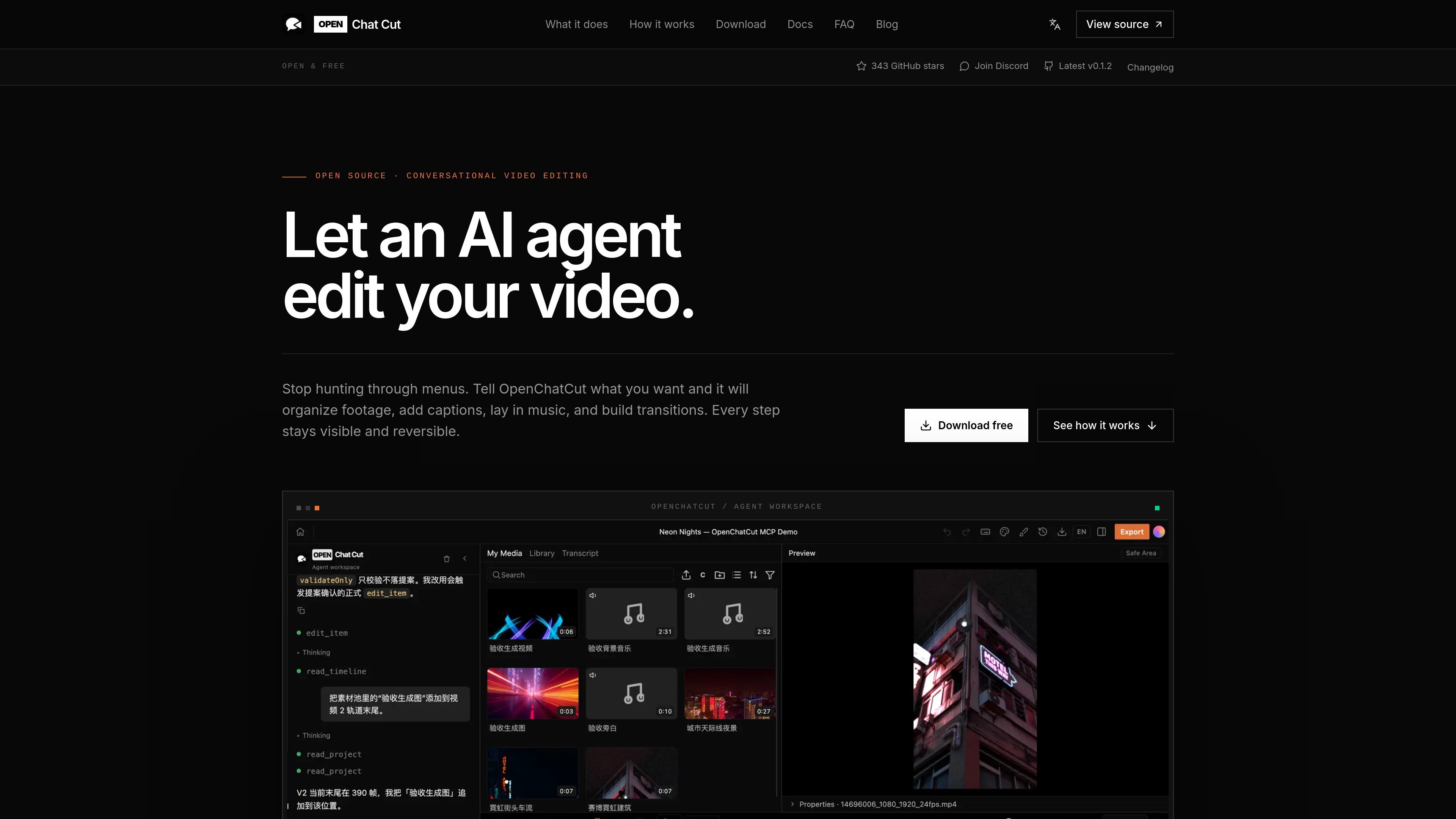
OpenChatCut is an open-source, local-first video editor built around AI-assisted editing on a real multitrack timeline. Instead of asking a model to generate a finished clip, it lets you describe the goal of an edit and then applies the changes directly to the project, where they remain visible, adjustable, and undoable.
The product is aimed at people who want conversational editing without giving up timeline control. The site positions it as a fit for interviews, talking-head videos, podcasts, and product demos, and it supports workflows where creators or teams can refine an AI-assisted first pass with normal editing tools before export.
OpenChatCut uses an actual multitrack project, so AI actions land on clips, captions, transitions, effects, LUTs, motion graphics, and keyframes rather than producing a flattened output you cannot change.
You can describe an edit in natural language, and the agent applies changes directly to the project state. The workflow supports iterative refinement with visible history and undo.
The built-in agent supports multiple providers and OpenAI-compatible APIs, and external agents such as Codex and Claude Code can work on the same project through MCP.
Projects and media stay local by default, which is important for large or private footage. The about page says online models, media search, and remote storage are optional add-ons.
The docs say exports can include video, audio, captions, and project formats such as FCPXML, depending on the current release.
The docs describe a local Streamable HTTP MCP endpoint for connecting external tools to the editor, with a default endpoint on localhost.
Use OpenChatCut to turn a rough script or spoken request into a first-pass edit with cuts, captions, music, and transitions, then refine the result on the timeline.
Use it for interview, talking-head, podcast, or product-demo footage where you need to adjust pacing, remove dead space, and keep control over the final cut.
Use the editor when you want to connect Codex, Claude, or another MCP-capable agent to a real project rather than a black-box generator.
Use the local-first setup when footage is private or large and you want media and project data to stay on your machine by default.
Use the export workflow when you need deliverables that remain editable or reviewable, such as captions or project files, instead of only a rendered video.
OpenChatCut is free to download and use. The pricing page says it does not sell seats or credit packs on the site, and the product is available as open source.
Projects and media stay on your machine by default. The about page says the default location is ~/.openchatcut, with IndexedDB used as a browser cache, and that cloud services are optional rather than required.
OpenChatCut edits a real multitrack timeline instead of producing a flattened one-shot video. That makes the result previewable, tweakable, and undoable, and it keeps tracks, captions, transitions, effects, and history in the project.
The docs say the built-in agent supports multiple providers and OpenAI-compatible APIs, and that external agents such as Codex and Claude Code can drive the project through MCP.
OpenChatCut exposes a local Streamable HTTP MCP endpoint for connecting external agents. The docs list the default endpoint as http://localhost:5199/api/external-mcp/mcp.
The docs note that early desktop builds may be unsigned, so macOS can warn on first launch. Users may need to approve the app in system settings.
The docs say you can export video, audio, captions, and project formats such as FCPXML, with capabilities depending on the current release.

Rizzle turns articles into editorial-grade video and distributes it across major channels with AI-assisted, human-reviewed workflows for publishers.

AnyClip is a visual intelligence platform for video that automates enrichment, improves discovery, and supports engagement and monetization.

Upsampler is an AI platform for creating, editing and upscaling images and videos in one workspace. Pay per credit, full API access, commercial use included.

CoCoClip.AI is a web-based AI video editor for short-form content, with text-to-video, image-to-video, and audio-to-video workflows for YouTube Shorts, TikTok, and Instagram Reels.

Podfy.ai is a browser-based AI video tool that turns text, scripts, audio, and music into edited videos with narration, subtitles, effects, and soundtrack for faster short-form social content.

Nim Video is a web-based AI video and image creation platform for turning prompts, images, and source footage into editable visuals. It offers a free tier and paid subscriptions with added credits, higher output options, and commercial-use features.