

End-to-end pentesting workflow
Penligent says it can move from asset discovery to validation in one workflow, combining profiling, attack surface mapping, probing, and exploit reproduction.

Penligent is an AI-assisted penetration testing platform for security teams, pentesters, and red teams. Automates discovery, validation, exploit reproduction, and evidence-based reporting.
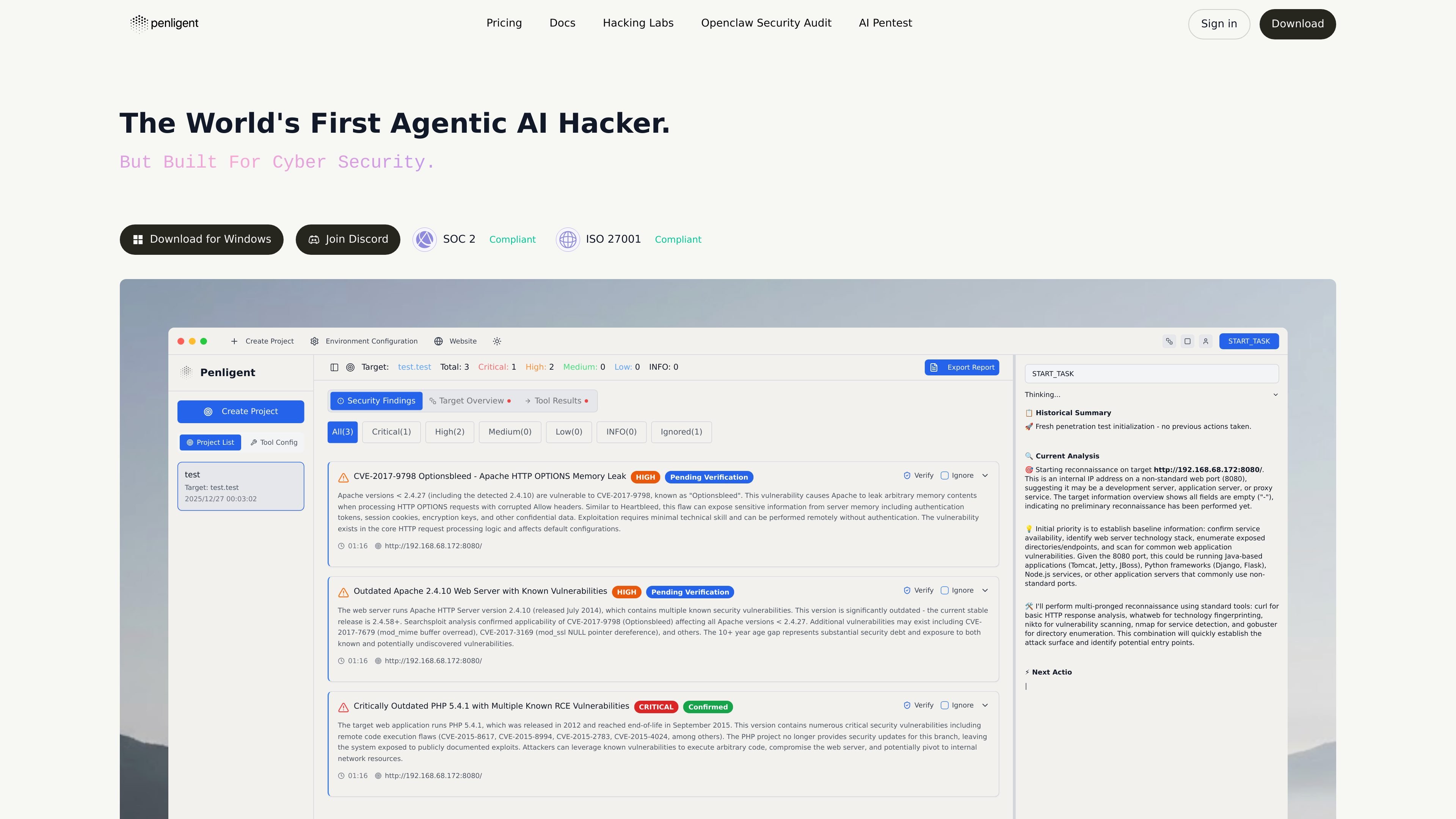
Penligent is an AI-assisted penetration testing platform that automates parts of the offensive security workflow for security teams, pentesters, and red teams. The public site describes it as an agentic AI hacker that can find vulnerabilities, verify findings, and execute exploits using real tool orchestration.
Its core workflow spans asset discovery, attack surface mapping, probing, exploit reproduction, and reporting. The product page also emphasizes evidence-driven output, including artifacts, reproduction steps, and audit-ready reports aligned with compliance-oriented workflows.
Penligent says it can move from asset discovery to validation in one workflow, combining profiling, attack surface mapping, probing, and exploit reproduction.
The platform highlights real tool orchestration and support for more than 200 pentest tools on demand, aimed at security engineers, pentesters, and red teams.
The site calls out real-time CVE exploit support and one-click PoC exploit script generation for always-on red teaming and vulnerability research.
Penligent emphasizes evidence-first results, with artifacts, reproduction steps, and traceable proof attached to findings.
The pricing page lists advanced WAF fingerprinting and evasion testing, comprehensive asset correlation, and sensitive API discovery on the Pro tier.
Higher-tier plans add team controls such as shared credit pools, role-based access control, SSO or SAML, authenticated flow testing, and CI/CD integration.
Use Penligent to map exposed assets, probe for common exposures, and move toward validation in a structured workflow rather than running isolated scans.
The platform is positioned for testing APIs and authenticated flows, including multi-role verification on higher tiers for workflows that depend on user state or permissions.
Penligent calls out business-logic focus, which makes it relevant when the goal is to find failures that affect real application behavior instead of only surface-level issues.
The site mentions AI agents as a target area, so teams can use the product when they need to assess agent behavior and related security exposure.
With evidence-chain reporting, one-click exploit reproduction, and audit-ready reports, the product also fits teams preparing documentation for internal review or compliance-oriented handoff.
The source describes Penligent as an AI-assisted penetration testing tool for security teams. It focuses on end-to-end workflows such as asset discovery, attack surface mapping, probing, exploit reproduction, and evidence-backed reporting.
The pricing page shows a Free plan, a Pro plan, Team, and Enterprise. Free includes the core workflow, Pro is listed at $39.92 per month billed annually, and Team and Enterprise use contact sales pricing.
The site says Penligent supports web apps, APIs, business logic, and AI agents. The pricing page also mentions authenticated flow testing, multi-role verification, CI/CD integration, and standardized audit-ready reporting on higher tiers.
The site highlights one-click reports, PDF or Markdown export, reproduction steps, and evidence-chain reporting. It also emphasizes verification and traceable proof rather than scanner-only findings.
The public pages do not provide a full setup guide or a detailed integrations list. They do state that the Free plan offers a no-complex-setup path and that Team includes CI/CD integration, SSO or SAML, and role-based access control.

blop is a QA agent that writes browser tests as code in your repo, runs them in CI, clusters repeated failures, and can open PRs to fix broken tests.

Orca is an Agent Development Environment for shipping with coding agents, running multiple CLI agents in parallel across isolated worktrees, with desktop and mobile workflows.

AI Magicx is a unified AI workspace for chat, image, video, voice, music, email and developer tasks, helping teams and creators manage multiple models in one place.

Paper is a design tool that connects canvas, code, and AI agents so teams can create, share, and ship work in one workflow. Includes desktop app and MCP access.

RLAMA is a local AI platform for building RAG systems and intelligent agents on macOS, Linux, and Windows, with HTTP API support.

Kastra authorization infrastructure for AI systems checks prompts, tool calls, shell commands, API requests, and browser actions before execution.