

Ask questions in chat
Users can ask natural-language questions and receive instant answers drawn from connected data sources, which is intended to speed up analysis without manually building every query.

Basedash is an AI-native BI platform for connected data, asking questions, and generating dashboards and reports with cloud, self-hosted, and enterprise options.
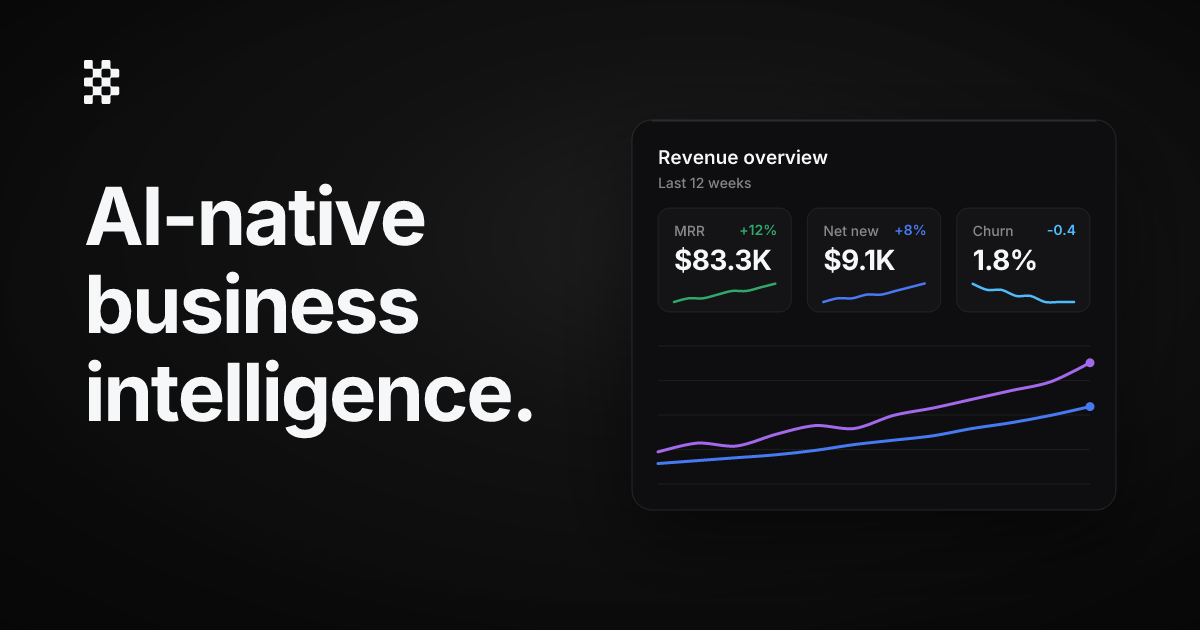
Basedash is an AI-native business intelligence platform for teams that want to build dashboards, ask questions, and generate reporting workflows on top of connected business data. The site positions it as a way to get trusted answers and visual reporting without the heavier setup usually associated with traditional BI tools.
The product centers on natural-language analysis: users can ask for tables, trends, dashboards, and account-level insights across functions such as product, sales, marketing, operations, and engineering. Basedash also offers a data-source layer for SQL databases, warehouses, and a large set of SaaS tools through Basedash Warehouse, which broadens the kinds of operational data teams can query in one place.
Users can ask natural-language questions and receive instant answers drawn from connected data sources, which is intended to speed up analysis without manually building every query.
Basedash can generate dashboards from a prompt, letting teams describe what they want to track and receive a custom dashboard in minutes.
The product supports charts, dashboards, and reports, with workflow examples that include trend analysis, cohort retention, and operational tables.
The data sources page says Basedash connects directly to SQL databases and warehouses, and can also sync SaaS tools through Basedash Warehouse.
The pricing page lists AI dashboards, chat, automated insights, Insights, automations, and an MCP server as part of the platform's workflow surface.
Pricing and security pages indicate support for enterprise controls such as SSO, SCIM, audit logs, custom AI models, self-hosting, and VPC-based deployment.
A product or analytics team can ask for cohort retention, KPI trends, or anomaly detection and then turn the results into dashboards for ongoing monitoring.
Sales and marketing teams can surface pipeline, campaign, and account activity to identify high-intent opportunities, active accounts, or channel performance changes.
Operations teams can build tables and dashboards for users, tickets, renewals, and other workflow records that need quick filtering and follow-up.
Engineering teams can query technical events such as errors, latency, SDK versions, or integration records to investigate reliability issues and usage patterns.
Teams with compliance or procurement requirements can use self-hosting, SSO, SCIM, audit logs, and VPC deployment options to fit internal review and security processes.
Yes. The pricing page states that every team can start with a 14-day free trial with no credit card required and full feature access.
Yes. Self-hosting is available, and the pricing page also says organizations can deploy in VPC-based environments when needed.
Basedash supports monthly and annual plans. The pricing page says teams can cancel at any time, so there is no long-term contract requirement stated.
Basedash is built to answer questions from connected data and generate dashboards and reports, with a focus on AI-native analytics workflows.
The site describes Basedash Warehouse for syncing 750+ SaaS tools, while direct connections are available for SQL databases and warehouses.

北极九章 is an enterprise AI data insight engine for natural-language data analysis. Ask by typing or voice and get charted results in workflows.
Tableau is a business intelligence and visual analytics platform that helps people explore data, create visualizations, and share insights. It offers hosted, self-managed, and desktop options for teams that need analytics, governance, and collaboration.

Hurree is an AI-powered reporting and analytics platform that centralizes company data, shared dashboards, and Riva summaries, recommendations, and forecasts.

Postfity is a social media management tool for scheduling, planning, publishing, and tracking posts across connected accounts. Includes analytics, inbox management, AI tools, team workflows, and Free and paid plans.

AnyClip is a visual intelligence platform for video that automates enrichment, improves discovery, and supports engagement and monetization.

Arcwise is an AI product for detecting meaningful metric changes and explaining them with data-grounded analysis. It turns warehouse and business-context data into decision-ready reports in app, docs, or slides.