

Multi-source ingestion
Ingests files, text, URLs, feeds, and connected accounts, including PDFs, audio, video, web pages, Slack messages, email, and knowledge base sources.

Graphlit is a context layer for AI agents that ingests content from connected tools, extracts structure, and makes it searchable for grounded chat, search, and knowledge workflows.
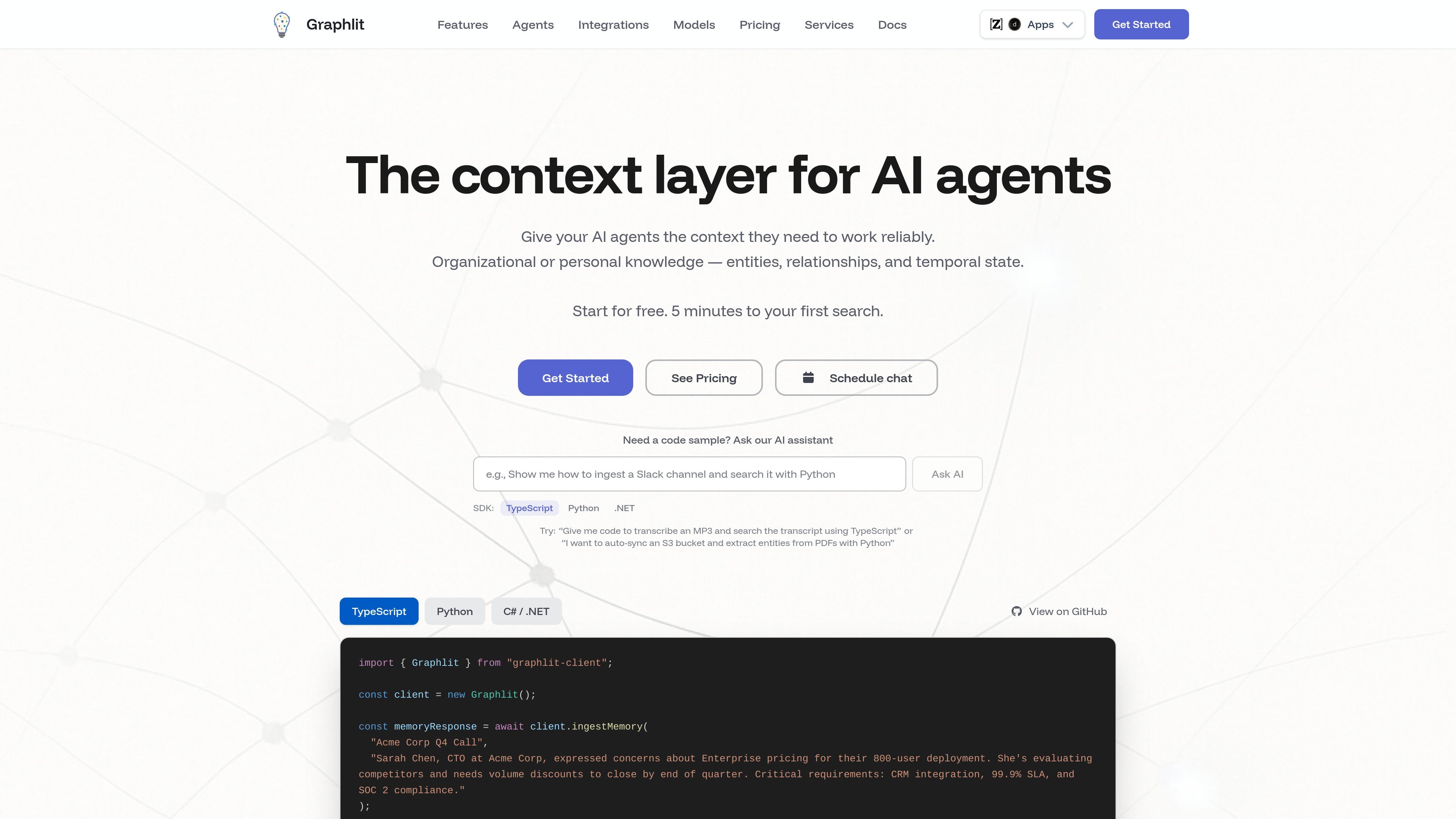
Graphlit is a context layer for AI agents and applications that need to work with organizational knowledge instead of isolated chat memory. It combines ingestion, extraction, search, chat, and knowledge graph workflows behind a single API.
The product is designed to bring content from files, web pages, messages, storage systems, and business tools into a searchable context layer. The site emphasizes real-time or continuous sync, provenance, and grounded answers so agents can use source-backed information rather than static prompts or ad hoc glue code.
Ingests files, text, URLs, feeds, and connected accounts, including PDFs, audio, video, web pages, Slack messages, email, and knowledge base sources.
Supports preparation, extraction, and enrichment workflows, with built-in transcription, OCR, embeddings, and completions.
Provides semantic search, keyword search, and hybrid search, plus source-grounded conversations with citations for retrieval-augmented use cases.
Extracts entities, observables, relationships, and temporal state to build organizational knowledge graphs rather than simple document indexes.
Connects to tools such as Slack, GitHub, Jira, Notion, Google Drive, S3, Gmail, Dropbox, and more, with continuous sync mentioned in the product messaging.
Offers SDKs and an MCP server for developer workflows, including TypeScript, Python, and .NET support and access from tools such as Claude, Cursor, and ChatGPT on higher plans.
Build assistants that answer from company knowledge with source citations, multi-turn memory, and retrieval over documents, messages, and connected apps.
Sync and search operational content from tools like Slack, GitHub, Jira, Notion, and email so teams can find context without manual ETL.
Extract people, companies, relationships, events, and ownership from content to support graph queries and relationship-aware applications.
Process PDFs, web pages, audio, video, and office files through ingestion, transcription, OCR, and enrichment pipelines for downstream AI use.
Connect external data sources to AI agents through MCP and SDKs so apps can retrieve context and trigger actions from familiar developer tools.
Graphlit is used to ingest content, extract structure, and make it searchable for AI applications that need grounded context. The site positions it as a context layer for AI agents, with support for search, RAG, chat, and knowledge graphs.
The pricing page shows a Free tier with limited usage and paid plans for Hobby, Starter, and Growth, plus a Custom option for larger integration and agent work. The site also says there is a free project to get started and that no credit card is required for the free tier.
Yes. The site references SDKs for TypeScript, Python, and .NET, and the home page shows example code in TypeScript.
Graphlit’s integrations page describes ingestion, preparation, and delivery across connected tools. The site highlights sources such as Slack, GitHub, Jira, Notion, Gmail, Google Drive, S3, Dropbox, and similar systems.
The pricing page says Graphlit includes ingestion and extraction, search and RAG, knowledge graphs, and agent context in one platform price. It also calls out citations, configurable workflows, and content feeds.

Dokkio is a cloud content organization and search platform for teams and individuals working across services like Google Drive, Dropbox, Gmail, Box, Slack, and OneDrive. It helps users search, tag, organize, and understand files, attachments, pages, and screenshots from one place.

Obsidian is a private note-taking and knowledge management app with local Markdown notes, links, graph view, Canvas, plugins, themes, sync and publishing.

Rayyan is an AI-powered platform for systematic and literature reviews, helping teams manage screening, extraction, bias assessment and reporting in one shared workflow.

Anara is an AI research workspace that searches your library and the web, then helps you write with cited claims and source-backed answers.

Quenti is an online learning platform for flashcards, practice tests, matching games, and AI-assisted grading for students, teachers, schools, and organizations.

IDWise is an identity verification platform for document checks, facial verification, proof of address, and compliance workflows with simple per-verification pricing and free integration options.