

Knowledge-graph-based RAG
The homepage describes the product as a knowledge-graph-based RAG assistant, indicating that it combines retrieval over structured knowledge with generated answers.

TiDB AI Assistant is a TiDB-focused Q&A tool built on knowledge-graph RAG, TiDB X Vector Storage, and PyTiDB, with web UI and Swagger API.
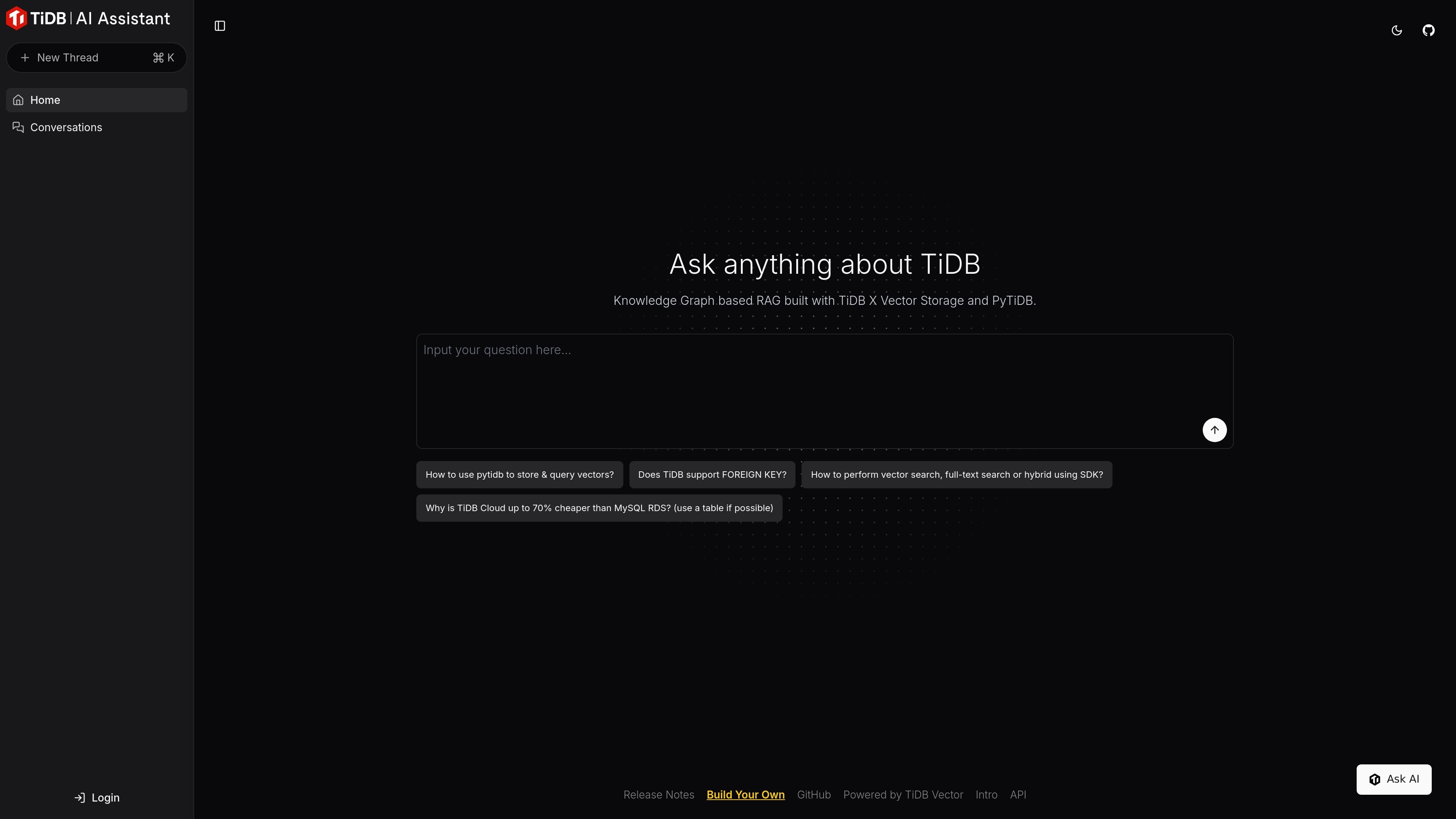
TiDB AI Assistant is a TiDB-focused question-answering product that presents itself as a knowledge-graph-based RAG system built with TiDB X Vector Storage and PyTiDB. The public homepage invites users to ask technical questions about TiDB and related workflows, and the product appears to be exposed through both a web interface and an API.
The examples on the site center on practical TiDB topics such as storing and querying vectors with PyTiDB, using foreign keys, running vector search, full-text search, or hybrid search, and asking about TiDB Cloud pricing comparisons. The API documentation adds more detail by exposing objects for chat, knowledge bases, embeddings, reranking, evaluation, and knowledge-graph retrieval.
The homepage describes the product as a knowledge-graph-based RAG assistant, indicating that it combines retrieval over structured knowledge with generated answers.
The product is built with TiDB X Vector Storage and PyTiDB, which ties the assistant to TiDB-oriented storage and Python access patterns.
The Swagger UI exposes endpoints and object models for chat, knowledge bases, documents, chunks, entities, relationships, embeddings, reranking, and evaluation tasks.
API schema names include vector search, full-text search, hybrid search, and knowledge-graph retrieval, showing multiple retrieval modes in the backend.
The docs include admin-oriented objects for API keys, data sources, models, and settings, suggesting the service is configurable through managed resources.
Ask operational or conceptual questions about TiDB, including topics such as foreign keys, cloud pricing, and feature behavior.
Query vectors through PyTiDB and compare vector search with full-text or hybrid retrieval approaches.
Build chat or knowledge-base workflows using the documented API objects for documents, chunks, embeddings, and retrieval.
Work with knowledge-graph retrieval for question answering where relationships and entities matter alongside raw text.
Inspect evaluation, reranking, and model-management objects in the API when tuning retrieval quality or assistant behavior.
The site shows TiDB AI Assistant as a web app with login access and an API documented through Swagger UI. The public pages do not provide setup steps beyond those entry points.
The homepage presents it as a knowledge-graph-based RAG assistant built with TiDB X Vector Storage and PyTiDB, and the API docs expose knowledge-base, vector search, knowledge-graph retrieval, chat, embedding, reranking, and evaluation-related objects.
The rendered pages do not show pricing details. The pricing URL returns a 404, so there is no public pricing information in the collected sources.
The homepage examples focus on TiDB-related questions such as vectors with PyTiDB, foreign keys, vector search, full-text search, hybrid search, and TiDB Cloud cost questions.

书生 is a general-purpose large model suite for language, multimodal, weather, ocean, industrial design, 3D, finance, and scientific discovery tasks.

心流AI助手 is an AI assistant for fast knowledge lookup, covering daily百科, life, entertainment, and academic Q&A on web and App.

Hugo is an AI-powered support agent for customer service teams. Resolve tickets, automate support work, and provide 24/7 replies with your business data.

Crossing Minds is a retrieval platform for accurate, secure, scalable AI applications. The public site also says the team is joining OpenAI.

Botnoi AI Chatbot is a web-based AI chatbot and voicebot platform for businesses to automate customer replies across chat and phone, with omnichannel setup, knowledge-base Q&A, and real-time monitoring.

小艺 is Huawei’s AI smart assistant for Q&A, writing, document reading, code help, image recognition, and file drag-and-drop.