

Unified AI traffic control
Govern LLM, MCP, and agent-to-agent traffic through a single gateway so API and AI traffic can be managed together.

Kong AI Gateway centralizes governance for LLM, MCP, and agent-to-agent traffic with security, observability, routing, and cost controls.
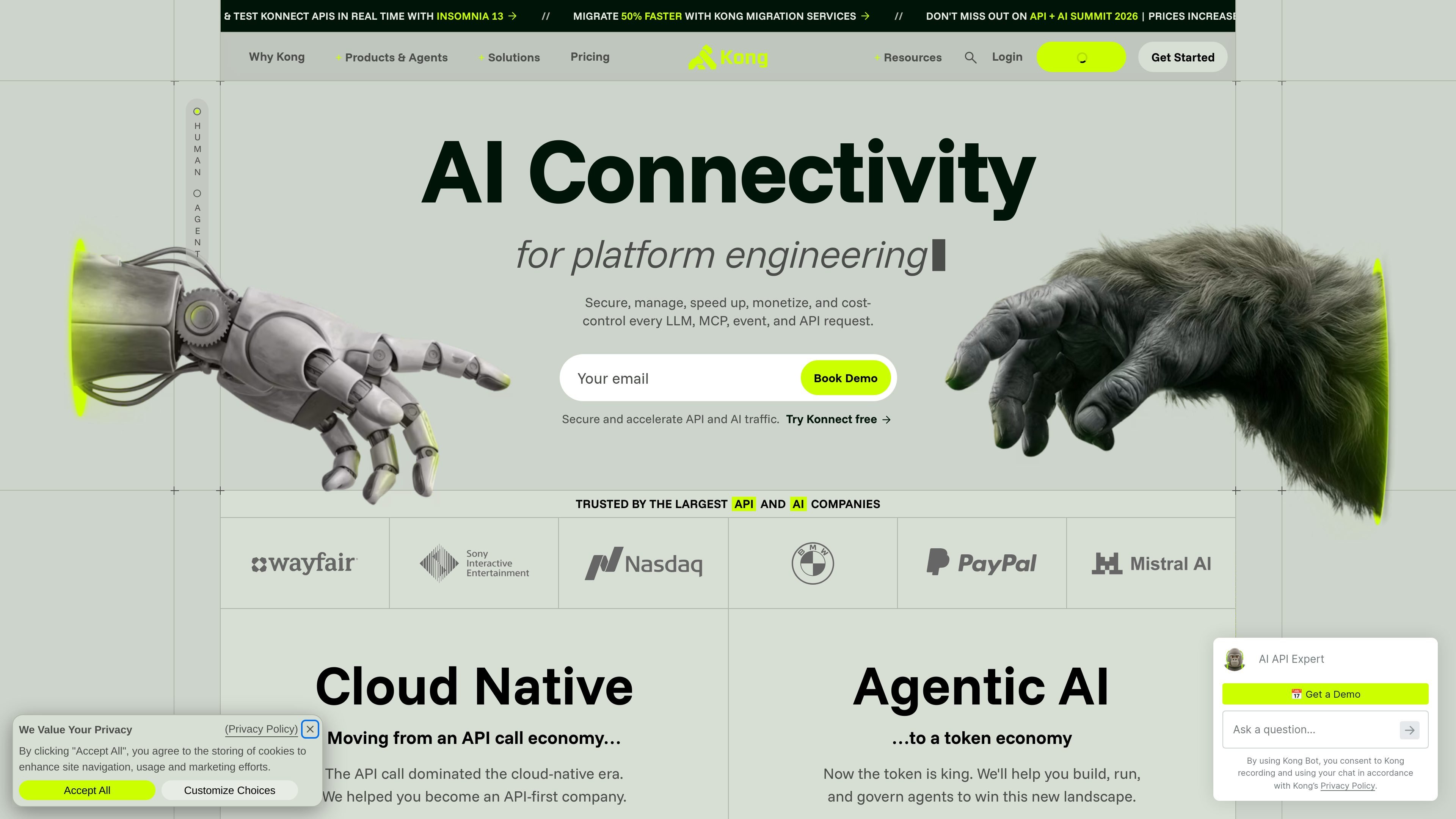
Kong AI Gateway is a gateway for governing AI traffic across large language models, MCP resources, and agent-to-agent workflows. The product pages describe it as part of Kong’s broader AI connectivity platform, where API traffic, AI traffic, and real-time data are managed from one platform.
Its core job is to centralize security, routing, observability, and cost control for AI requests. The source highlights capabilities such as semantic caching, token-based rate limiting, prompt and PII protections, quota management, and telemetry for AI usage and spend.
Govern LLM, MCP, and agent-to-agent traffic through a single gateway so API and AI traffic can be managed together.
Apply PII sanitization, semantic prompt guards, access control, routing, and load balancing to AI requests.
Track token usage, AI consumption, tool usage, latency, errors, and cost with AI observability and metrics.
Use semantic caching, token-based rate limiting, and quota management to control consumption and reduce unnecessary spend.
Generate and govern MCP servers and proxies, including auth for MCP access and context optimization.
Manage multi-agent traffic with centralized AuthN/Z, auditability, and detailed telemetry on A2A calls.
Centralize governance for applications and agents that call multiple LLMs, so access, routing, and usage policies are enforced in one place.
Put MCP-backed agent workflows into production with server generation, auth enforcement, and context optimization.
Track and manage agent-to-agent communication with telemetry, auditability, and centralized authorization for multi-agent systems.
Reduce AI spend by applying semantic caching, rate limits, quotas, and cost analytics to token-heavy workloads.
Apply PII sanitization, prompt guards, and observability to AI requests that handle sensitive or regulated data.
Kong AI Gateway governs LLM, MCP, and agent-to-agent traffic through a single gateway. The source pages describe centralized access control, routing, observability, token controls, semantic caching, and guardrails for AI traffic.
The pricing page shows a free trial for Kong Konnect, a Plus plan billed per Gateway per month, and an Enterprise plan with custom annual pricing. AI Gateway capabilities such as paid plugins are included in Plus and Enterprise packaging details shown on the pricing page.
The product pages describe AI traffic governance for developers and platform teams working with LLMs, MCP resources, and multi-agent systems. Kong positions the gateway for production AI infrastructure rather than consumer chat use.
The source highlights centralized security, routing, observability, quota management, and cost controls. It also describes support for LLMs, MCP servers, and A2A traffic, but does not provide a complete public list of every supported model or deployment option on these pages.

Orca is an Agent Development Environment for shipping with coding agents, running multiple CLI agents in parallel across isolated worktrees, with desktop and mobile workflows.

AI Magicx is a unified AI workspace for chat, image, video, voice, music, email and developer tasks, helping teams and creators manage multiple models in one place.

Paper is a design tool that connects canvas, code, and AI agents so teams can create, share, and ship work in one workflow. Includes desktop app and MCP access.

blop is a QA agent that writes browser tests as code in your repo, runs them in CI, clusters repeated failures, and can open PRs to fix broken tests.

RLAMA is a local AI platform for building RAG systems and intelligent agents on macOS, Linux, and Windows, with HTTP API support.

Kastra authorization infrastructure for AI systems checks prompts, tool calls, shell commands, API requests, and browser actions before execution.