

OTEL-compatible tracing
Capture traces from Latitude's SDK or by pointing an existing OpenTelemetry pipeline at the platform, so traces can flow in without a proprietary format.

Latitude is an open-source AI agent observability and monitoring platform for tracing production sessions, detecting issues, and verifying fixes.
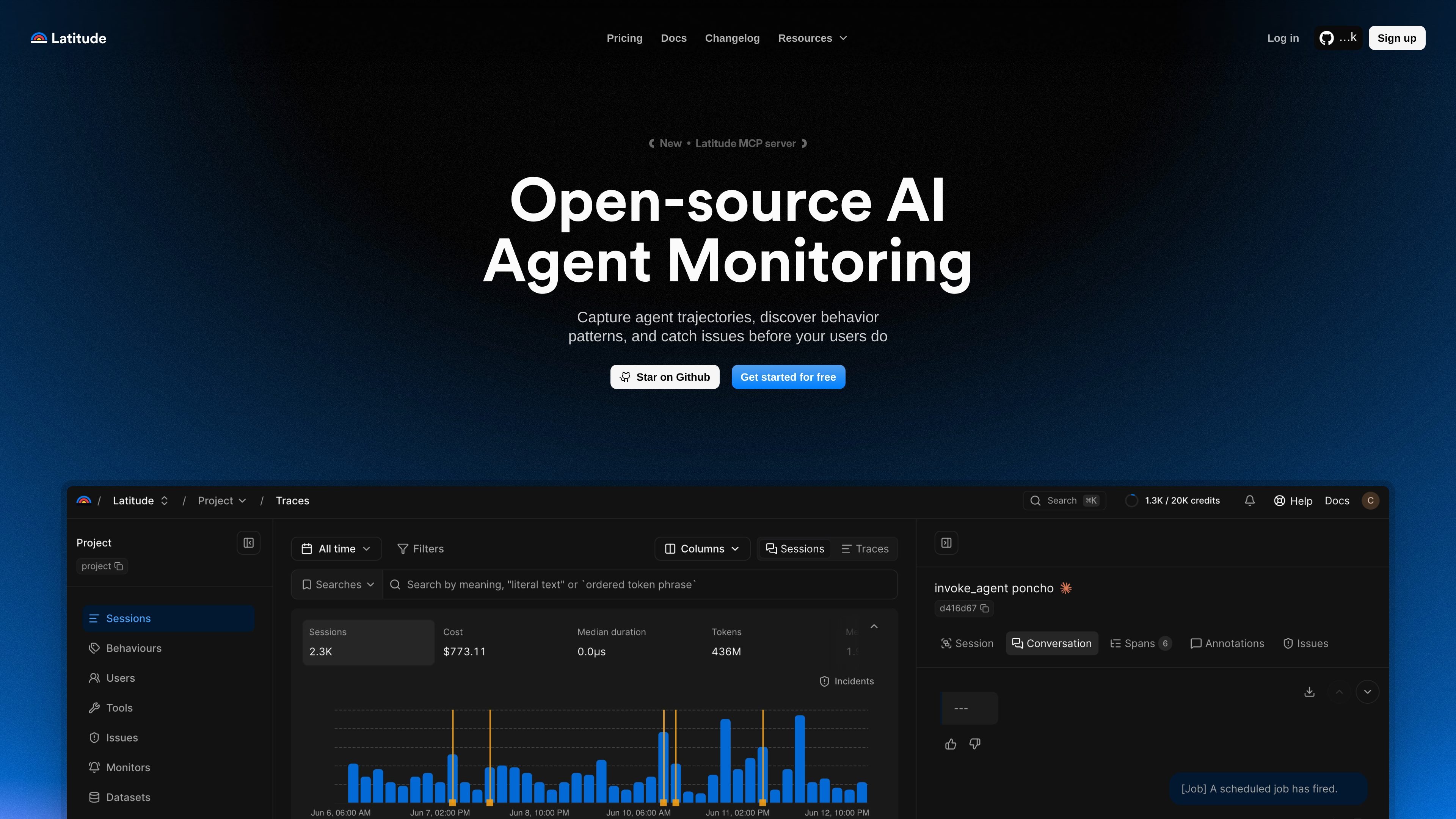
Latitude is an open-source AI agent observability and monitoring platform. It is designed to help teams inspect real production traffic, find what is failing, and verify that a fix actually worked after deployment.
The product centers on traces, session search, issue detection, and evaluation workflows. It can connect through its SDK or an existing OpenTelemetry pipeline, and it adds tools for clustering similar failures, annotating traces, and turning production examples into repeatable evals.
Capture traces from Latitude's SDK or by pointing an existing OpenTelemetry pipeline at the platform, so traces can flow in without a proprietary format.
Analyze completed sessions to identify what the conversation was about, what happened, and where escalations, abandonments, retries, tool failures, or trust breaks occurred.
Search across 100% of traces using semantic search, exact text, and metadata filters to narrow down real examples quickly.
Detect new issues or escalations and route alerts to Slack, email, or webhooks so teams can respond before users complain.
Turn validated production issues into evals, build versioned golden datasets, and run regression checks against new traces.
Leave inline feedback on traces, spans, or outputs, and use the resulting structured annotations in search, clustering, and eval workflows.
Inspect production traces to understand what an agent actually did during a session, including messages, tool calls, errors, and other failure signals.
Search across all conversations to find cohorts of real examples that match a question, a release window, or a particular failure pattern.
Detect issues as they appear, cluster similar failures, and send alerts to the team so problems can be triaged before they spread.
Convert a validated production issue into an eval backed by real examples, then rerun it against new traces after shipping a fix.
Use annotations, datasets, and issue clustering to keep review work structured across a team working on AI agents.
Latitude is set up to monitor AI agents and surface issues from production traces. The pricing page also indicates a free Starter plan and paid Pro and Enterprise options.
The source says Latitude captures traces, searches conversations, discovers issues, and supports telemetry through an SDK or an existing OpenTelemetry pipeline.
The homepage says it can send issue alerts to Slack, email, or webhooks, and the pricing page notes Slack support on the Starter plan and priority support on Pro.
The homepage says Latitude offers observability, session search, conversation intelligence, issue discovery, automated evals, dataset management, human annotations, advanced filters, and failure mode clustering.

blop is a QA agent that writes browser tests as code in your repo, runs them in CI, clusters repeated failures, and can open PRs to fix broken tests.

Bluejay is a QA platform for AI agents to test, monitor, and improve voice and chat systems before and after launch with simulations and replays.

Orca is an Agent Development Environment for shipping with coding agents, running multiple CLI agents in parallel across isolated worktrees, with desktop and mobile workflows.

BotLab is a tool for testing video-game bots by running them in simulated game clients, reviewing session logs, and comparing results in the Reactor. It offers a free tier for short sessions and a paid Pro plan for longer online runs.

AI Magicx is a unified AI workspace for chat, image, video, voice, music, email and developer tasks, helping teams and creators manage multiple models in one place.

Paper is a design tool that connects canvas, code, and AI agents so teams can create, share, and ship work in one workflow. Includes desktop app and MCP access.