

Pull request product review
Checks each pull request against the product specs and guardrails stored in the repo, so spec drift is caught before merge.

Prelint reviews pull requests against product specs and decision rules to catch drift, contradictions, and misalignment before shipping.
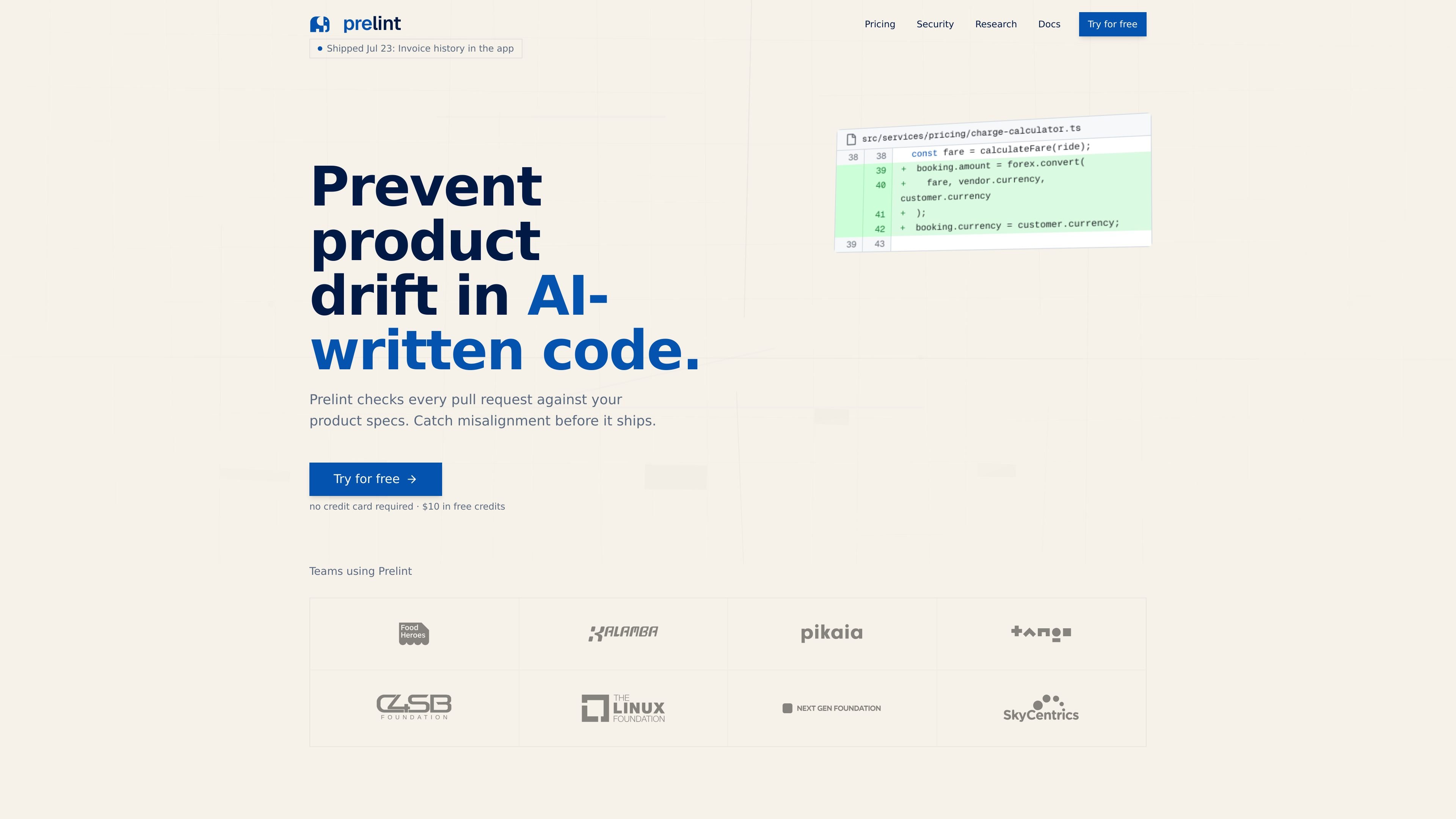
Prelint is a product review tool for pull requests. It checks changes against product specifications, decision rules, and repo-based context so teams can catch product drift, inconsistencies, and misalignment before code ships.
The site positions Prelint as a complement to technical code review: code review catches implementation errors, while Prelint reviews whether the change still matches the intended product behavior, constraints, and terminology. Reviews run automatically on pull requests and return findings, no-findings results, and summary comments for the team to act on.
Checks each pull request against the product specs and guardrails stored in the repo, so spec drift is caught before merge.
Flags contradictions, conflicting technology choices, and duplicated effort when a change no longer matches the existing product decisions.
Returns inline findings and a summary comment on the pull request, giving engineers a concrete review result to act on.
Lets people ask product questions grounded in the repository specs so they can get answers without scheduling a sync.
Supports machine-readable product constraints and version-controlled docs alongside code, including Markdown and YAML.
Produces an auditable record of who reviewed, what was found, how it was resolved, and when, which is useful for change-management evidence.
Useful when AI-written code is moving quickly and you want changes checked against product intent before they land.
Helpful for teams that store product decisions in Markdown or YAML next to the code and want those decisions enforced on every PR.
Useful when a pull request could change pricing, terminology, integrations, or other product rules that need consistent enforcement.
Helpful for teams that want a review trail they can export for audits, especially where oversight of AI-written code matters.
Useful when product or engineering teams need grounded answers about why something works a certain way without calling a meeting.
Prelint reviews pull requests against product specs and guardrails, then posts findings or a no-findings result on the PR. The pricing page says a completed review is charged when it finishes and posts its result.
The pricing page says reviews pause when you hit your monthly limit, and you can set that limit in Settings under Billing.
Yes. The pricing page says public repositories are free.
Yes. The security page says you can add a .prelintignore file or set exclusions in the interface so listed files are excluded from analysis and never sent to a model.
The security page says Prelint runs in the United States on AWS infrastructure, uses AWS Bedrock models, does not execute repository code, and does not train on your data.

blop is a QA agent that writes browser tests as code in your repo, runs them in CI, clusters repeated failures, and can open PRs to fix broken tests.

Orca is an Agent Development Environment for shipping with coding agents, running multiple CLI agents in parallel across isolated worktrees, with desktop and mobile workflows.

BotLab is a tool for testing video-game bots by running them in simulated game clients, reviewing session logs, and comparing results in the Reactor. It offers a free tier for short sessions and a paid Pro plan for longer online runs.

Firebase Studio is a web-based workspace for full-stack app development with Gemini-assisted coding, app previews, cloud emulators, collaboration, and browser deployment.

EZsite AI is an AI website builder that turns a URL into a fullstack React or Vue.js app with hosting, custom domains, code export, and backend features.

AI Magicx is a unified AI workspace for chat, image, video, voice, music, email and developer tasks, helping teams and creators manage multiple models in one place.