Tractian icon

Tractian

Revendiquer

Tractian is a predictive maintenance, condition monitoring, and CMMS platform for industrial teams. Uses sensor data and AI to detect issues early and prioritize work orders.

Tractian

Overview

Tractian is a predictive maintenance, condition monitoring, and CMMS platform for industrial operations. It combines sensor data, AI analysis, and maintenance workflow software so teams can detect failure signals early and turn them into prioritized work orders and follow-up actions.

The product site positions Tractian as an end-to-end system for maintenance and reliability teams. Its monitoring products track machine health in real time, while its CMMS tools manage work orders, preventive maintenance, parts, and reporting; the mobile app and integration pages show that it can also feed condition data into existing systems and technician workflows.

Core capabilities

Real-time condition monitoring

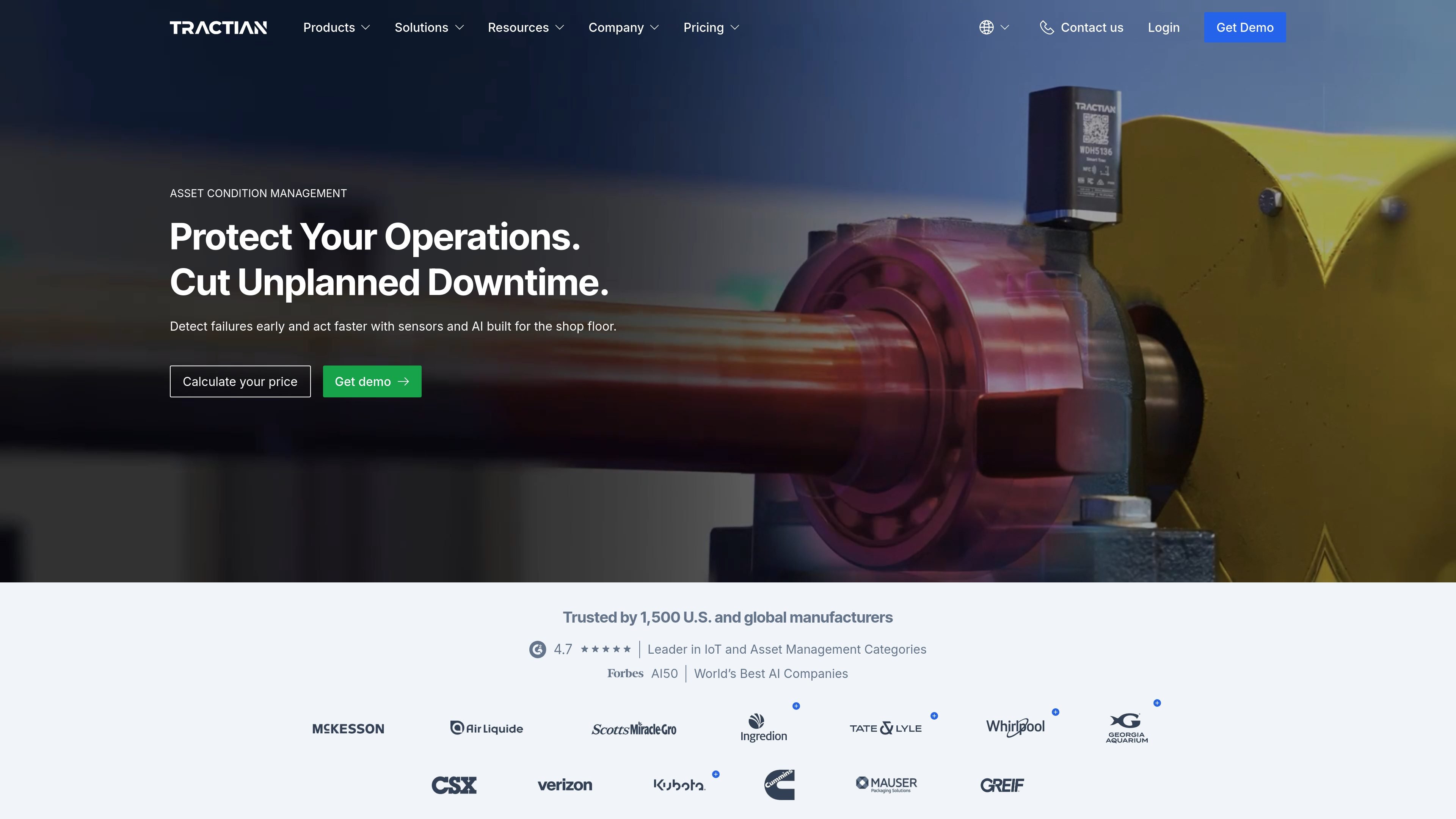
Tractian’s sensors monitor condition signals in real time so teams can detect failure indicators before a machine stops production. The home page highlights vibration, temperature, ultrasound, and RPM as part of the monitoring stack.

AI failure detection and alerting

The platform turns condition data into alerts, fault context, and suggested next steps so maintenance teams can decide what to do sooner and with more specificity.

CMMS workflow management

The CMMS plans include asset and location management, unlimited requesters, preventive maintenance, work order management, parts inventory management, and dashboards for maintenance tracking.

Mobile work order execution

The mobile app workflow dispatches prioritized work orders with failure mode, severity, SOP, and timeline context to technicians in the field, including offline-friendly execution.

Reliability analysis and reporting

The source pages describe root cause analysis, downtime prevention, reliability inspections, and failure lifecycle management for teams that need traceability from detection through resolution.

Integrations with existing systems

The platform is designed to connect with existing tools through APIs and SQL connectors, with examples that include CMMS, EAM, and ERP systems.

Common use cases

  • Detect early signs of equipment failure

    Use Tractian to watch equipment health continuously, spot anomalies in vibration, temperature, ultrasound, or RPM, and act before a failure becomes a stoppage.

  • Run condition-based maintenance

    Use the CMMS workflow to turn asset condition into prioritized work orders, preventive maintenance tasks, and maintenance logs instead of relying on fixed calendar intervals.

  • Execute field work with context

    Use the mobile app to send technicians to the floor with failure mode context, severity trend, SOP guidance, and repair feedback captured back into the CMMS or EAM.

  • Augment existing maintenance software

    Use the integrations approach to enrich an existing CMMS, EAM, or ERP system with real-time machine data and automated work order triggers.

  • Investigate recurring failures

    Use reliability and reporting tools to group insights, track root-cause patterns, and review whether a repair actually resolved the failure.

Pros and Cons

Pros

  • Combines condition monitoring and CMMS rather than treating them as separate tools.
  • Uses real-time machine data to prioritize maintenance work instead of relying only on calendar schedules.
  • Supports mobile execution with contextual work orders for technicians in the field.
  • Connects to existing systems through APIs and SQL connectors, including named CMMS, EAM, and ERP examples.
  • Offers both monitoring-only and bundled monitoring-plus-CMMS purchasing paths.

Cons

  • The public pages do not provide a complete feature-by-feature CMMS or integration matrix, so buyers may need a demo to confirm fit for a specific stack.
  • Pricing is annual and starts with minimum user counts, which may make it less suitable for very small teams.
  • The source pages do not spell out every deployment, onboarding, or configuration step, so implementation expectations remain somewhat open-ended.

FAQ

What does Tractian do?

Tractian’s platform combines condition monitoring sensors with CMMS software. On the monitoring side, it tracks machine signals such as vibration, temperature, ultrasound, and RPM; on the CMMS side, it uses that condition data to help trigger and prioritize work orders.

Who is it built for?

The source pages show Tractian for condition monitoring, CMMS, mobile maintenance workflows, and work order management. The platform is aimed at maintenance, reliability, plant, and operations teams that need to act on asset condition rather than only calendar schedules.

How is Tractian priced?

The pricing page shows annual plans with a minimum of 5 users for Standard and 10 users for Enterprise. It also shows a Bundle option that combines CMMS with monitoring sensors.

Does it integrate with existing systems?

For the mobile CMMS workflow, Tractian says it can connect through APIs and SQL connectors to existing CMMS, EAM, or ERP systems, and it names SAP PM, IBM Maximo, UpKeep, Limble, MaintainX, eMaint, SAP, and Oracle as supported examples.

What should a buyer expect during setup?

The source emphasizes early fault detection, prioritized work orders, and feedback back into asset history, but it does not provide a full implementation guide or setup timeline on the pages provided.

Quick Facts

Category
Predictive maintenance, condition monitoring, and CMMS
Platform
Industrial software with connected sensors and mobile maintenance workflows
Primary users
Maintenance, reliability, plant, and operations teams
Pricing shape
Paid annual plans with per-user pricing and minimum seat counts
Pricing page
Plans shown for Standard, Enterprise, and Bundle
Source domain
tractian.com