

Website-to-code cloning
Accepts a public URL and produces a cloned site as componentized code rather than a flat scrape of the page.

Ditto is an open-source website cloner that turns a public URL into editable Next.js or Vite code. Self-host, use the API, or connect via MCP.
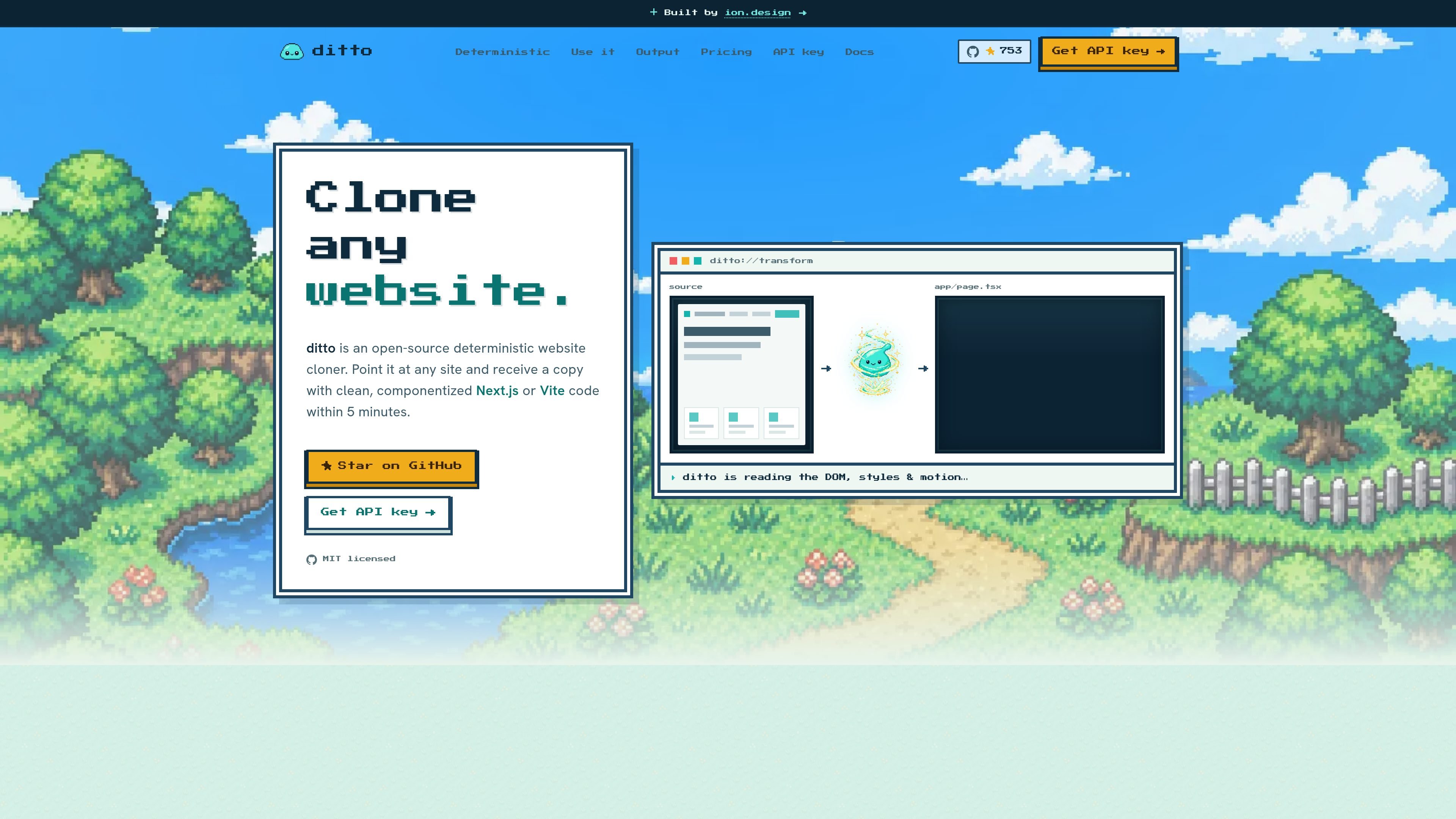
Ditto is an open-source deterministic website cloner. It takes a public URL and turns it into a clean, componentized codebase, with the homepage and API examples showing Next.js and Vite as output targets.
The product is positioned for builders who want a faithful starting point rather than a blank canvas. The site says Ditto preserves fidelity, extracts design systems and other UI details, and can be used as a self-hosted tool, a hosted API, or an MCP-connected agent workflow.
Accepts a public URL and produces a cloned site as componentized code rather than a flat scrape of the page.
Reconstructs output as Next.js or Vite projects, giving users a real codebase they can edit and build on.
Described as deterministic, with the site explicitly contrasting it with LLM-based guessing.
Extracts design systems, tokens, fonts, interactions, motion, breakpoints, and page sections according to the homepage copy.
Splits repeated DOM into components, lifts regions into sections, and emits editable semantic content and project files.
Supports three access modes: self-hosted open source, hosted REST API, and MCP server for agents.
A developer can send a public site URL to Ditto and get a codebase that serves as a starting point for rebuilding or extending the UI in Next.js or Vite.
A team can run the open-source cloner on its own machine or infrastructure when it wants to inspect the pipeline and keep the workflow in-house.
An application can call the hosted REST API to queue a clone job, monitor progress, and retrieve the finished project without setting up the infrastructure locally.
An AI agent or builder loop can connect to the MCP server and use Ditto as a tool for turning a target URL into code during an iterative workflow.
A designer or engineer can review the generated components, sections, content model, and extracted tokens as a structured base for further editing.
Ditto is an open-source website cloner that takes a public URL and returns a componentized codebase. The source shows it can output Next.js or Vite projects and can be used through the self-hosted pipeline, the hosted REST API, or an MCP server.
The site shows three usage paths: self-host the cloner with MIT-licensed source code, send jobs to the hosted REST API at api.ditto.site, or connect the MCP server for agent workflows.
The homepage says Ditto can reconstruct pages into clean, componentized Next.js or Vite code. It also mentions extracted design systems, tokens, fonts, interactions, motion, breakpoints, and sections.
The homepage describes Ditto as deterministic and says it does not rely on an LLM to guess at the page structure. The product page also emphasizes fidelity-preserved output and byte-stable copies.
The pricing page at /pricing returned a 404 in the collected evidence, so there is no confirmed pricing information on the site snapshot provided.

EZsite AI is an AI website builder that turns a URL into a fullstack React or Vue.js app with hosting, custom domains, code export, and backend features.

Termo is an AI agent platform with dedicated VMs for browsing, code execution, memory, and scheduled automation for research and build tasks.

Orca is an Agent Development Environment for shipping with coding agents, running multiple CLI agents in parallel across isolated worktrees, with desktop and mobile workflows.

Firebase Studio is a web-based workspace for full-stack app development with Gemini-assisted coding, app previews, cloud emulators, collaboration, and browser deployment.

AI Magicx is a unified AI workspace for chat, image, video, voice, music, email and developer tasks, helping teams and creators manage multiple models in one place.

Paper is a design tool that connects canvas, code, and AI agents so teams can create, share, and ship work in one workflow. Includes desktop app and MCP access.