

Ticker-based research workflow
Enter a ticker or ask a research question and the system pulls filings, earnings transcripts, peer disclosures, recent news, and sell-side commentary before writing the memo.

ResearchGPT is an AI-assisted equity research tool that turns a ticker or research question into a cited investment memo with bull and bear cases, peer context, and risks.
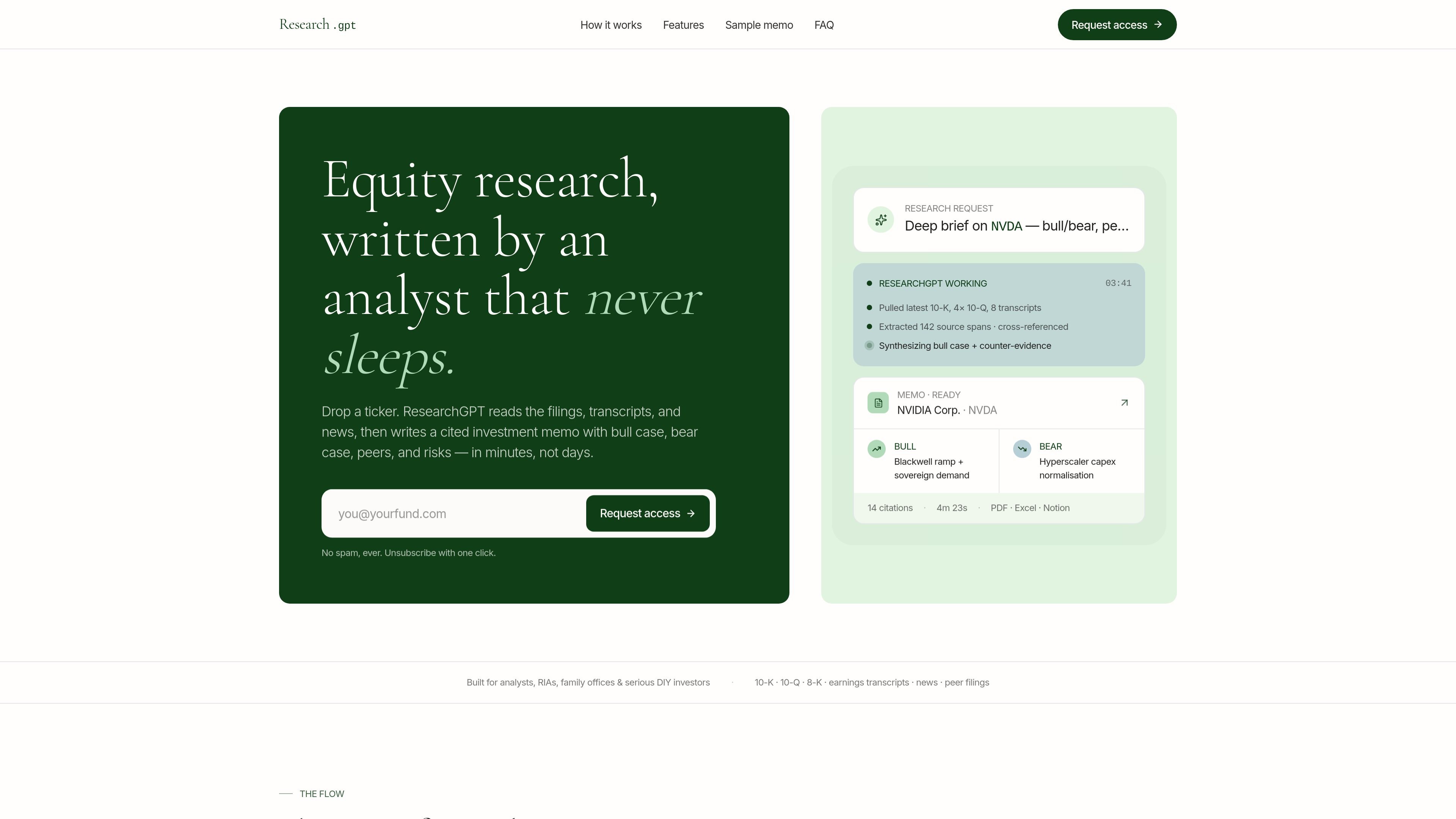
ResearchGPT is an AI-assisted equity research tool that turns a ticker or research question into a sourced investment memo. The product is designed to help analysts and serious investors move from raw public disclosures to a structured view of the bull case, bear case, peer context, and key risks.
According to the site, the system reads SEC filings, earnings transcripts, peer disclosures, recent news, and related commentary, then synthesizes a memo in minutes. The result is positioned as a research deliverable that can be reviewed, exported, and used in an IC pre-read or internal model workflow.
Enter a ticker or ask a research question and the system pulls filings, earnings transcripts, peer disclosures, recent news, and sell-side commentary before writing the memo.
Every claim is tied to a source span, with citations shown on the memo so readers can audit the underlying evidence.
The generated memo includes both the bull case and the bear case, so users can review supporting evidence and counter-evidence in one place.
The product surfaces peer companies and compares them using revenue growth, gross margin, and forward valuation multiples.
It extracts and ranks risk factors from filings and highlights management commentary from earnings calls.
Outputs are available for PDF, Excel, Notion, and API-based workflows.
Use ResearchGPT to turn a ticker into a research memo that covers thesis, counter-thesis, peers, and filing-based risks before a meeting or recommendation.
Use the product to speed up diligence on a company by pulling filings, transcripts, and news into one sourced summary instead of searching each document manually.
Use the peer-comparison view to sanity-check growth, margin, and valuation against segment peers when evaluating a name.
Use the risk extraction and management commentary sections to focus on recent filing changes, customer concentration, supply-chain constraints, or guidance signals.
Use the export options to move research into an IC pre-read, spreadsheet model, note-taking system, or connected workflow.
It takes a ticker or a research question and produces a cited investment memo built from filings, transcripts, news, and related primary sources. The output is structured for research work rather than a chat-style response.
The source text says the product logs every source span and grounds each claim to a verbatim citation marker. If a claim cannot be sourced, the agent declines to make it.
The site says output can be exported to PDF, Excel, and Notion, and that it can also be wired to your stack via API.
The product is positioned for analysts, RIAs, family offices, and serious DIY investors, with the clearest fit being people who read filings and earnings materials regularly.
The pricing page is not available in the provided evidence. The home page says beta users will lock in early-supporter pricing for life and that the team is targeting a price point between Perplexity Pro and AlphaSense, but no exact price is published.

Gilion is an AI platform for financial deal work and non-dilutive funding. It helps bankers, investors, founders, and scaleups work across sourcing, due diligence, monitoring, reporting, and capital access.

Finlo is a web-based stock portfolio platform with curated, strategy-based portfolios, monthly updates, and premium research tools for long-term investors.

Streetbeat is an AI platform for financial services, built for advisors, banks, fintechs, and investors with SEC registration and SOC 2 compliance.
PolyLens is an AI-powered prediction market intelligence product for tracking trending Polymarket markets in English and Chinese, with structured summaries and MCP tools.

Reflexivity is an investment analysis platform for institutional investors, combining market and company data with explainable AI for research, portfolio analysis, scenario testing, document review, and screening via web platform or API.

Predictice is a legal research and analysis platform for legal professionals, with jurisprudence search, litigation analysis, assistant tools and document audit workflows.