

RAG system creation
Create Retrieval-Augmented Generation systems from local folders, websites, and multiple document formats such as .txt, .md, and .pdf.

RLAMA is a local AI platform for building RAG systems and intelligent agents on macOS, Linux, and Windows, with HTTP API support.
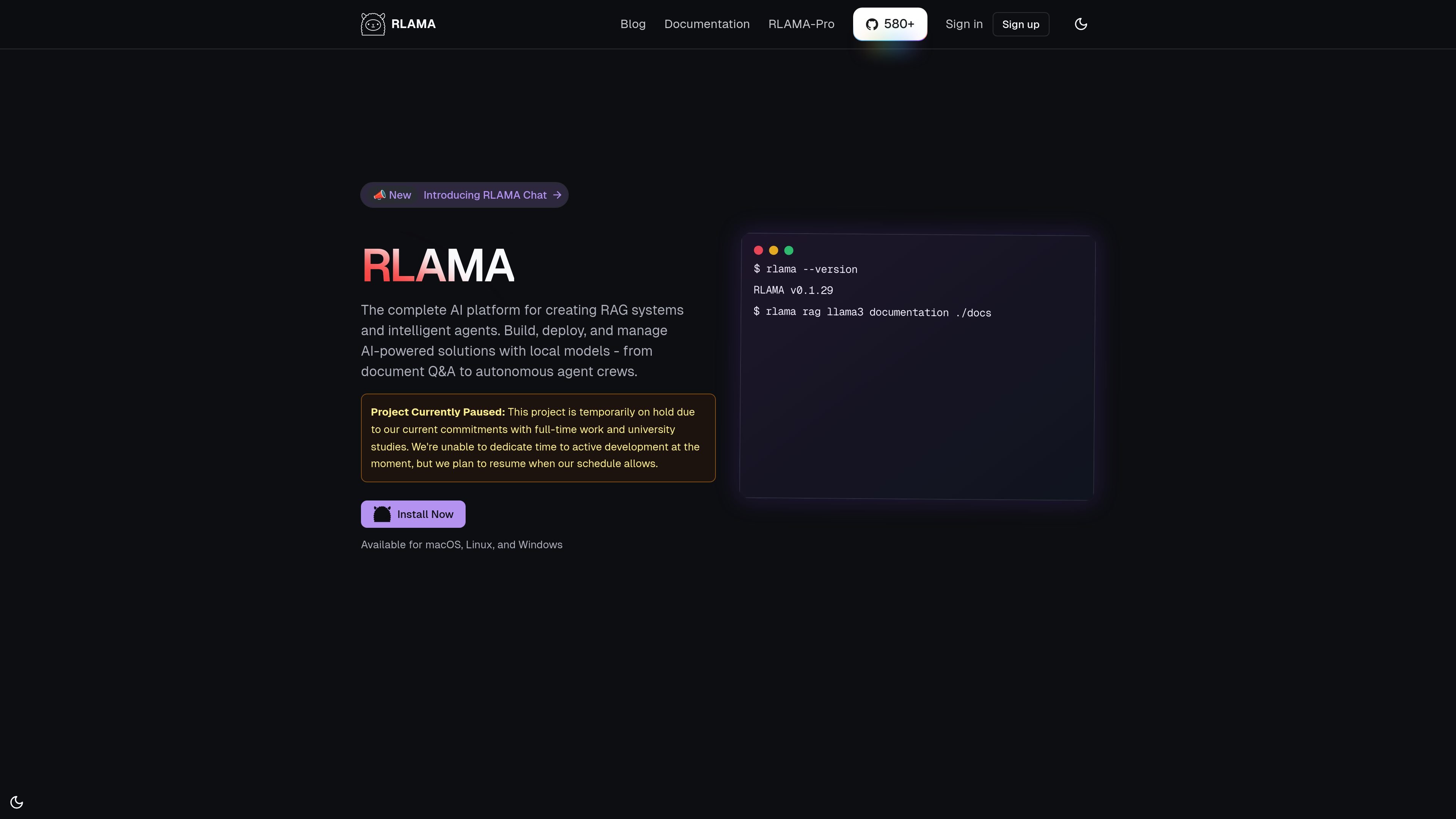
RLAMA is a local AI platform for creating Retrieval-Augmented Generation systems and intelligent agents. It combines document-based question answering, agent creation, and multi-agent coordination in one toolset.
The site shows both command-line and visual workflows for building RAG systems, running agents, and managing crews. It also emphasizes local processing, with no data sent externally, and notes support for macOS, Linux, and Windows.
Create Retrieval-Augmented Generation systems from local folders, websites, and multiple document formats such as .txt, .md, and .pdf.
Build agents with roles like researcher, writer, coder, and analyst, then equip them with tools such as RAG search, code execution, and web search.
Run sequential, parallel, or hierarchical workflows so multiple agents can collaborate on larger tasks.
Use the visual builder to set a RAG name, choose a model, configure sources, and tune chunking settings without writing commands.
Chat with RAG systems and agents through interactive terminal sessions for query, update, and version workflows.
Integrate RLAMA into other applications through an HTTP API server, with support for macOS, Linux, Windows, Ollama, and OpenAI models.
Index technical documentation and answer questions over manuals, specifications, and project files using RAG systems.
Build a secure local knowledge base for sensitive documents where processing stays on the user’s machine.
Create specialized agents for research, analysis, coding, or writing tasks and give them access to search tools.
Coordinate multiple agents for content creation, review, and publishing workflows that need several steps or roles.
Automate multi-step processes with sequential or parallel agent workflows for tasks that benefit from orchestration.
RLAMA is presented as a local AI platform for building RAG systems and intelligent agents. The site shows CLI commands, a visual RAG builder, and interactive chat sessions for working with those systems.
The site says RLAMA is available for macOS, Linux, and Windows. The download page also shows a macOS install command and notes that Ollama should be installed first.
RLAMA supports local models and also mentions OpenAI model support alongside Ollama. The page examples show commands for creating RAG systems, agents, and crews.
The site presents RLAMA as a tool for document Q&A, private knowledge bases, research assistants, AI agent workflows, content crews, and automated multi-step workflows. Those scenarios are the clearest fit based on the source content.
The site states that the project is temporarily on hold because of the team's full-time work and university commitments. That suggests users should expect limited active development for now.
I dati sul traffico sono solo a scopo di riferimento.

Orca is an Agent Development Environment for shipping with coding agents, running multiple CLI agents in parallel across isolated worktrees, with desktop and mobile workflows.

AI Magicx is a unified AI workspace for chat, image, video, voice, music, email and developer tasks, helping teams and creators manage multiple models in one place.

Paper is a design tool that connects canvas, code, and AI agents so teams can create, share, and ship work in one workflow. Includes desktop app and MCP access.
blop is a QA agent that writes browser tests as code in your repo, runs them in CI, clusters repeated failures, and can open PRs to fix broken tests.

Kastra authorization infrastructure for AI systems checks prompts, tool calls, shell commands, API requests, and browser actions before execution.

AakarDev AI helps teams manage AI provider access, project setups, logs, and analytics in one dashboard with BYOK support.