

POC development
The homepage describes proof-of-concept builds for AI and machine learning solutions, aimed at getting an initial version running quickly.

Width.ai is an AI and machine learning consulting company that helps teams design, build, and deploy custom AI systems, with a focus on generative AI, chatbots, automation, and production ML software. The public site presents project-based development, consulting, and integration into existing workflows rather than a self-serve software product.
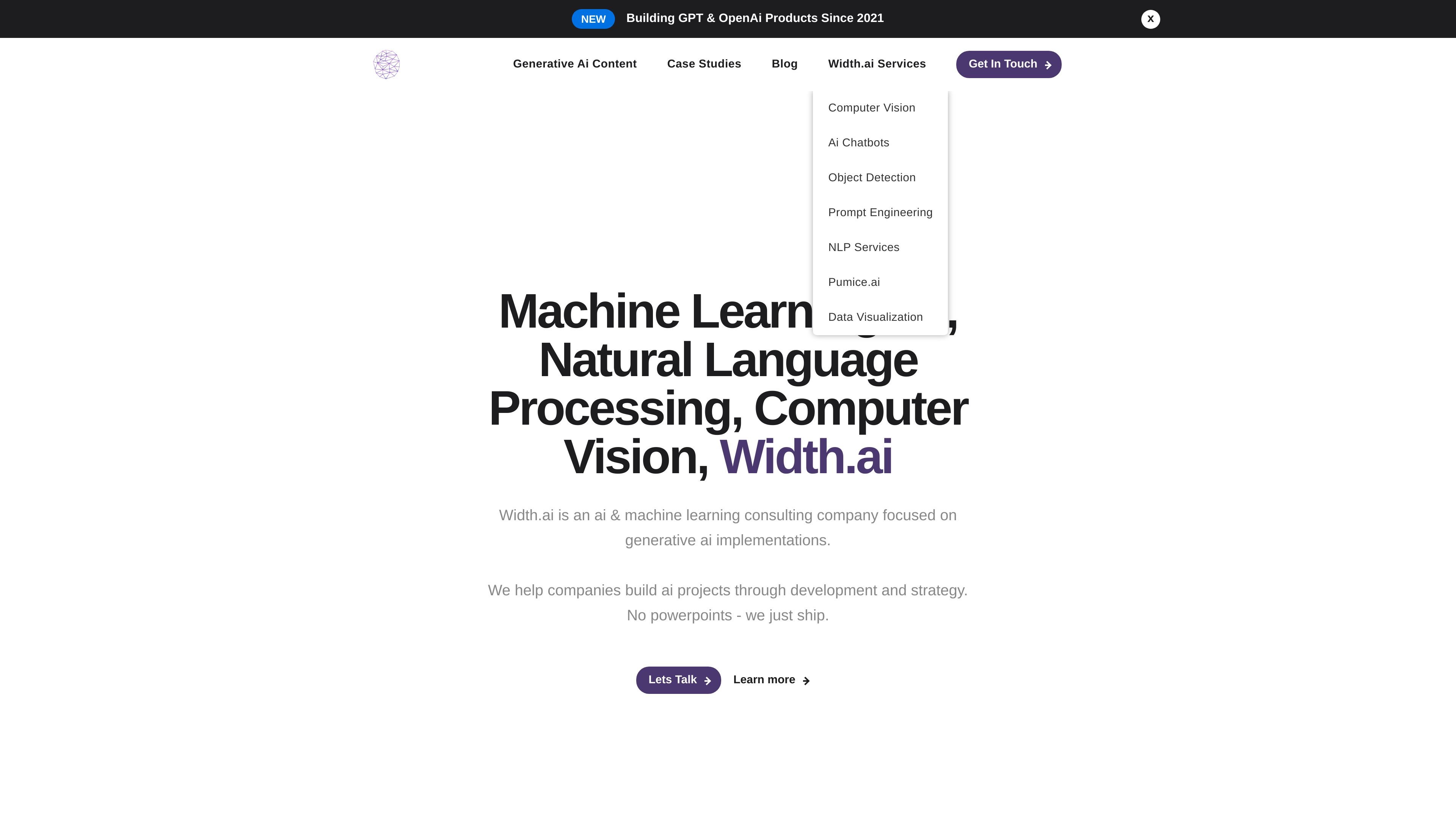
Width.ai is an AI and machine learning consulting company focused on generative AI implementations. The public site presents it as a team that helps companies build AI projects through development and strategy rather than as a general-purpose software vendor.
Its homepage says the company has been building with LLMs since 2021 and emphasizes shipping working systems, including proof-of-concept builds, production ML and AI software development, and consulting for teams that need help implementing AI effectively. Public case studies and service pages point to work in chatbots, agents, backend automation, NLP, computer vision, product categorization, and document processing.
The company also offers custom chatbot development services, including strategy and scoping, conversation design, architecture, build and fine-tune, integration into an existing stack, and optimization. That makes the service suitable for teams that want a custom AI system designed around a specific workflow, dataset, or product goal rather than a prepackaged tool.
The homepage describes proof-of-concept builds for AI and machine learning solutions, aimed at getting an initial version running quickly.
Width.ai builds production ML and AI software for MVPs through enterprise products, based on the site’s description of custom software development.
The company offers AI consulting to help teams implement AI effectively and avoid poor project decisions, according to the homepage copy.
The chatbot services page describes strategy and scoping, conversation design, architecture, build and fine-tune, integration, and optimization for custom chatbots and agents.
The site says it builds backend automation systems for service companies, from simple automations to more complex agentic systems, with emphasis on working through existing tools.
Case-study posts show work in NLP, computer vision, product categorization, document processing, and analytics dashboards, indicating a broad applied-AI practice.
Teams that have an AI idea but need an initial version built quickly can use the company for proof-of-concept development.
Businesses that need AI features inside a customer-facing or internal product can engage Width.ai for custom ML and AI software development.
Service companies that want to reduce manual work can use backend automation systems that connect with their existing tools and operations.
Teams building chatbots or agents can use the service for conversation design, architecture, fine-tuning, integration, and monitoring.
Organizations that need guidance on whether an AI approach makes sense can use consulting to plan the project and avoid implementation mistakes.
Width.ai appears to focus on AI and machine learning consulting rather than a self-serve software product. Public pages show project-based work, consulting, and development for generative AI, chatbots, NLP, computer vision, and automation.
The public pages show a free consultation / scoping call flow, including a contact page and calls to book a free scoping call on the chatbot services page. A public pricing page exists, but it is protected and the posted content does not reveal prices.
The site describes work across POC builds, production machine learning and AI software development, and AI consulting. The chatbot services page also lists strategy and scoping, conversation design, architecture, build and fine-tune, integration, and optimization.
Source pages mention integrations into an existing stack and channels, backend automation systems that integrate with existing tools, and chatbot work that can be wired into a customer’s stack. The sources do not name a fixed integration catalog.
Case-study pages highlight generative AI, agentic systems, NLP, computer vision, image classification, document processing, and product categorization. This suggests the team works best on custom AI implementations rather than generic software development.

AI Magicx is a unified AI workspace for chat, image, video, voice, music, email and developer tasks, helping teams and creators manage multiple models in one place.
OpenAI offers ChatGPT, API, Platform tools, and Codex for conversational AI, model building, and research and product updates.

AakarDev AI helps teams manage AI provider access, project setups, logs, and analytics in one dashboard with BYOK support.

书生 is a general-purpose large model suite for language, multimodal, weather, ocean, industrial design, 3D, finance, and scientific discovery tasks.

Orca is an Agent Development Environment for shipping with coding agents, running multiple CLI agents in parallel across isolated worktrees, with desktop and mobile workflows.

Paper is a design tool that connects canvas, code, and AI agents so teams can create, share, and ship work in one workflow. Includes desktop app and MCP access.