

Teams with defined responsibilities
A Team is an agent coworker assigned to a real part of the business. You define what it owns in plain language instead of asking it to handle an unstructured queue.

YAGNI is a web app for managing AI agent Teams inside your business, with responsibilities, commitments, review, and human approval for key actions.
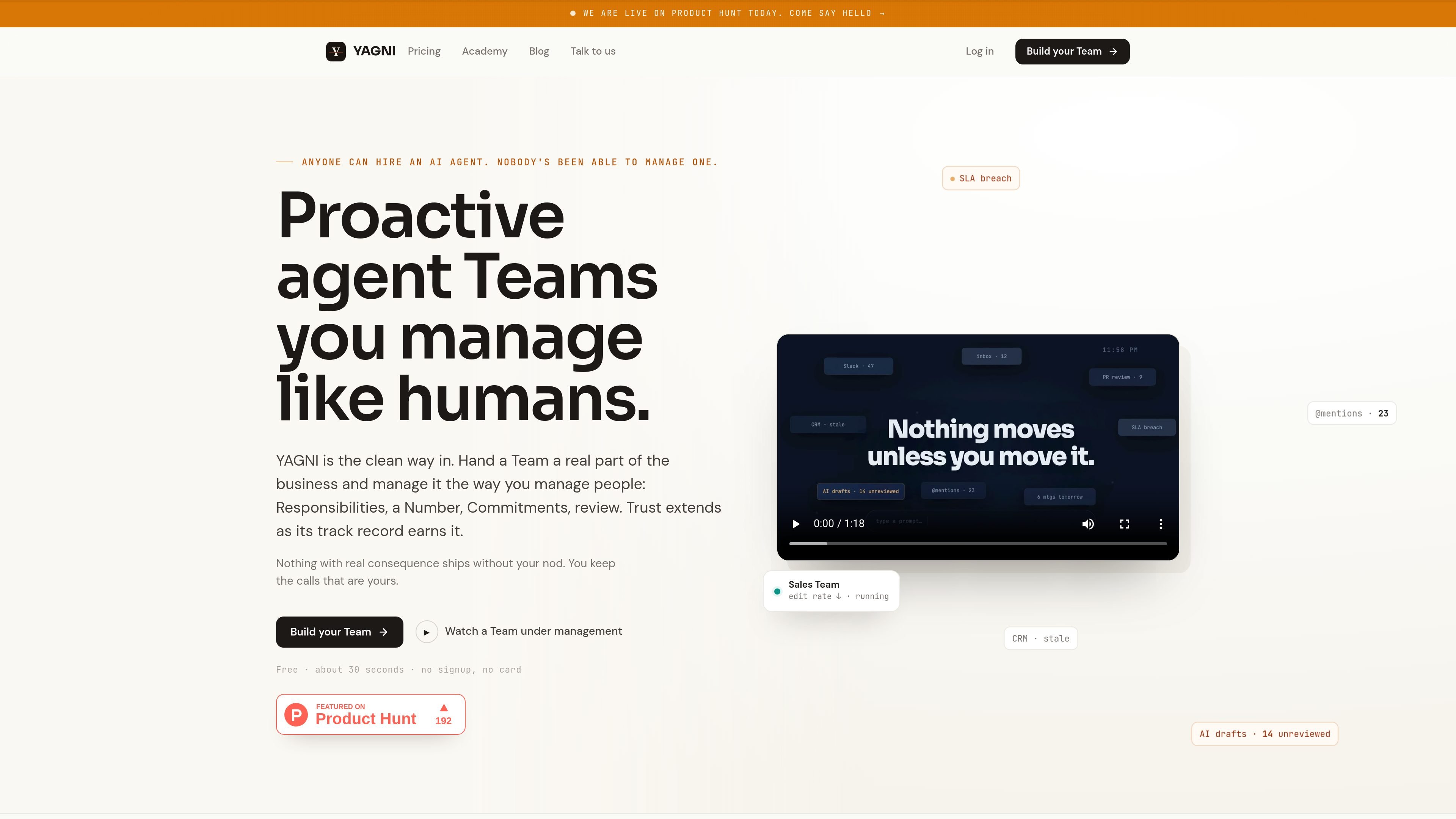
YAGNI is a workspace-level system for managing AI agent Teams as if they were part of the company org chart. Instead of treating agents as ad hoc assistants, it gives each Team a defined responsibility, a single measured Number, deadlines through Commitments, and a review step before anything consequential ships.
The product is designed to fit alongside the tools a company already uses. YAGNI reads and writes through connected systems, shows a Feed of drafts and decisions, and leaves Receipts from source tools such as Slack, Gmail, HubSpot, Stripe, Google Calendar, and GitHub so work can be verified instead of assumed.
The site positions YAGNI as useful for teams that want to delegate recurring business work, gradually grant more autonomy based on track record, and keep humans in control of high-stakes actions. It also offers a website-based setup flow that researches public company pages and job postings, then proposes the first Teams to create.
A Team is an agent coworker assigned to a real part of the business. You define what it owns in plain language instead of asking it to handle an unstructured queue.
Each Team works against a single Number, such as qualified meetings or edit rate, so progress is measured against one clear operating target.
Teams work through Commitments with end dates, so their work is framed as an ongoing plan rather than a one-off prompt.
The Feed surfaces drafts, decisions, and receipts. Routine work can execute on its own, while consequential actions wait for approval.
Track record changes the Team's authority over time. Teams start in Training, then can move through Supervised and Autonomous based on accepted work and promotions grounded in that record.
YAGNI starts from your public company site and job signals to draft a company profile and proposed Teams, which you can edit before connecting tools.
Use it for recurring revenue work such as lead qualification, meeting booking, CRM upkeep, or follow-up drafting when you want an agent Team to own that slice of the pipeline and report back through a measured Number.
Use it for support workflows that produce drafts, receipts, or staged decisions, especially where routine replies can be handled automatically but refunds, exceptions, or other consequential actions still need review.
Use it when your team wants agent help inside the communication tools it already relies on. YAGNI can read from connected systems, draft responses, and preserve source-linked outputs instead of forcing a separate workflow.
Use it for code-adjacent work when you want a terminal coding agent that starts with your company's decisions, conventions, and owners rather than a blank prompt, and can ask the YAGNI app for cited answers.
Use it when you are setting up a new workspace and want the system to research your public company site and roles first, then suggest Teams, Responsibilities, and likely Connections for you to edit and claim.
No. The pricing page says every new workspace starts with 20 starter credits and no card on file.
You give YAGNI your company website, optionally a role, focus, or public job posting, and it researches public company pages and public hiring signals before proposing a company profile and Teams for review.
YAGNI runs Teams under management rather than a traditional task queue. Teams own a part of the business, propose work, leave receipts, and stage decisions for anything consequential.
The pricing page says YAGNI Code is in internal preview and can be turned on per workspace after a demo. It uses the same pooled monthly credits as other workspace activity, so there is no separate coding bill.
When a workspace runs out of credits, work pauses gracefully. Drafts, docs, and history remain visible, and credit-spending work resumes after you add credits, upgrade, or wait for the monthly refill.

Paper is a design tool that connects canvas, code, and AI agents so teams can create, share, and ship work in one workflow. Includes desktop app and MCP access.

Hurree is an AI-powered reporting and analytics platform that centralizes company data, shared dashboards, and Riva summaries, recommendations, and forecasts.

Orca is an Agent Development Environment for shipping with coding agents, running multiple CLI agents in parallel across isolated worktrees, with desktop and mobile workflows.

Firebase Studio is a web-based workspace for full-stack app development with Gemini-assisted coding, app previews, cloud emulators, collaboration, and browser deployment.

AI Magicx is a unified AI workspace for chat, image, video, voice, music, email and developer tasks, helping teams and creators manage multiple models in one place.

Superside is an AI-powered creative service for enterprise and in-house teams, with global talent, AI-first workflows, and subscription-based support.