

Multi-source context graph
Ingest chat, business data, user interactions, and documents into a temporal context graph that organizes people, things, relationships, and changes over time.

Zep is an AI agent memory platform for storing and retrieving context from chats, business data, and documents with temporal context graphs. Credit plans and enterprise deployment options available.
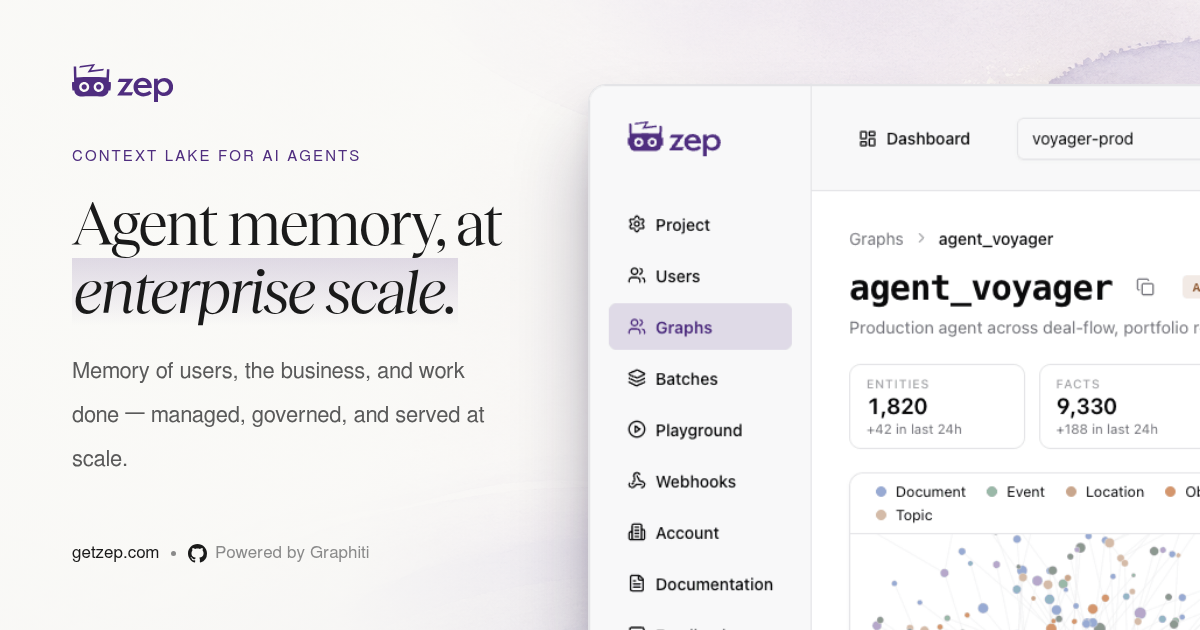
Zep is an agent memory platform for AI systems that need to store, update, and retrieve context across chats, business data, and documents. It builds temporal context graphs so agents can work with relevant memory instead of raw message history.
The product is positioned for enterprise use, with managed cloud deployment, VPC and BYOK options, and controls for access, retention, and audit. Zep also describes credit-based self-serve plans alongside an Enterprise plan with custom credits, negotiated rates, and a guaranteed SLA.
Ingest chat, business data, user interactions, and documents into a temporal context graph that organizes people, things, relationships, and changes over time.
Assemble token-efficient context from the graph so agents can retrieve relevant memory without manually stitching together sources.
When new information conflicts with an existing fact, Zep invalidates the older fact and preserves history for past-date queries.
Surface Observations from graph patterns, such as recurring behaviors or co-occurrences, to give agents a broader view than individual facts alone.
Apply access control, retention rules, and audit logs at the substrate level across graphs, queries, and layers.
Choose managed cloud, your VPC, or your own keys through cloud deployment options designed for enterprise environments.
Store recurring user preferences, past decisions, and ongoing relationships so an assistant can retrieve the right context before responding.
Ingest product, account, and operational data alongside chats so support or success agents can answer with current account context.
Track changes in facts over time, such as preference shifts or updated business status, while preserving older states for audit or review.
Assemble governed context for large-scale agent deployments where access rules, retention, and audit trails must be applied consistently.
Surface repeated patterns and co-occurrences from memory graphs to support planning, recommendations, or account analysis.
Zep is built to ingest chat messages, business data, and documents, then retrieve relevant context for an AI agent in under 200 milliseconds.
The pricing page shows self-serve credit-based plans for Flex and Flex Plus, plus an Enterprise plan with custom credits, negotiated rates, and a guaranteed SLA.
Yes. Zep says it is SOC 2 Type II certified and offers HIPAA Business Associate Agreements on the Enterprise plan.
Zep supports cloud deployment, deployment in your VPC, and a BYOK option where Zep’s managed service uses your own encryption keys. Enterprise pages also mention BYOC.
Zep says its memory can be updated when new information contradicts existing facts, while old facts remain as history and can be queried by date.

Obsidian is a private note-taking and knowledge management app with local Markdown notes, links, graph view, Canvas, plugins, themes, sync and publishing.

Uniforge is Leeroo’s enterprise context engine for AI agents, connecting systems, enriching records with web data, checking data quality, and building ML models in your cloud.

Anara is an AI research workspace that searches your library and the web, then helps you write with cited claims and source-backed answers.

Quenti is an online learning platform for flashcards, practice tests, matching games, and AI-assisted grading for students, teachers, schools, and organizations.

Prompt Genie is a prompt management and optimization tool for AI workflows, plus Claude Code memory to reduce repeat reads and token spend.

Quantifind Graphyte is a pure-SaaS financial crimes automation platform for AML-KYC screening, investigations, and reporting. It helps financial services teams use external data, AI-driven matching, and APIs to work from onboarding through SAR submission.