


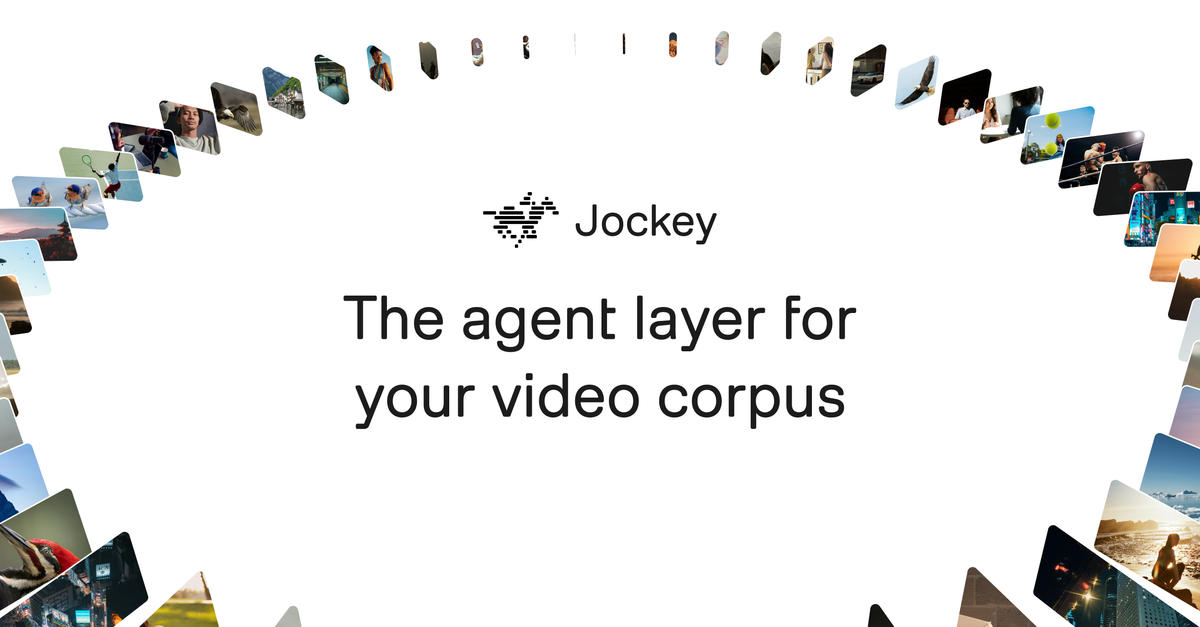
Natural-language video search
Ask for a person, place, scene, quote, or moment in plain language and Jockey returns matching clips from a connected video library.
Jockey is TwelveLabs’ video intelligence agent. The homepage describes it as an agent layer for video understanding that can organize, search, and assemble across a video library, with the product currently in research preview.
The product is positioned around natural-language interaction with video: users can ask questions, find specific clips or quotes, and generate summaries or highlight reels. The page also shows Jockey connected to Claude, with a developer path through the TwelveLabs API and SDK, and links the product to TwelveLabs’ Marengo and Pegasus models for retrieval and video-language reasoning.
Ask for a person, place, scene, quote, or moment in plain language and Jockey returns matching clips from a connected video library.
Use the assistant to move from broad questions to specific moments without browsing folders or opening every file.
Point Jockey at a topic and receive an edit-ready cut of relevant moments, as shown in the highlight reel examples.
Connect Jockey to Claude and ask questions directly from the chat interface you already use; the page notes ChatGPT is coming soon.
Use the developer examples to query the product through the TwelveLabs SDK with a model name, knowledge store ID, and session ID.
Return machine-readable, timestamped metadata and frame-accurate results for downstream products and playback links, based on the broader platform pages.
Search a creative archive for ads by hook, talent, logo, format, or tone, then compare patterns across the library before planning the next shoot.
Ask for the strongest moments in a footage archive and turn them into a rough, edit-ready highlight reel.
Find a quote, a specific scene, or a named person in a large media archive without opening files one by one.
Embed video understanding into a product search or analytics workflow using the API examples and knowledge-store pattern shown on the page.
Ask for a person, place, scene, or moment directly inside Claude after connecting the library through the integration workflow shown on the homepage.
Jockey is presented as a research preview. The homepage says it is currently accepting limited sign-ups and offers a free-trial style entry point, while the pricing page shows TwelveLabs also has Free, Developer, and Enterprise API plans for its broader platform.
The homepage says Jockey can organize, search, and assemble across a video library. The examples show natural-language search, quote finding, highlight reel creation, and analysis that returns clip-level results.
The homepage shows two named assistant integrations: Claude is connected now, and ChatGPT is listed as coming soon. It also shows an MCP endpoint for Jockey.
The page shows Jockey being used through a chat-style interface where a user can ask for clips, summaries, and lists of moments. It also includes SDK example code for calling a Jockey model via the TwelveLabs client.
The source specifically ties Jockey to TwelveLabs models Marengo and Pegasus. The model pages describe Marengo as the retrieval and embedding model and Pegasus as the video-language model for description and analysis.

RLAMA is a local AI platform for building RAG systems and intelligent agents on macOS, Linux, and Windows, with HTTP API support.

Crossing Minds is a retrieval platform for accurate, secure, scalable AI applications. The public site also says the team is joining OpenAI.

Orca is an Agent Development Environment for shipping with coding agents, running multiple CLI agents in parallel across isolated worktrees, with desktop and mobile workflows.

AI Magicx is a unified AI workspace for chat, image, video, voice, music, email and developer tasks, helping teams and creators manage multiple models in one place.

Paper is a design tool that connects canvas, code, and AI agents so teams can create, share, and ship work in one workflow. Includes desktop app and MCP access.
blop is a QA agent that writes browser tests as code in your repo, runs them in CI, clusters repeated failures, and can open PRs to fix broken tests.