

Runtime authorization at the action boundary
Checks prompts, tool calls, shell commands, and API requests before execution, with the site describing sub-millisecond decision latency.

Kastra authorization infrastructure for AI systems checks prompts, tool calls, shell commands, API requests, and browser actions before execution.
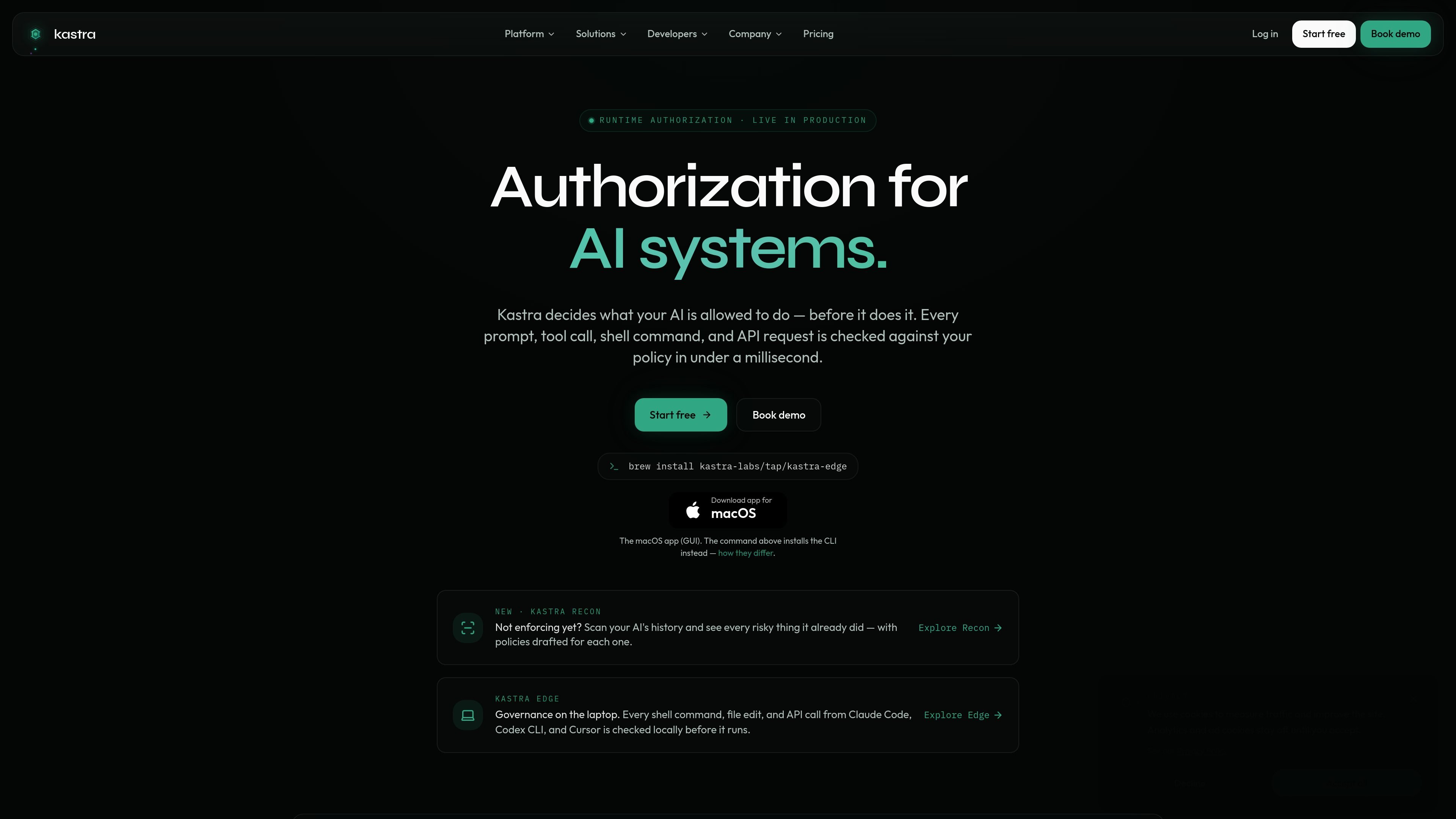
Kastra is authorization infrastructure for AI systems. Its main job is to decide what an AI is allowed to do before the action runs, rather than recording or analyzing behavior after the fact.
The product checks prompts, tool calls, shell commands, API requests, and browser actions against policy in under a millisecond. The same policy layer can be used across local coding agents, autonomous workflows, and enterprise deployments, with deployment options that include cloud, self-hosted, and air-gapped environments.
Checks prompts, tool calls, shell commands, and API requests before execution, with the site describing sub-millisecond decision latency.
Lets teams write policies in Kastra Policy Language, a typed DSL that lives in git, is reviewed in pull requests, and can be tested against fixtures.
Supports allow, deny, redact, and escalate or approval-based outcomes depending on the policy and surface being evaluated.
Runs enforcement on developer laptops, browser agents, backend services, and other AI surfaces using the same policy model.
Produces signed, append-only audit traces that can be replayed and exported to SIEM tools such as Datadog, Splunk, and S3.
Includes Kastra Recon, which scans historical agent activity, surfaces risky actions already taken, and drafts policies for them.
Use Kastra on a developer laptop to gate destructive commands, file edits, and local API calls from coding assistants before they run.
Apply the same policy layer to autonomous agent workflows so each step is checked and sensitive steps can require human approval.
Govern browser-based agents by intercepting clicks, navigation, form fills, and downloads before they fire in the DOM.
Review historical agent activity with Recon to find risky actions already taken and draft policies before turning on enforcement.
Run authorization in enterprise environments where teams want signed evidence, audit exports, and deployment models that include self-hosted or air-gapped setups.
Kastra is positioned as authorization infrastructure for AI systems. It sits in the path of prompts, tool calls, shell commands, API requests, browser actions, and other AI-generated actions, then allows, denies, or in some cases requires approval before the action runs.
The source describes deployment models including cloud, self-hosted, and air-gapped. The pricing page also says Enterprise can run in self-hosted, BYOC, or air-gapped environments.
Kastra’s pricing page lists support for Claude Code, Codex CLI, Cursor, OpenClaw, and any OpenAI-compatible runtime, plus custom agents through SDKs.
Yes. The pricing page includes Shadow Mode for observing activity before enforcement, and the policy-engine page describes replaying historical actions against policy versions to see what would have changed.
The site says decisions and audit records can be streamed to SIEM destinations including Datadog, Splunk, and S3. The policy-engine page also notes first-party SDKs for TypeScript, Python, Go, Rust, Java, and Swift.
트래픽 데이터는 참고용으로만 확인하세요.

Orca is an Agent Development Environment for shipping with coding agents, running multiple CLI agents in parallel across isolated worktrees, with desktop and mobile workflows.

AI Magicx is a unified AI workspace for chat, image, video, voice, music, email and developer tasks, helping teams and creators manage multiple models in one place.

Paper is a design tool that connects canvas, code, and AI agents so teams can create, share, and ship work in one workflow. Includes desktop app and MCP access.

blop is a QA agent that writes browser tests as code in your repo, runs them in CI, clusters repeated failures, and can open PRs to fix broken tests.

RLAMA is a local AI platform for building RAG systems and intelligent agents on macOS, Linux, and Windows, with HTTP API support.

AakarDev AI helps teams manage AI provider access, project setups, logs, and analytics in one dashboard with BYOK support.