

Predictive Query Language
Define predictive tasks with PQL, a SQL-like syntax that specifies the target and data context for prediction.

Kumo.ai is a predictive AI platform for relational data, generating predictions from warehouse data with a SQL-like interface.
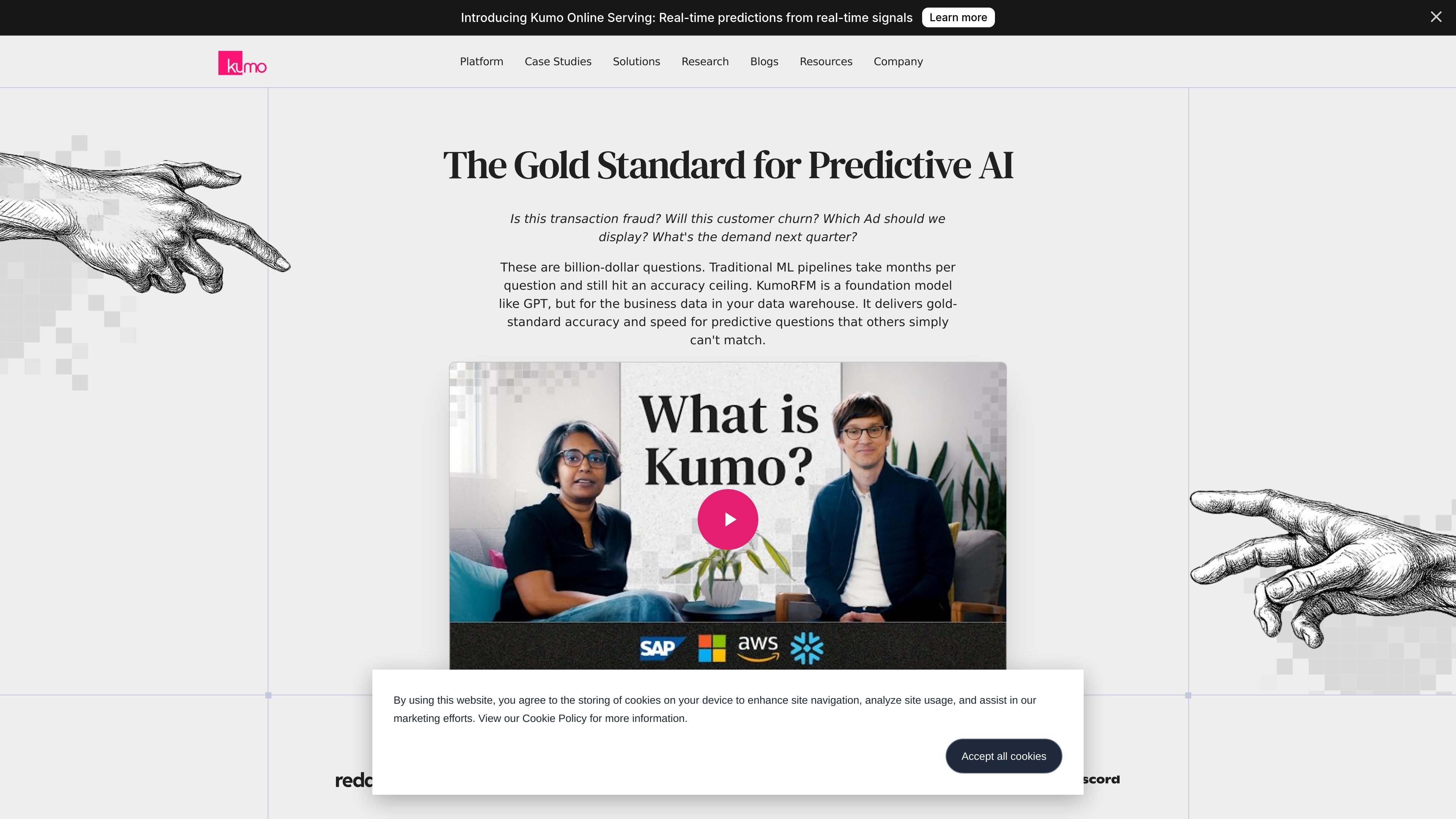
Kumo.ai is a predictive AI platform for relational data. Its core product, KumoRFM, is described as a relational foundation model that generates predictions directly from data warehouse data without requiring manual feature engineering or a conventional ML pipeline.
Users define prediction tasks with Predictive Query Language (PQL), a SQL-like interface, then ask for outputs such as churn, fraud, demand, ranking, or recommendation predictions. The platform is positioned for teams that want fast predictive workflows with optional fine-tuning for task-specific performance.
Define predictive tasks with PQL, a SQL-like syntax that specifies the target and data context for prediction.
Start from a connected warehouse and generate predictions without a traditional feature-engineering or pipeline workflow.
Use KumoRFM for immediate predictions, with fine-tuning available when a task needs more optimization.
Let the system automate major ML steps such as feature preparation, label engineering, training dataset creation, model optimization, and MLOps.
Use the coding agent to translate natural language into PQL and support SDK-based workflows in a notebook or IDE.
Rely on an architecture that separates the user-facing predictive query interface from the underlying cache, metadata, and processing layers.
Build models for churn, fraud, demand, or ranking questions by writing a predictive query instead of assembling a traditional training pipeline.
Use the platform for transaction fraud, account takeover, fraud ring detection, chargeback forecasting, and similar risk-focused workloads.
Apply Kumo to lead scoring, customer lifetime value, win-back targeting, cross-sell, and product recommendation workflows.
Support planning and operations scenarios such as demand forecasting, inventory planning, budget allocation, and supply chain decisions.
Use the coding agent and SDK workflows to move from natural-language questions to PQL inside a notebook or IDE.
Kumo uses Predictive Query Language (PQL), a SQL-like interface, to define predictive tasks. The documentation says the platform can automate feature engineering, training table generation, and model training from that query.
The homepage describes Kumo as connecting directly to your warehouse, and the security documentation says users access the platform through the predictive query interface while data remains in the customer data store.
The source materials describe Kumo as suitable for tasks such as fraud detection, churn prediction, demand forecasting, lead scoring, recommendations, and other predictive questions on relational data.
The homepage says Kumo can be fine-tuned for specific use cases, and the overview says it supports both instant in-context predictions and task-specific optimization.
The homepage includes a pricing link, but the current pricing page is a 404 and no pricing details are available in the collected sources.

Hurree is an AI-powered reporting and analytics platform that centralizes company data, shared dashboards, and Riva summaries, recommendations, and forecasts.

北极九章 is an enterprise AI data insight engine for natural-language data analysis. Ask by typing or voice and get charted results in workflows.

Postfity is a social media management tool for scheduling, planning, publishing, and tracking posts across connected accounts. Includes analytics, inbox management, AI tools, team workflows, and Free and paid plans.

AnyClip is a visual intelligence platform for video that automates enrichment, improves discovery, and supports engagement and monetization.

Arcwise is an AI product for detecting meaningful metric changes and explaining them with data-grounded analysis. It turns warehouse and business-context data into decision-ready reports in app, docs, or slides.

15Five is an AI-powered performance management platform for HR teams and managers, combining reviews, engagement surveys, goals, compensation, and analytics in one system.