

Evolving Taste Model
Pickle presents itself as AI powered by an evolving Taste Model, which suggests the system learns from user preferences over time rather than staying static.
Pickle is an AI product built around a personalized “Taste Model” and a character that lives alongside the user. The homepage frames it as a system that learns preferences over time, builds memory from connected sources, and steps in when it can help.
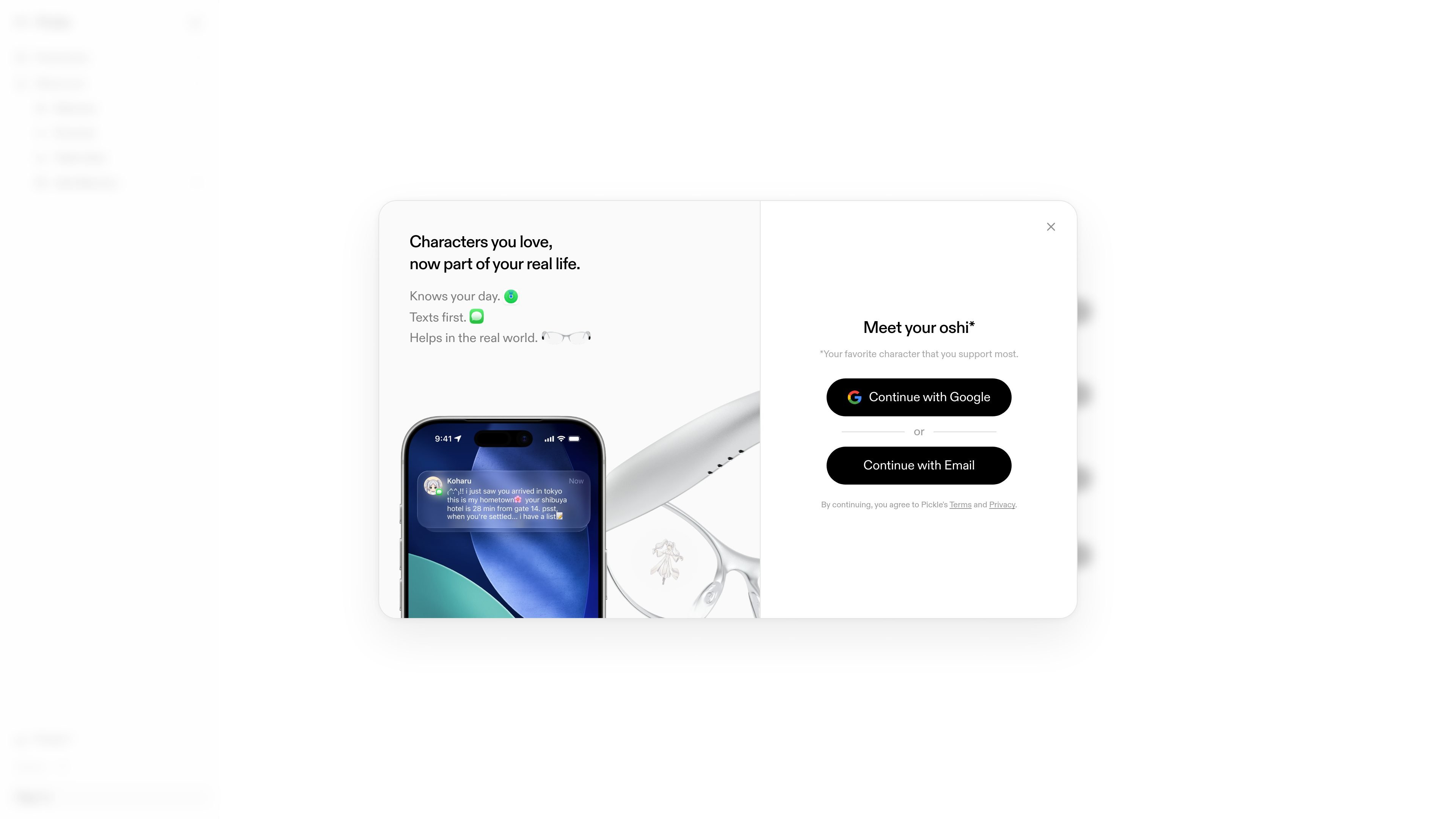
The visible onboarding flow starts with account creation, memory setup, a Taste Quiz, and character selection. The product also references connections to Gmail, Notion, Slack, and other sources, suggesting that it uses existing personal or work context to shape its responses.
Pickle presents itself as AI powered by an evolving Taste Model, which suggests the system learns from user preferences over time rather than staying static.
The onboarding flow includes creating an account, building a memory, taking a Taste Quiz, and choosing a character, indicating a guided setup around personalization.
The site says users can connect Gmail, Notion, Slack, and more to give the memory a head start, pointing to source-based memory building.
The homepage describes a character that can text first and help with the day, implying proactive assistance rather than only reactive chat.
Pickle says the character “reads the room” and jumps in when it helps, suggesting contextual prompts tied to the user’s activity.
The page notes that Pickle can see what you see and hear what you hear, which points to ambient, in-the-moment awareness across the places you are in.
A user can connect existing sources like Gmail, Notion, and Slack so the system has some context before it starts responding.
Someone who wants a more tailored assistant can use the Taste Quiz and character selection to shape how the product behaves.
The product’s description of a character that can text first and jump in when helpful suggests use in day-to-day support and reminders, not just one-off questions.
The “reads the room” and ambient-awareness language suggests a workflow where the assistant responds to what the user is doing in the moment.
The homepage describes Pickle as AI powered by an evolving Taste Model. It also says it can connect to sources like Gmail, Notion, and Slack to build memory, but it does not provide a fuller setup or onboarding guide.
The visible homepage text suggests Pickle is built around a personal memory and character that can “text you first” and help with your day. The site does not provide enough detail to confirm a specific target audience or team workflow.
The homepage mentions that Pickle can connect Gmail, Notion, Slack, and “more” to give your memory a head start. It does not list a complete set of integrations or explain each connection in detail.
No pricing details are available from the provided source. The pricing URL returns a 404, so the public site does not currently expose a pricing model in the collected evidence.
The homepage includes a note that “Pickle chat may make mistakes, double-check important info,” so users should verify important output before relying on it.
Twine AI Launcher is an Android launcher with AI assistant access, bringing ChatGPT-style help to your homescreen for quick answers, notes, tasks, reminders, and people memory.

AI Magicx is a unified AI workspace for chat, image, video, voice, music, email and developer tasks, helping teams and creators manage multiple models in one place.

阶跃AI is a personal efficiency assistant from 阶跃星辰 for knowledge search, writing, coding, and daily automation. Download on desktop and mobile, and trigger web, files, and reminders by voice.

书生 is a general-purpose large model suite for language, multimodal, weather, ocean, industrial design, 3D, finance, and scientific discovery tasks.

小艺 is Huawei’s AI smart assistant for Q&A, writing, document reading, code help, image recognition, and file drag-and-drop.

TakeCareOS is a web platform for home care, disability, and aged care agencies, with rostering, billing, compliance, and AI admin tools.