

Semantic paper search
Search across about 148 million academic papers using semantic matching, so queries can find related work even when the wording differs.

Cito is a programmatic search service for academic papers with semantic and keyword search across a local corpus of 148 million papers.
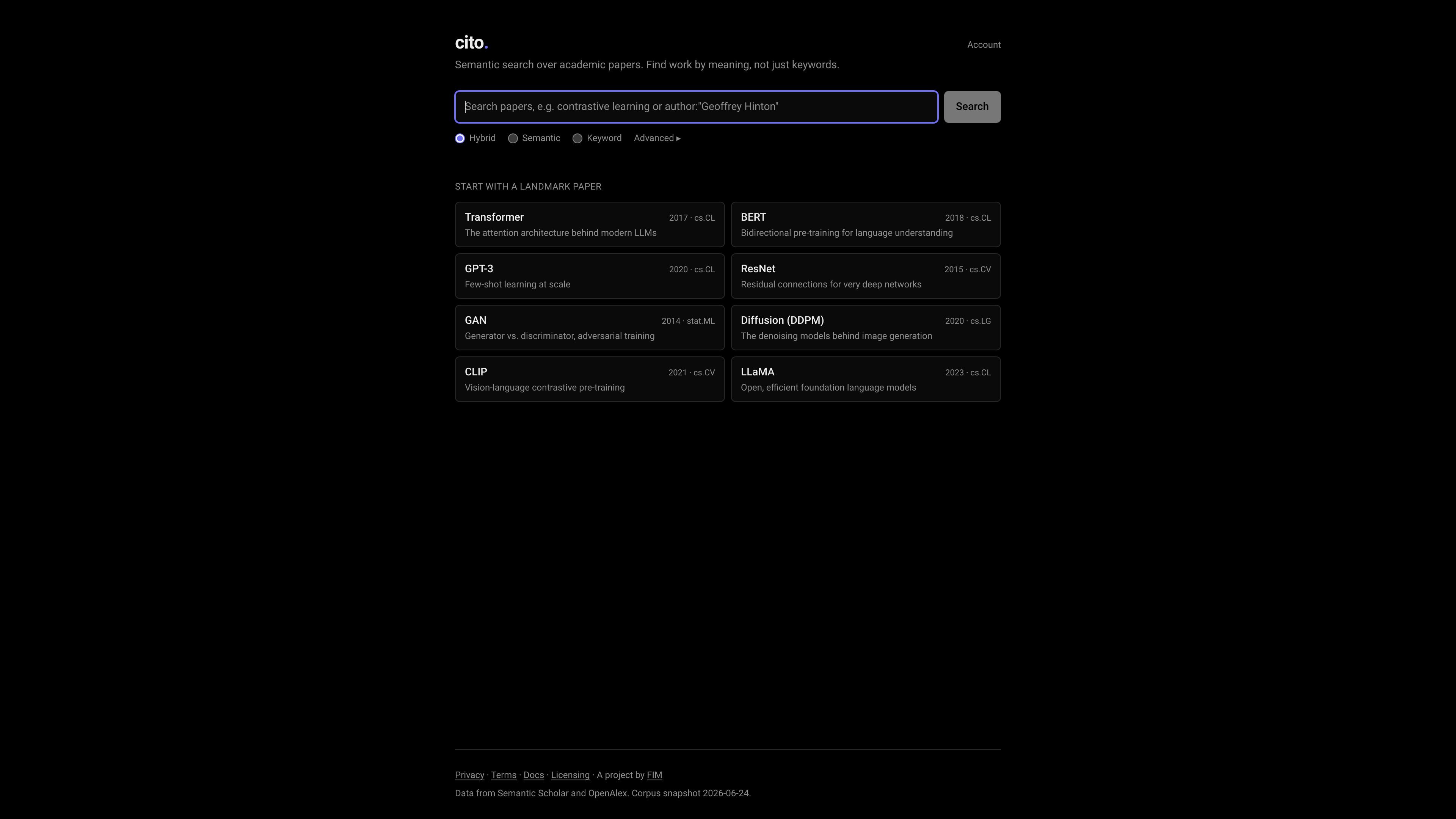
Cito is a fast programmatic search service for academic literature. It searches a local corpus of roughly 148 million papers and combines semantic and keyword retrieval into one ranked result set, so users can find papers by meaning as well as by exact terms.
The product is aimed at people who need reliable paper discovery through an API rather than a browser search box. Because the corpus is self-hosted, Cito does not inherit upstream rate limits at query time, and the results are generated from its own indexes for reproducible behavior.
Search across about 148 million academic papers using semantic matching, so queries can find related work even when the wording differs.
Match exact terms, jargon, authors, and acronyms with BM25 search over titles and abstracts, which helps narrow down precise paper references.
Combine semantic and keyword rankings with reciprocal-rank fusion, giving weight to papers that score well in both systems.
Use only the semantic retriever or only the keyword retriever when a workflow calls for one mode; the docs expose mode=semantic and mode=keyword.
Get reproducible ordering from the same query and corpus snapshot, with no third-party API calls at query time.
Receive structured paper metadata and direct open-access PDF links when available, instead of a full-text hosting layer.
Look up a landmark paper or a topic area by concept rather than exact wording, which is useful when you only know the idea behind the work.
Search for papers that mention a specific method, acronym, model name, or author term and want exact lexical matches to surface alongside related semantic results.
Build a research or discovery feature into an application using the API, with reproducible ranking from a fixed corpus snapshot.
Move from a search result to the source paper by using the provided metadata and open-access PDF link when one exists.
Use the licensing terms and attribution guidance to republish search results in a product, dataset, or paper without guessing about data rights.
Cito is a programmatic search service for academic literature. It combines semantic search and keyword search over a local corpus of roughly 148 million papers, then fuses the results into one ranked list.
The docs say Cito uses SPECTER2 for semantic retrieval and BM25 over titles and abstracts for keyword retrieval. You can also run either mode alone with mode=semantic or mode=keyword.
Cito returns metadata such as title, authors, venue, publication date, DOI, citation count, and abstract when available. When an open-access copy exists, it also includes a direct PDF link to the source host.
Yes. The licensing page states that Cito is built on openly licensed scholarly data and that you may use results in commercial products, research, and publications, as long as you keep the required attribution string from API responses: “Data from Semantic Scholar”.
Cito does not proxy or re-host full text. PDF links point to the original publisher or repository, and any use of a downloaded PDF is governed by that origin's terms.

GetESP analyzes CSV email lists to identify recipient ESPs and spam protection tools, helping segment lists and choose the right provider for better deliverability.

Predictice is a legal research and analysis platform for legal professionals, with jurisprudence search, litigation analysis, assistant tools and document audit workflows.

北极九章 is an enterprise AI data insight engine for natural-language data analysis. Ask by typing or voice and get charted results in workflows.

clickworker provides human-generated and human-validated data services for surveys, store checks, tagging, list building, crowdtesting, and AI training data.

Rayyan is an AI-powered platform for systematic and literature reviews, helping teams manage screening, extraction, bias assessment and reporting in one shared workflow.

Finlo is a web-based stock portfolio platform with curated, strategy-based portfolios, monthly updates, and premium research tools for long-term investors.