

Stacked PR workflows
Create and manage stacked pull requests from the terminal with Graphite CLI. The feature page shows commands for creating stacks, logging them, submitting PRs, modifying stacked branches, and syncing local changes.

Graphite is a GitHub-connected code review platform for stacked pull requests, AI-assisted review, and merge workflows. Manage PRs, feedback, and CI in one system.
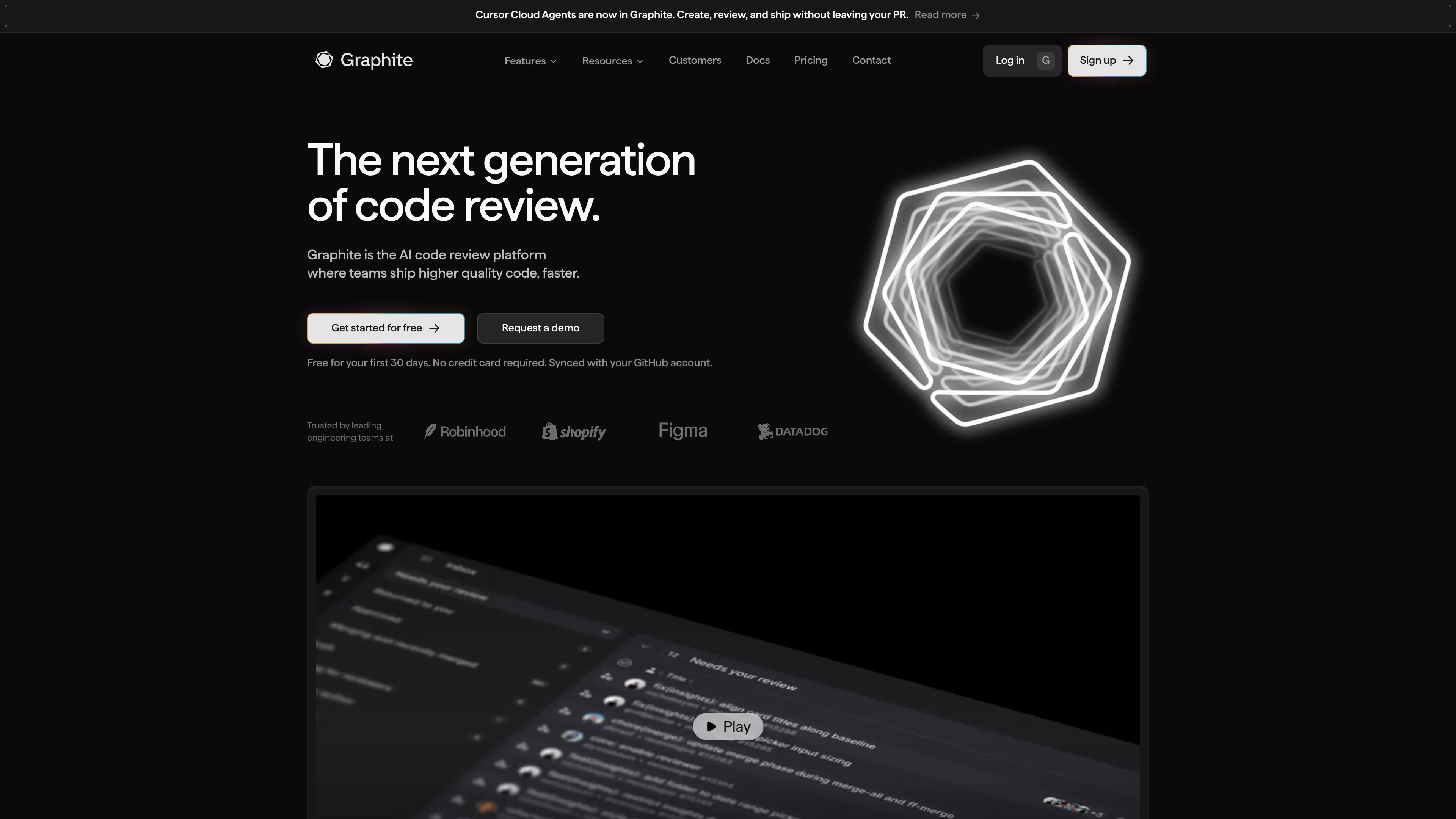
Graphite is a GitHub-connected code review platform built around stacked pull requests, AI-assisted review, and a streamlined merge workflow. The product combines a CLI, PR inbox, Graphite Chat, merge queue, and developer metrics so teams can manage review and delivery in one system.
The site positions Graphite for teams that want smaller pull requests, faster review cycles, and less time spent waiting on merges or repetitive CI runs. It also offers a free Hobby plan, paid Starter and Team plans, and an Enterprise plan for organizations that need advanced controls and support.
Create and manage stacked pull requests from the terminal with Graphite CLI. The feature page shows commands for creating stacks, logging them, submitting PRs, modifying stacked branches, and syncing local changes.
Use a unified inbox to track pull requests, review requests, CI status, stack information, and labels in one place. The inbox can be customized with filters and keyboard-driven actions.
Get immediate, actionable feedback on pull requests with Graphite Chat. The home and features pages describe it as a collaborative reviewer that can surface bugs, explain code, and help with CI failures and suggested fixes.
Route pull requests through a stack-aware merge queue that keeps branches green and reduces merge conflicts. The site says merges can happen from Graphite, GitHub, or the terminal.
Use developer metrics to understand team performance over time. Graphite Insights is presented as historical reporting for trends and bottlenecks rather than vanity metrics.
Reduce redundant CI runs with CI optimizations designed for stacked PRs. The docs explain that the system can decide which PRs in a stack should run CI and that the step is exposed through open-source wrappers for Buildkite and GitHub Actions.
Break a large change into sequenced pull requests so each piece can be reviewed and shipped independently. Graphite’s stack tools and recursive rebasing reduce the manual work of keeping those branches aligned.
Centralize review requests, CI status, and stack information for a team that handles many parallel pull requests. The inbox gives reviewers one place to sort, filter, and act on incoming work.
Use AI feedback to catch issues and resolve CI problems without leaving the pull request page. Graphite Chat is presented as a collaborative reviewer that can explain code, suggest fixes, and help apply changes.
Cut down redundant test runs on stacked pull requests by adding Graphite’s CI optimization step to your pipeline. The docs describe repository-level configuration for Buildkite and GitHub Actions.
Route approved changes through a merge queue to keep the main branch green and reduce merge conflicts. The product also supports merging from Graphite, GitHub, or the terminal.
Graphite is built around GitHub-connected code review workflows. The site shows support for personal accounts on the Hobby plan and all GitHub organization repositories on the paid Starter plan and above.
The pricing page shows a free Hobby plan, a paid Starter plan at $20 per user/month billed annually, a Team plan at $40 per user/month billed annually, and an Enterprise plan with custom pricing.
Graphite’s core workflow centers on stacked pull requests, a PR inbox, Graphite Chat, AI reviews, merge queue, and developer metrics. The site also highlights CLI and VS Code support, plus Slack notifications and CI optimization documentation.
The site describes Graphite Chat as a collaborative AI reviewer that can give feedback on pull requests, help fix CI failures, and apply suggested fixes in context. The pricing page also notes that Graphite Chat is limited on Hobby and Starter plans and unlimited on Team and Enterprise plans.
Yes. The pricing page includes an Enterprise plan for advanced control, security, and support, with features such as SAML, audit logs, ACLs, GHES support, premium support and SLAs, custom MSA, custom payments, and private uploads.

JetBrains makes developer tools for individuals and teams, including IntelliJ IDEA, PyCharm, DataGrip, WebStorm, Rider, and CLion, with built-in run/debug/test workflows.

Orca is an Agent Development Environment for shipping with coding agents, running multiple CLI agents in parallel across isolated worktrees, with desktop and mobile workflows.

Firebase Studio is a web-based workspace for full-stack app development with Gemini-assisted coding, app previews, cloud emulators, collaboration, and browser deployment.

小艺 is Huawei’s AI smart assistant for Q&A, writing, document reading, code help, image recognition, and file drag-and-drop.

EZsite AI is an AI website builder that turns a URL into a fullstack React or Vue.js app with hosting, custom domains, code export, and backend features.

AI Magicx is a unified AI workspace for chat, image, video, voice, music, email and developer tasks, helping teams and creators manage multiple models in one place.