

24/7 admissions coverage
Sarah responds to inquiries around the clock, collecting intake information, answering common questions, and moving patients toward a scheduled appointment.

mdhub is an AI operating system for behavioral health clinics, streamlining admissions, clinical documentation, and billing workflows while keeping patient care moving.
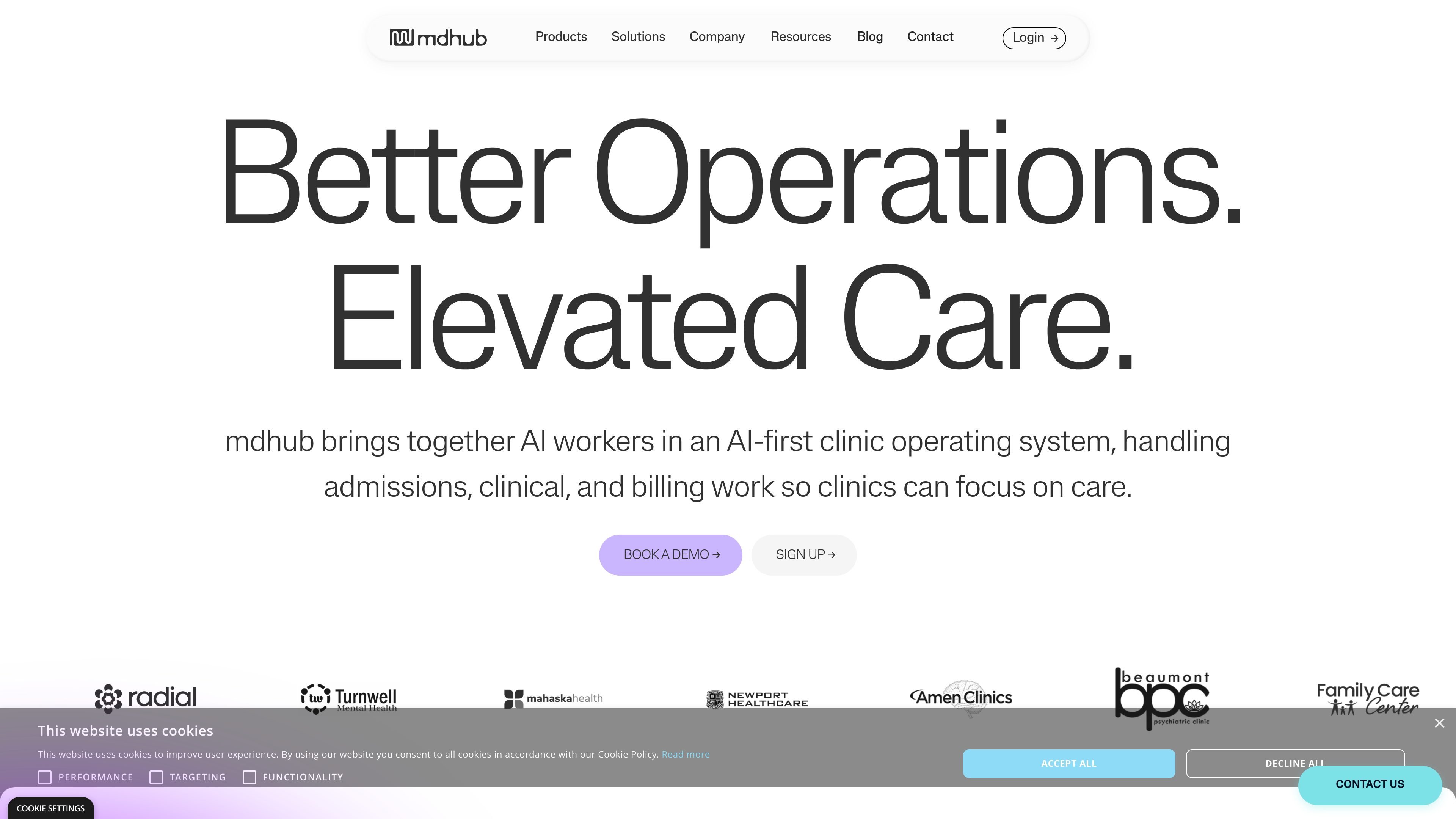
mdhub is an AI operating system for behavioral health clinics. It coordinates specialized AI workers across admissions, clinical documentation, and billing so clinic teams can reduce manual administrative work while keeping care moving.
The product is organized around named workers such as Sarah for admissions and Emma for clinical documentation. Across the site, mdhub positions itself as a system for handling intake, notes, claims-related work, and follow-up inside workflows designed for behavioral health practices.
The homepage describes the platform as enterprise ready, HIPAA-compliant, and SOC 2-certified, with workflows intended to standardize operations across clinicians, teams, and locations. The pricing page adds details about clinician-facing documentation tools, EHR integration, and multiple access modes including a mobile app and in-browser recorder.
Sarah responds to inquiries around the clock, collecting intake information, answering common questions, and moving patients toward a scheduled appointment.
Sarah checks insurance eligibility before scheduling so teams can focus on qualified patients and fewer follow-up surprises.
Emma supports clinicians before, during, and after sessions by pre-charting, generating structured notes, and handling follow-up summaries.
Emma assigns CPT codes from clinical context and formats notes to support billing workflows.
The platform connects admissions, clinical, and billing work in one system so tasks can move forward without manual handoffs.
The site describes integrations with EHRs, CRM systems, phone systems, web forms, messaging channels, and a mobile or in-browser recorder.
Use Sarah to capture new patient inquiries, check eligibility, and schedule appointments without requiring staff to respond manually to every call or form submission.
Use Emma to prepare charts, generate structured notes during or after a session, and reduce the time clinicians spend on documentation.
Use mdhub to connect admissions, charting, and billing workflows so work can move from one stage to the next with fewer handoffs.
Use Sarah to standardize admissions across single-site or multi-site behavioral health organizations that want consistent intake handling.
Use Emma to support documentation, coding, and follow-up in practices that work through a mobile app or browser-based recorder.
Yes. The pricing page says Emma integrates with your EHR, and Sarah is described as working with mdhub EHR and CRM systems as well as leading platforms such as Athenahealth, Epic, Netsmart, and Tebra.
Emma is positioned as a clinical assistant for documentation, pre-charting, notes, coding, and follow-up. Sarah is positioned as an admissions coordinator for intake, insurance verification, matching, and scheduling.
The pricing page says most practices can start with mdhub in about 30 seconds, using either the mobile app or the in-browser recorder. Sarah’s page says setup is usually handled by the team and practices go live within a few days.
mdhub says its products are HIPAA-compliant, with Enterprise-grade security on the homepage and a security section that references SOC 2 certification and tools such as Drata. The pricing page also says patient data is handled under HIPAA data processing and storage protocols.
The source describes Sarah as responding by voice, text, fax, phone systems, web forms, and messaging channels, and Emma as working through a mobile app, in-browser recorder, and web portal.

TakeCareOS is a web platform for home care, disability, and aged care agencies, with rostering, billing, compliance, and AI admin tools.

CompUp is a compensation management platform for planning, approving, communicating, and analyzing pay decisions, plus total rewards statements and candidate offers.

CaptivateIQ is sales commission and sales planning software for incentive compensation, quota and territory planning, reporting, and payout workflows. SmartGrid models plans and calculates commissions in real time.

小艺 is Huawei’s AI smart assistant for Q&A, writing, document reading, code help, image recognition, and file drag-and-drop.

JustPaid is an AI revenue operations platform for billing, invoicing, collections, and accounts receivable. Automate invoice workflows, payment tracking, and reconciliation across connected systems.

Quanta provides SaaS accounting services backed by software that keeps financial work traceable and current. It helps finance teams close faster, explain changes, and monitor key metrics in real time.