

Document ingestion and structure mapping
Upload scientific reports, CMC packages, and supporting documents. Scoop classifies and maps the content to IND structure so the drafting workflow starts from source material rather than a blank page.

Scoop is an AI platform for drafting and maintaining IND regulatory submissions, with source-traceable documents for regulatory teams, CROs, and consultants.
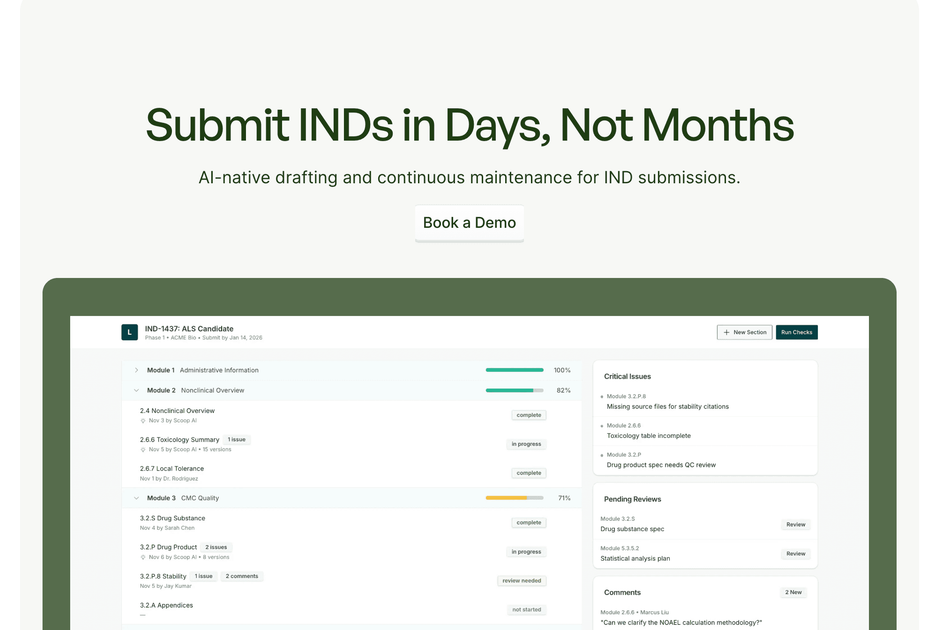
Scoop is an AI platform for pre-clinical regulatory submissions, centered on IND drafting and ongoing maintenance. The homepage positions it as a tool for teams that need to turn study and manufacturing data into submission-ready documents quickly while keeping those documents aligned with later scientific updates.
Rather than treating filings as static documents, Scoop describes a workflow that ingests source materials, drafts traceable narratives, detects conflicts across sections, and updates affected text when underlying inputs change. The product is aimed at regulatory affairs teams, CROs, and consultants that need help with module drafting, cross-referencing, and maintaining consistency over time.
Upload scientific reports, CMC packages, and supporting documents. Scoop classifies and maps the content to IND structure so the drafting workflow starts from source material rather than a blank page.
Generates submission-ready narratives and links statements back to source files, giving reviewers a path from each sentence to the underlying evidence.
Checks for conflicting values and outdated language across sections so teams can catch internal inconsistencies before they propagate through a filing.
Supports ongoing updates when new studies complete or manufacturing changes occur, then highlights affected sections and regenerates updated text.
Produces output intended to read like regulatory writing rather than generic summaries, which matters when teams need prose that can be edited into a filing workflow.
Presents an IND Sync workflow described as continuously versioned and updated, reflecting the product’s focus on living submissions instead of one-time document generation.
Teams preparing an initial IND can upload reports, CMC packages, and supporting documents, then generate submission-ready narratives mapped to the IND structure.
Regulatory teams can compare new study results or manufacturing changes against existing text, identify the affected sections, and update the filing instead of manually reconciling each module.
CROs and consultants can use the system to produce client-facing regulatory documents at scale while keeping source traceability available for review and revisions.
Reviewers can inspect conflicting values, outdated language, and source links during internal checks before a document moves into the final submission workflow.
Organizations that need help with amendments or annual reports can use the product’s maintenance-oriented workflow, though the public site does not show a dedicated module list for those document types.
Scoop is positioned as AI-native software for drafting and continuously maintaining IND-related regulatory submissions. The homepage says it converts study and manufacturing data into dynamic regulatory documents that stay aligned as the science changes.
The homepage lists regulatory affairs teams, CROs, and consultants as the primary audiences. It describes automating module drafting, formatting, cross-referencing, and client submission generation.
The site says Scoop supports ongoing maintenance after the first draft. It specifically mentions amendments and annual reports in the FAQ list, but does not provide a detailed implementation guide on the public pages.
The homepage includes an FAQ item asking whether it can integrate with existing document management or eCTD tools. The public pages do not name specific integrations or connectors.
The site’s FAQ includes a question about accuracy, and the product copy emphasizes traceability and inconsistency detection. However, the public pages do not publish a numeric accuracy claim or validation methodology.

Hurree is an AI-powered reporting and analytics platform that centralizes company data, shared dashboards, and Riva summaries, recommendations, and forecasts.

小艺 is Huawei’s AI smart assistant for Q&A, writing, document reading, code help, image recognition, and file drag-and-drop.

Arcwise is an AI product for detecting meaningful metric changes and explaining them with data-grounded analysis. It turns warehouse and business-context data into decision-ready reports in app, docs, or slides.

PC Builder AI suggests custom PC parts by budget and build type, with real-time prices for gaming and workstation builds.

LexWorkplace is a cloud-based document and email management system for law firms, helping teams organize matters, search documents and email, and manage legal workflows from Outlook.

Anara is an AI research workspace that searches your library and the web, then helps you write with cited claims and source-backed answers.