

Multi-format labeling interfaces
Annotate camera images, point clouds, and sequences in the same platform, with support for image, point cloud, and sequence interfaces.

Segments.ai is a multi-sensor data labeling platform for robotics and autonomy teams. It supports image, point cloud, and sequence annotation, plus Python SDK and API access.
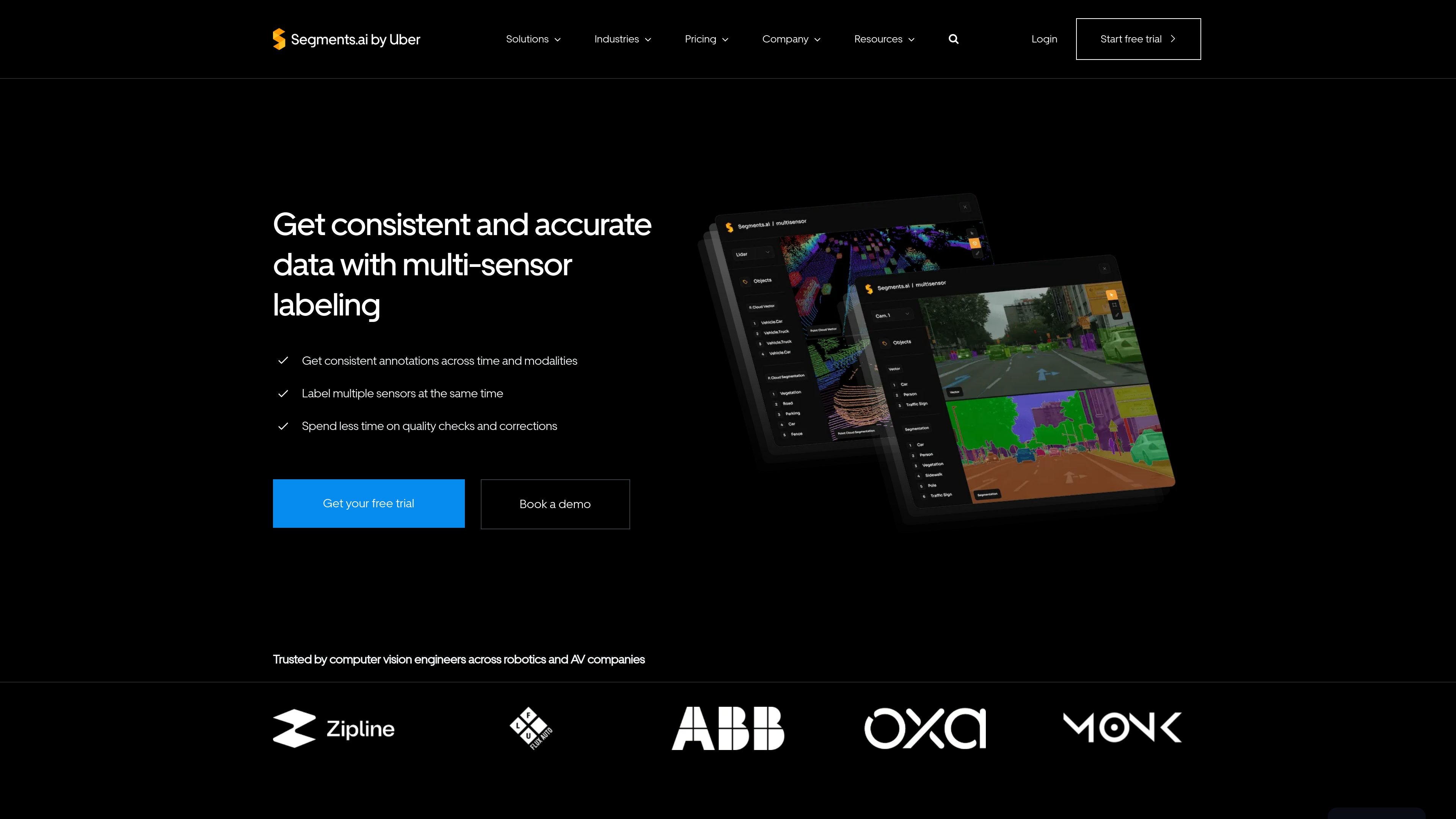
Segments.ai is a multi-sensor data labeling platform for robotics and autonomy teams, with a focus on image annotation, 3D point cloud labeling, and workflows that combine camera and LiDAR data. The product page positions it as a tool for building better datasets and accelerating the labeling process without moving away from existing ML pipelines.
The platform includes web-based interfaces for images, point clouds, and sequences, plus ML-assisted tooling, sensor fusion interfaces, and programmatic access through a Python SDK and API. Pricing is organized into Core, Fusion, and Enterprise plans, with the higher tiers adding advanced integration, security, and workflow customization options.
Annotate camera images, point clouds, and sequences in the same platform, with support for image, point cloud, and sequence interfaces.
Use ML-powered labeling tools, active learning, and model-assisted labeling pipelines to speed up annotation and improve consistency.
Manage datasets and labeling operations with QA and organization management tools, plus metrics dashboards on higher-tier plans.
Work with sensor fusion interfaces for advanced multi-sensor projects that combine image and point cloud data.
Integrate labeling into existing pipelines with a Python SDK, public API, webhooks, and cloud bucket connections.
Export labels to popular ML workflows and frameworks, with documented support for PyTorch, TensorFlow, and Hugging Face on the SDK page.
Teams building datasets for robotics or autonomy can annotate camera and LiDAR data in one place instead of splitting work across separate tools.
Computer vision teams can label 2D images with bounding boxes, segmentation, keypoints, polygons, and polylines, using ML-assisted features to reduce repetitive work.
Perception teams working with LiDAR can label point clouds, including workflows for dynamic objects and static objects described by batch mode and merged point cloud tools.
Engineering teams can connect Segments.ai to their ML pipeline with the Python SDK, API, cloud storage providers, and webhooks to automate dataset handling.
Organizations that need oversight on labeling quality can use QA and organization management tools, and higher-tier metrics dashboards, to manage the labeling process more systematically.
Segments.ai provides a 14-day free trial. The pricing page also mentions free academic licenses for students or researchers, and the team says it is open to discussing options for startups based on stage and needs.
Yes. The platform supports image, point cloud, and sequence interfaces, along with cloud bucket integrations, Python SDK and API access, and exports to popular ML workflows.
The source describes web-based labeling for 2D images and 3D point clouds, plus programmatic dataset management through the Python SDK and API. It also mentions sensor fusion interfaces for advanced multi-sensor setups.
The source highlights image annotation, point cloud labeling, and multi-sensor labeling for robotics and autonomy. It does not provide a full list of all supported annotation formats beyond examples such as bounding boxes, segmentation, keypoints, polygons, and polylines.
Segments.ai is positioned for machine learning engineers, computer vision teams, data scientists, and robotics/autonomy workflows. The pricing page also distinguishes between Core, Fusion, and Enterprise plans for different levels of setup complexity and automation.

北极九章 is an enterprise AI data insight engine for natural-language data analysis. Ask by typing or voice and get charted results in workflows.

Orca is an Agent Development Environment for shipping with coding agents, running multiple CLI agents in parallel across isolated worktrees, with desktop and mobile workflows.

GetESP analyzes CSV email lists to identify recipient ESPs and spam protection tools, helping segment lists and choose the right provider for better deliverability.

Firebase Studio is a web-based workspace for full-stack app development with Gemini-assisted coding, app previews, cloud emulators, collaboration, and browser deployment.

EZsite AI is an AI website builder that turns a URL into a fullstack React or Vue.js app with hosting, custom domains, code export, and backend features.

AI Magicx is a unified AI workspace for chat, image, video, voice, music, email and developer tasks, helping teams and creators manage multiple models in one place.