Codesphere icon

Codesphere

Reivindicar

Codesphere is a virtual cloud platform for development, deployment and operations across on-prem, cloud and hybrid infrastructure, with portability and security.

Codesphere

What Codesphere is

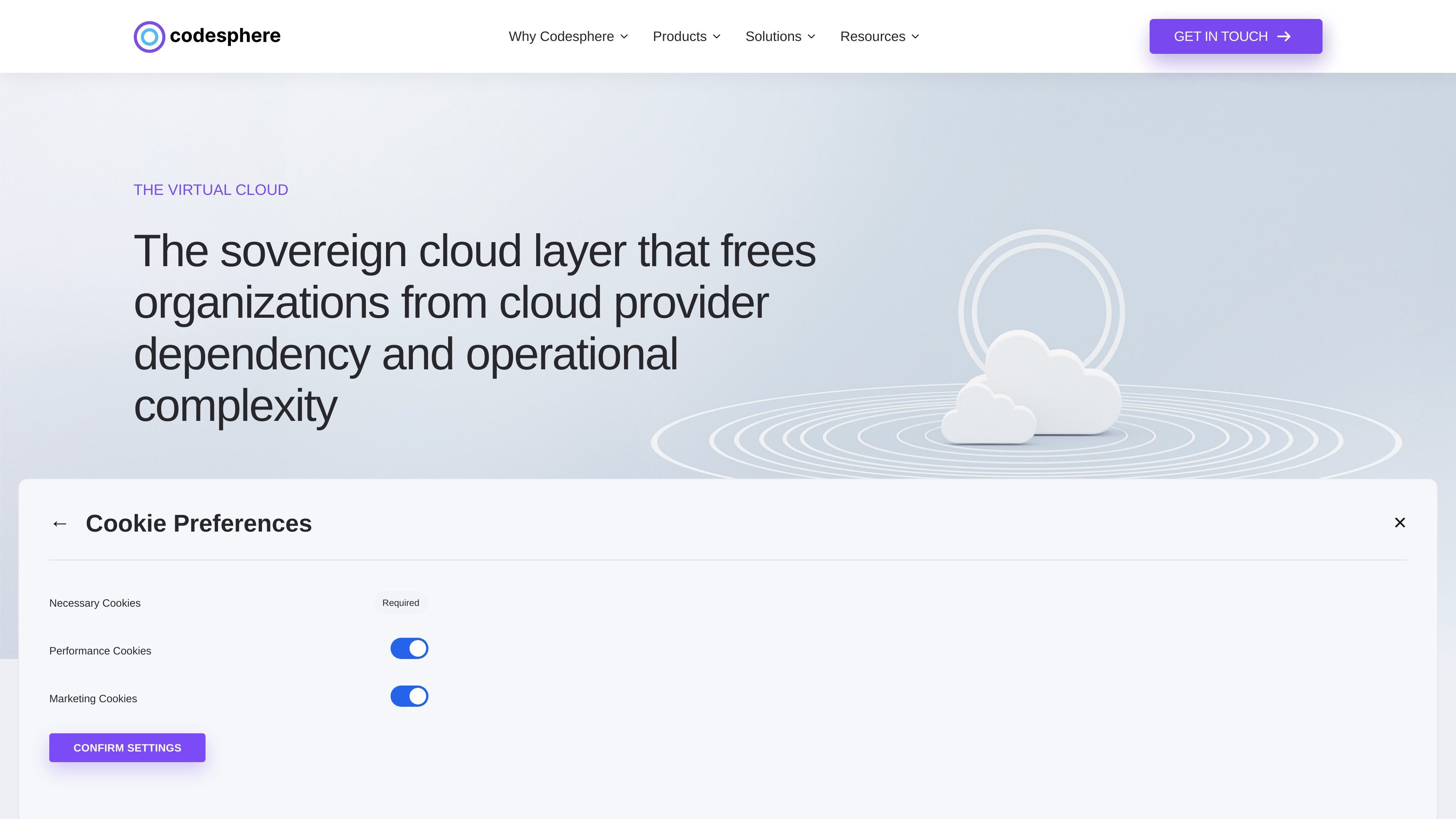
Codesphere is a virtual cloud platform for organizations that want to abstract infrastructure into a unified layer for development, deployment, and operations. The company describes it as a sovereign cloud layer that can run across on-premises, cloud, and hybrid environments, with the goal of reducing cloud-provider dependency and operational complexity.

The product is aimed at enterprises, public authorities, and technical teams working in regulated or distributed environments. Source pages emphasize portability, vendor neutrality, security controls, and standardized deployment workflows rather than a single hosted cloud service.

Core capabilities

Infrastructure abstraction layer

Codesphere’s Virtual Cloud Provider technology abstracts infrastructure across hyperscalers and on-premises systems into a unified platform, so teams can work against a single operational layer instead of separate stacks.

Deployment architecture

The platform is designed to decouple compute from runtimes and standardize network storage, which the company says reduces deployment complexity compared with fragmented infrastructure setups.

Security controls for sensitive workloads

The security page describes sandboxed execution, air-gapped options, and a zero-trust cloud environment for sensitive workloads and restricted operating environments.

Portable across deployment environments

Codesphere states that its platform can be installed on any infrastructure and supports on-prem, cloud, and hybrid environments, making portability a core capability.

Unified platform toolset

The homepage references compute and runtimes, storage and databases, networking, infrastructure as code, logging and monitoring, IAM and security, and FinOps tools as product areas under the platform.

Cost control and operational standardization

The site highlights reduced infrastructure, personnel, and license costs through standardized workflows and centralized control, with cost management described as part of the technology stack.

Common use cases

  • Multi-cloud management

    The site positions Codesphere for teams managing multiple cloud environments who want a unified front end and less provider-specific complexity.

  • On-prem and hybrid cloud operations

    Codesphere describes support for on-premises, cloud, and hybrid deployment, making it relevant for organizations that need to operate across mixed infrastructure estates.

  • Application modernization

    The homepage and solution pages highlight legacy migration and modernization, including a reference to shifting legacy infrastructure to the cloud without specialized DevOps resources.

  • Secure AI infrastructure

    The security page highlights sandboxed execution and air-gapped options, and the homepage references AI projects delivered in a heavily regulated environment.

  • Internal developer platform

    Codesphere frames the platform as a developer and operator toolset that unifies deployment technology, workspaces, integrations, and infrastructure for internal teams.

Pros and Cons

Pros

  • Can abstract infrastructure across hyperscalers and on-premises systems into a single platform layer.
  • Supports on-prem, cloud, and hybrid deployment scenarios.
  • Positions security and compliance as first-class concerns, including zero-trust, sandboxed execution, air-gapped options, ISO 27001, and SOC 2.
  • Covers the broader application lifecycle with areas for compute, storage, networking, infrastructure as code, logging, security, and cost control.
  • Designed to reduce vendor lock-in and make infrastructure more portable.

Cons

  • The public sources do not provide published pricing or plan details.
  • The pages emphasize platform abstraction and operational control, so teams still need to evaluate fit for their own infrastructure and governance requirements.

FAQ

Who is Codesphere for?

Codesphere presents the Virtual Cloud as a platform layer that can be installed on any infrastructure, including on-premises, cloud, and hybrid environments. The source positions it for teams that need sovereignty, compliance, or reduced cloud-provider dependency.

How does onboarding work?

The site describes Codesphere as a sovereign cloud layer that unifies development, deployment, and management of applications. It emphasizes deployment technology, workspaces, integrations, and infrastructure, but does not publish a step-by-step setup flow on the pages provided.

Is it suitable for regulated or air-gapped environments?

The product is positioned for regulated environments and restricted deployments. The security page calls out sandboxed execution, air-gapped options, and ISO 27001 plus SOC 2 compliance.

What do teams produce with the platform?

Codesphere says its platform can be installed on any infrastructure and can abstract hyperscalers and on-premises systems into a unified platform. The site does not publish a detailed list of exported artifacts or exact workflow outputs on the pages provided.

What does Codesphere cost?

The pricing page is not available and the site does not show public plan details in the collected sources. Based on the evidence here, pricing should be treated as not publicly disclosed.

Quick Facts

Category
Virtual cloud platform
Platform
On-prem, cloud, and hybrid infrastructure
Primary users
Enterprises, public authorities, and technical teams
Source domain
codesphere.com
Pricing
Not publicly disclosed in the provided sources
Notable workflow
Unify development, deployment, and management across infrastructure