

One-command installation
The homepage presents a single-command install flow using a shell installer, which keeps setup simple for local use.

BaseRT is a local LLM runtime for Apple Silicon. Install once, run supported models on your device, and connect a coding agent without using an external API.
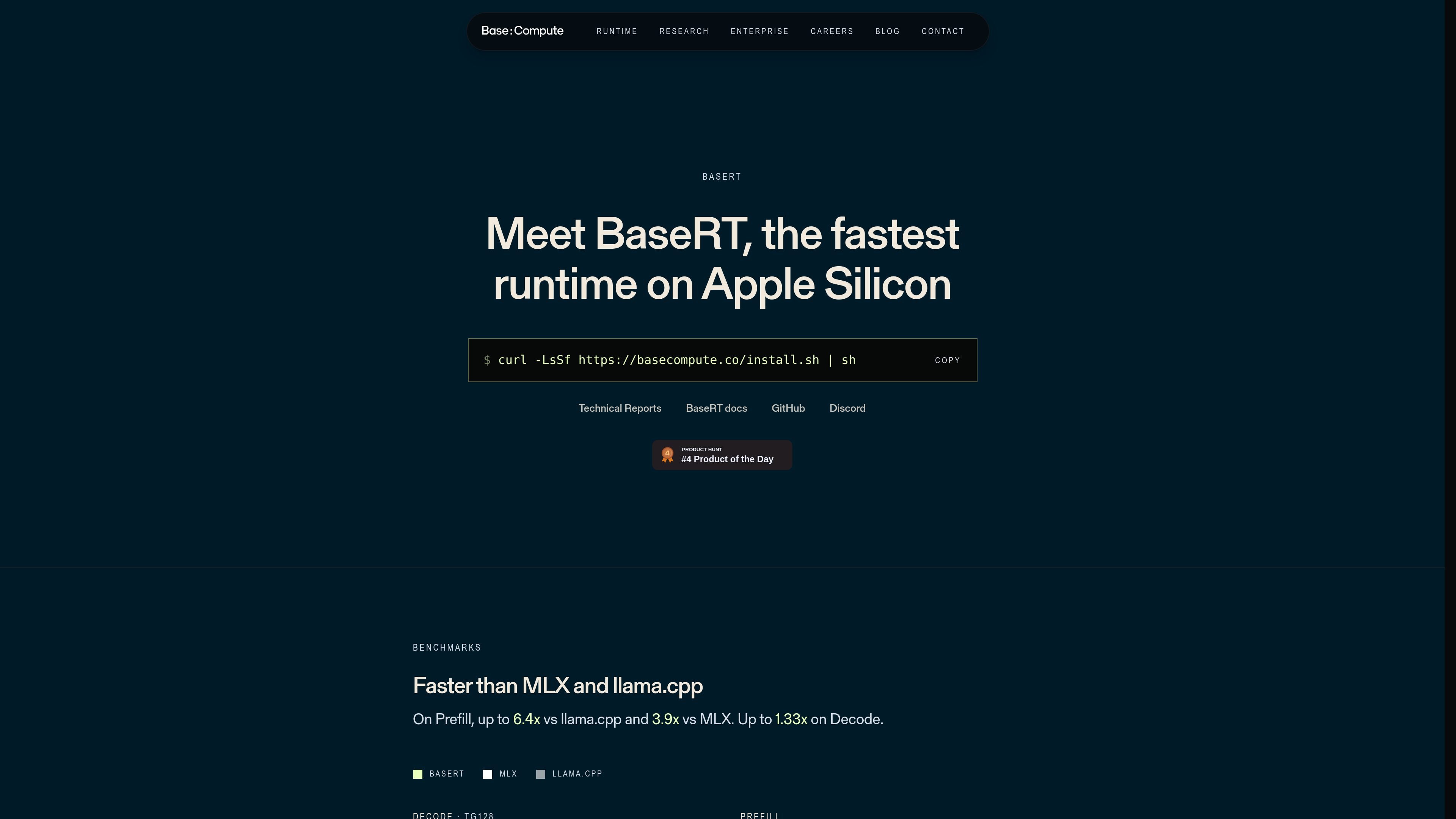
BaseRT is a local LLM runtime from Base Compute for Apple Silicon. The homepage describes it as the fastest LLM runtime on Apple Silicon and shows a one-command install flow for running models on your own device.
Its core job is to serve and run open models locally, with an emphasis on keeping inference on-device for individual developers and for coding-agent workflows. The product page specifically shows a local model being served and then connected to a coding agent without sending data to an external API.
Base Compute’s research page frames BaseRT as a native Metal inference runtime for Apple Silicon, with technical reports focused on throughput gains over llama.cpp and MLX. The enterprise page extends that on-device approach to teams that want AI on hardware they already own.
The homepage presents a single-command install flow using a shell installer, which keeps setup simple for local use.
BaseRT is described as a native Metal inference runtime built for Apple Silicon, with technical reports explaining that it uses chip-specific kernel fusion and custom dispatch logic.
The product page says BaseRT can serve a model locally and then be used by a coding agent on the same machine, keeping prompts and outputs on-device.
The homepage lists supported model families including Qwen3, Qwen3.5, Qwen3.6, Llama 3.1, Llama 3.2, Gemma 3, Gemma 4, Mistral, Phi-3, and Nomic BERT.
The research page states support for a wide range of model families across eight quantisation formats from Q2 to FP16 on Apple M-series devices.
The site provides links to technical reports, docs, GitHub, and Discord, which gives users a path for deeper implementation details and community support.
Developers can run a coding agent against a model served on their own Mac, keeping the full loop local instead of routing prompts through a hosted API.
Individuals who want to experiment with open models on Apple Silicon can install BaseRT quickly and run inference on their own machine.
Engineering teams can use the enterprise workflow to evaluate how local AI fits into their existing laptop and workstation fleet before adopting it more broadly.
Organizations handling sensitive material can keep AI-assisted drafting, summarization, or analysis on-device to avoid sending data to a third-party service.
Teams focused on performance can use the research and benchmark material to compare BaseRT with llama.cpp and MLX on Apple hardware.
BaseRT is installed from the command line with a one-line install script shown on the product page. After installation, you can serve a supported model locally and point a coding agent at that server.
The homepage highlights local coding-agent workflows and says BaseRT is for people building on-device AI with open source models. The enterprise page also positions it for organizations that want AI on laptops and workstations they already own.
BaseRT supports local model serving on Apple Silicon, and the research page says it supports a wide range of model families across Apple M-series devices. The homepage lists Qwen3, Qwen3.5, Qwen3.6, Llama 3.1, Llama 3.2, Gemma 3, Gemma 4, Mistral, Phi-3, and Nomic BERT as supported models.
The source does not document a public pricing page for BaseRT. The pricing URL currently returns a 404, so pricing and plan details are not verified from the available evidence.
The product pages focus on Apple Silicon and Apple M-series devices. The enterprise page mentions Windows and Linux workstations as general on-device AI hardware, but the BaseRT runtime itself is presented on the site as an Apple Silicon runtime.
Данные о трафике приведены только для справки.
Аналитика трафика пока недоступна.

AakarDev AI helps teams manage AI provider access, project setups, logs, and analytics in one dashboard with BYOK support.

Orca is an Agent Development Environment for shipping with coding agents, running multiple CLI agents in parallel across isolated worktrees, with desktop and mobile workflows.

AI Magicx is a unified AI workspace for chat, image, video, voice, music, email and developer tasks, helping teams and creators manage multiple models in one place.

Paper is a design tool that connects canvas, code, and AI agents so teams can create, share, and ship work in one workflow. Includes desktop app and MCP access.

blop is a QA agent that writes browser tests as code in your repo, runs them in CI, clusters repeated failures, and can open PRs to fix broken tests.

RLAMA is a local AI platform for building RAG systems and intelligent agents on macOS, Linux, and Windows, with HTTP API support.