

Side-by-side model comparisons
Users submit a prompt and the platform runs it through several AI models so the results can be judged against one another rather than in isolation.

Design Arena is a web-based benchmark for AI-generated design. Compare model outputs side by side and vote on the strongest result.
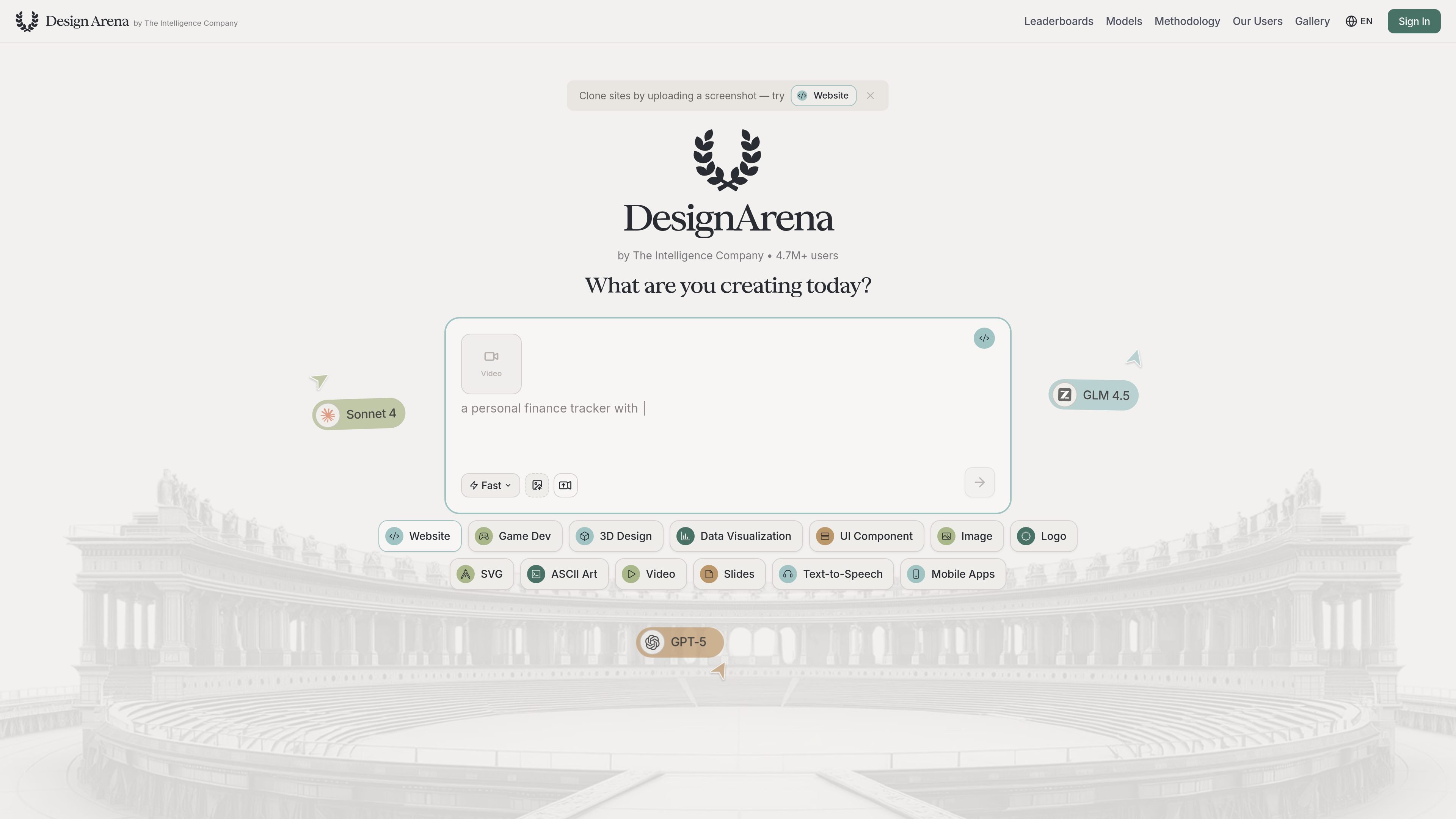
Design Arena is a crowdsourced benchmark for AI-generated design. It gives the same prompt to multiple models, shows their outputs side by side, and lets users vote on which result is strongest.
The site positions itself as a way to evaluate design capability through community judgment rather than curated examples. Leaderboards are updated from pairwise votes, and the methodology page explains that model rankings are derived from those comparisons using a Bradley-Terry framework.
Users submit a prompt and the platform runs it through several AI models so the results can be judged against one another rather than in isolation.
The methodology page describes a tournament structure with initial pairings, winners and losers brackets, and a final ranking that produces a complete ordering of the four models in each session.
Model identities stay hidden during evaluation, which is intended to reduce brand bias and keep attention on the design output.
Votes from the community update the leaderboards directly, so each pairwise comparison contributes to the ranking data.
The methodology page says rankings are calculated with the Bradley-Terry model, using pairwise comparison data and win rates to estimate model strength.
The models page exposes per-model details such as overall win rate, input cost, output cost, context window, and maximum output tokens.
Product teams can compare several model outputs from the same prompt to see which one produces the most usable design direction for a website, app, or interface task.
People building on AI design tools can review leaderboards, win rates, and model specs to choose a model that fits their task and token budget.
Researchers and practitioners can use the public methodology to understand how the benchmark works and what the voting process measures.
Community members can cast votes on anonymous side-by-side results and contribute to the rankings without needing technical setup.
Users interested in the current landscape of AI-generated design can browse the site's prompt categories and model pages to see which kinds of tasks are being benchmarked.
Design Arena uses community voting to compare AI-generated design outputs from multiple models. The methodology page describes a tournament format in which prompts are sent to four models, their results are compared pairwise, and the votes feed leaderboard calculations.
The site presents Design Arena as a crowdsourced benchmark for AI-generated design. It covers design-related outputs such as websites, game development, mobile apps, UI components, slides, and other prompt categories shown on the homepage and users page.
The methodology page says all methodologies are open for community review and feedback, and it provides a contact email at `[email protected]` for inquiries.
The public sources show browsing pages for leaderboards, models, methodology, and users, but they do not document any integrations, export options, or API access.

Paper is a design tool that connects canvas, code, and AI agents so teams can create, share, and ship work in one workflow. Includes desktop app and MCP access.

Superside is an AI-powered creative service for enterprise and in-house teams, with global talent, AI-first workflows, and subscription-based support.

Framer is an AI website builder for professional sites. It helps teams design, manage CMS content, optimize SEO, collaborate, and publish from a single no-code workflow.

My QR Code is a web-based QR code generator for links, vCards, files and more, with design customization, export formats and scan tracking.

Dropmagic is an AI Shopify store builder that creates branded storefronts from source products with AI copy, images and design. Launch faster without coding.

SlideSpeak is an AI presentation maker that turns prompts and source files into editable PowerPoint decks. It also redesigns slides, translates, summarizes, and supports branding and video presentations.