

Unified live data layer
Combines claims, EHR, pharmacy, labs, ADT, telephony recordings, and payer file drops into one canonical member or patient record so different teams work from the same source of truth.

Pelica Health provides an AI workforce for value-based care teams, combining a shared data layer, role-specific copilots, and action tools for outreach, documentation, and review. It helps organizations coordinate quality, risk adjustment, pharmacy, and care management work from one record.
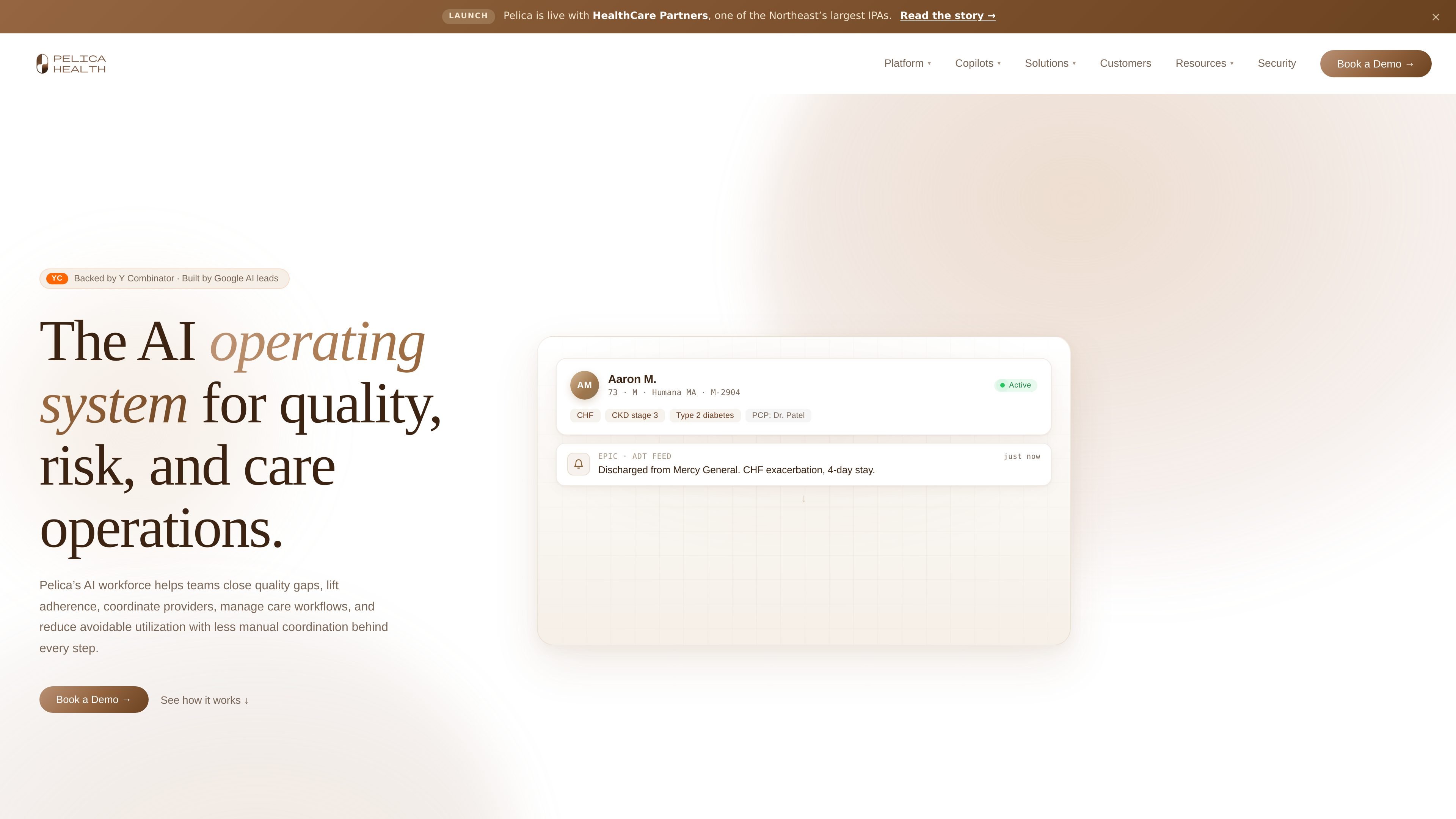
Pelica Health is an AI workforce for value-based care operations. The site positions it as an operating system for quality, risk, and care teams that need to work from one canonical record instead of separate spreadsheets, portals, and vendor tools.
The product combines a live data layer, role-specific AI copilots, and action tools for outreach, documentation, and review. In the source examples, that means surfacing HCCs at the point of care, closing quality and pharmacy gaps, coordinating providers, and helping care teams reduce manual coordination across the workflow.
Combines claims, EHR, pharmacy, labs, ADT, telephony recordings, and payer file drops into one canonical member or patient record so different teams work from the same source of truth.
Provides role-specific copilots for risk adjustment, quality and Stars, pharmacy and Part D, provider network, and care management, plus an AI Data Analyst for plain-English analysis and SQL generation.
Surfaces suspected HCCs, quality gaps, and other opportunities while the member is still in scope, with V28-aware trumping and RADV-defensible documentation attached to captures.
Moves work into action through outbound voice, SMS, EMR overlays such as Epic SMART-on-FHIR and Athena marketplace, a portal, and a coder workspace for encounter and claim review.
Builds ranked worklists and rebalances them as new reports arrive, so teams can prioritize outreach, review the highest-value opportunities first, and avoid duplicate work across functions.
Risk teams use the platform to compare claims against charts, surface suspected HCCs during the care window, and keep documentation attached for RADV defensibility.
Quality and Stars teams use one ranked worklist to close care gaps, coordinate outreach, and reduce duplicate calls across teams working from different systems.
Pharmacy teams use the shared record to support adherence work and Part D gap closure, while updates flow back to other copilots and projections.
Care management teams use ADT-driven worklists, follow-up planning, and outreach support to coordinate post-discharge and transition-of-care tasks.
Provider network teams use EMR overlays and provider-facing actions to surface care already delivered and capture credit closer to the point of care.
Pelica is designed for value-based care teams that need to coordinate quality, risk adjustment, pharmacy, care management, and provider workflows from one shared record. The source shows use across health plans, IPAs/MSOs, ACOs, and risk-bearing medical groups.
The source describes a deployment that uses live data from claims, EHR, pharmacy, labs, ADT, telephony recordings, and payer SFTP drops. It presents those inputs as part of a canonical record that multiple copilots can read and write.
Pelica includes role-specific copilots and action surfaces such as outbound voice, EMR overlays, a provider and staff portal, and a coder workspace. The goal is to move work from analysis into outreach, documentation, and review.
The customer story says HealthCare Partners went live in about two weeks, and the risk-adjustment page gives a similar two-week go-live claim. The site also says Pelica deploys forward by embedding with the team and learning the workflow.
The customer story states that Pelica is HIPAA compliant and SOC 2 Type II, with tenant isolation, end-to-end encryption, a full audit trail, and zero-retention agreements with LLM providers. It also notes that HITRUST certification is in progress.

TakeCareOS is a web platform for home care, disability, and aged care agencies, with rostering, billing, compliance, and AI admin tools.
Twine AI Launcher is an Android launcher with AI assistant access, bringing ChatGPT-style help to your homescreen for quick answers, notes, tasks, reminders, and people memory.

AI Magicx is a unified AI workspace for chat, image, video, voice, music, email and developer tasks, helping teams and creators manage multiple models in one place.

阶跃AI is a personal efficiency assistant from 阶跃星辰 for knowledge search, writing, coding, and daily automation. Download on desktop and mobile, and trigger web, files, and reminders by voice.

Speakflow online teleprompter for writing and organizing scripts, voice scrolling, team collaboration, and cross-device syncing. Free and paid plans available.

CREAO is an AI agent platform for turning recurring business work into reusable workflows, with schedules, approvals, and tool integrations.