

Idea discovery with evidence summaries
Browse a large list of business ideas with signal counts, opportunity scores, and short evidence excerpts so you can narrow a longlist quickly.

Trend Seeker is a business-idea research platform for AI, SaaS, and app ideas, backed by signals from Reddit, job ads, podcasts, and communities.
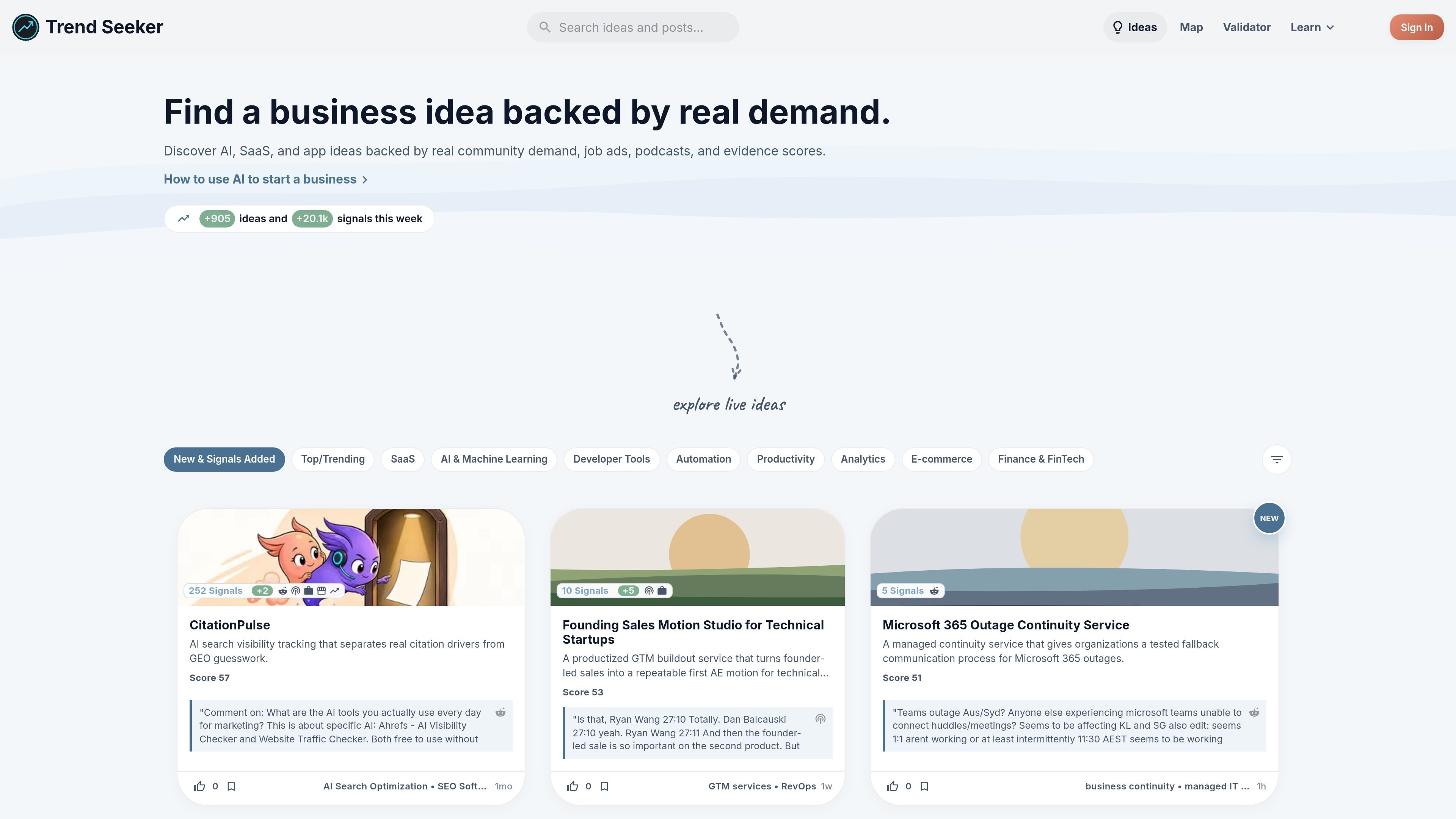
Trend Seeker is a business-idea research platform that helps users find and compare opportunities backed by real market signals. The site focuses on AI, SaaS, app, and related ideas, and presents each idea with signal counts, opportunity scores, and short evidence excerpts so readers can assess demand before they build.
The product’s main job is to reduce guesswork in early-stage idea selection. Instead of relying only on broad trend claims, it surfaces ideas from sources such as Reddit, job ads, podcasts, communities, and Google Trends-style demand signals, then organizes them into individual idea pages and a semantic Demand Map for comparison and exploration.
Browse a large list of business ideas with signal counts, opportunity scores, and short evidence excerpts so you can narrow a longlist quickly.
Open an individual idea page to see the problem statement, potential solution, market analysis, and market-validation signals tied to that idea.
Review where signals cluster across the site’s semantic map, including problem regions, cluster names, and relative evidence strength.
Compare signals from multiple source types shown on the site, including Reddit, job ads, podcasts, communities, and trend data.
Use opportunity score and evidence-strength fields as a screening layer before spending time on deeper research or execution.
A founder can scan AI, SaaS, and app ideas, then use the evidence snippets and opportunity scores to decide which opportunities deserve deeper research.
A product team can compare multiple candidate problems side by side and use the evidence fields to prioritize the ones with stronger market signals.
A builder can use the Demand Map to find dense problem clusters, identify adjacent opportunities, and spot areas with stronger or weaker evidence.
A researcher can open a specific idea page to understand the stated problem, proposed solution, and the signals that support the market thesis.
Trend Seeker is a business-idea discovery tool that surfaces AI, SaaS, app, and other product ideas from real market signals. The site shows ideas with opportunity scores, evidence strength, and source signal excerpts so users can compare demand before building.
The product is aimed at founders, product teams, and builders who want to evaluate ideas using evidence from sources such as Reddit, job ads, podcasts, communities, and Google Trends-style signals shown on the site.
The rendered pages show idea lists, individual idea analysis pages, and a Demand Map that clusters ideas by problem region and signal density. Users can browse ideas, inspect the evidence behind them, and explore where demand is concentrated.
The available pages do not show a pricing breakdown, and the pricing URL currently returns a not found error in the collected sources. That means the access model is not confirmed from the evidence provided here.

Predictice is a legal research and analysis platform for legal professionals, with jurisprudence search, litigation analysis, assistant tools and document audit workflows.

GetESP analyzes CSV email lists to identify recipient ESPs and spam protection tools, helping segment lists and choose the right provider for better deliverability.

NameSnack is a free business name generator that finds brandable names, checks domain availability, and offers a logo maker and naming guides.

Rayyan is an AI-powered platform for systematic and literature reviews, helping teams manage screening, extraction, bias assessment and reporting in one shared workflow.

Finlo is a web-based stock portfolio platform with curated, strategy-based portfolios, monthly updates, and premium research tools for long-term investors.

Anara is an AI research workspace that searches your library and the web, then helps you write with cited claims and source-backed answers.