

Unified model access
Connect OpenAI, Claude, Gemini, Groq, Mistral, and other model providers through one gateway so applications can use chat, completion, embedding, and reranking models with a consistent API.

TrueFoundry is an enterprise AI gateway and MCP gateway platform for deploying, governing, and observing LLM and agent workloads. It helps teams manage model access, routing, compliance, and deployment across SaaS or private infrastructure.
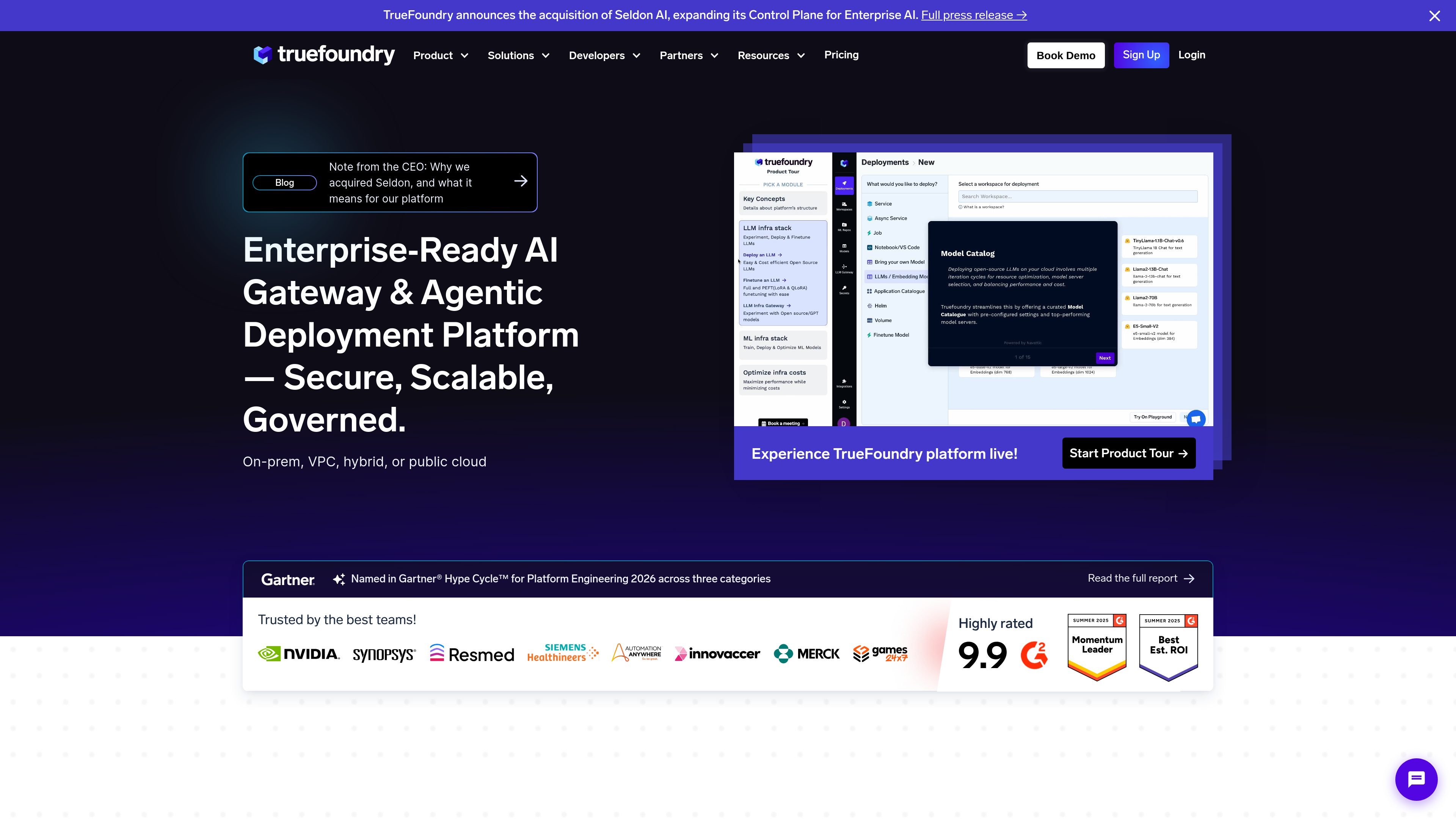
TrueFoundry is an enterprise AI gateway and MCP gateway platform for teams that need to deploy, secure, govern, and observe LLMs and agentic workloads. The site presents it as a unified control layer for model access, routing, tool orchestration, prompt management, and production deployment across enterprise environments.
The platform is positioned for organizations running AI at scale across cloud, VPC, on-prem, or air-gapped infrastructure. It supports model routing, access control, observability, compliance-oriented logging, and deployment workflows for models, MCP servers, and agents built with frameworks such as LangGraph, CrewAI, or AutoGen.
Connect OpenAI, Claude, Gemini, Groq, Mistral, and other model providers through one gateway so applications can use chat, completion, embedding, and reranking models with a consistent API.
Apply rate limits, RBAC, budget controls, cost-based quotas, and policy filters to control who can use models, endpoints, and agent workloads.
Monitor token usage, latency, error rates, request volume, and request/response logs from one place, with metadata tags for user, team, or environment.
Route traffic with latency-based, priority-based, fallback, and weight-based policies to reduce disruption when providers are slow or unavailable.
Deploy in SaaS, VPC, on-prem, or air-gapped environments, with options for the control plane, gateway plane, or both.
Use the platform for agents, MCP servers, prompt management, and model serving so teams can manage infrastructure and workflows in one system.
Centralize access to many LLM providers behind one API, so application teams can switch models, manage keys, and apply consistent governance without rebuilding integrations.
Set usage limits, routing rules, and policy controls for teams or services that need predictable spend and controlled access to production models.
Deploy agents with tool access, memory, and orchestration through MCP servers and an agents registry, with isolation by team or project.
Track requests, latency, errors, token usage, and logs to troubleshoot model behavior, review outputs, and maintain an audit trail for regulated environments.
Run deployments in VPC, on-prem, or air-gapped infrastructure when data residency or internal security requirements prevent public-cloud-only operation.
TrueFoundry’s pricing page says the platform offers a 7-day free trial, with paid plans after that. The plan structure also includes a Developer tier, usage-based Pro and Pro Plus tiers, and an Enterprise tier with custom pricing.
Yes. The pricing page states that Enterprise supports full VPC and air-gapped installations for both the control plane and gateway plane. The overview page also says the platform can run on-prem, in VPC, hybrid, or public cloud environments.
The site describes AI Gateway as the control layer for managing model access, routing, guardrails, observability, and policy enforcement across many models. It is intended for enterprise teams that want a single interface for LLM use across applications and teams.
The MCP Gateway page and homepage describe it as a way to provision and manage Model Context Protocol infrastructure for agents, including server deployment, traffic control, rate limits, and isolation by team or project. The homepage also references an MCP & Agents Registry for tools and APIs.
The source material does not describe a single-click setup flow, but it does say users can try a live environment immediately from the website without a credit card. The platform also offers setup assistance on paid plans and dedicated onboarding for Enterprise.

Kastra authorization infrastructure for AI systems checks prompts, tool calls, shell commands, API requests, and browser actions before execution.

Orca is an Agent Development Environment for shipping with coding agents, running multiple CLI agents in parallel across isolated worktrees, with desktop and mobile workflows.

AI Magicx is a unified AI workspace for chat, image, video, voice, music, email and developer tasks, helping teams and creators manage multiple models in one place.

Paper is a design tool that connects canvas, code, and AI agents so teams can create, share, and ship work in one workflow. Includes desktop app and MCP access.
blop is a QA agent that writes browser tests as code in your repo, runs them in CI, clusters repeated failures, and can open PRs to fix broken tests.

RLAMA is a local AI platform for building RAG systems and intelligent agents on macOS, Linux, and Windows, with HTTP API support.