

Multiple agent API modes
Build end-to-end, voice-to-video, or voice-only agent flows through the published API options, depending on whether you need a full video conversation or a narrower audio-first experience.

TruGen AI is a platform for real-time conversational video agents with expressive avatars, vision context, and API workflows for branded customer interactions.
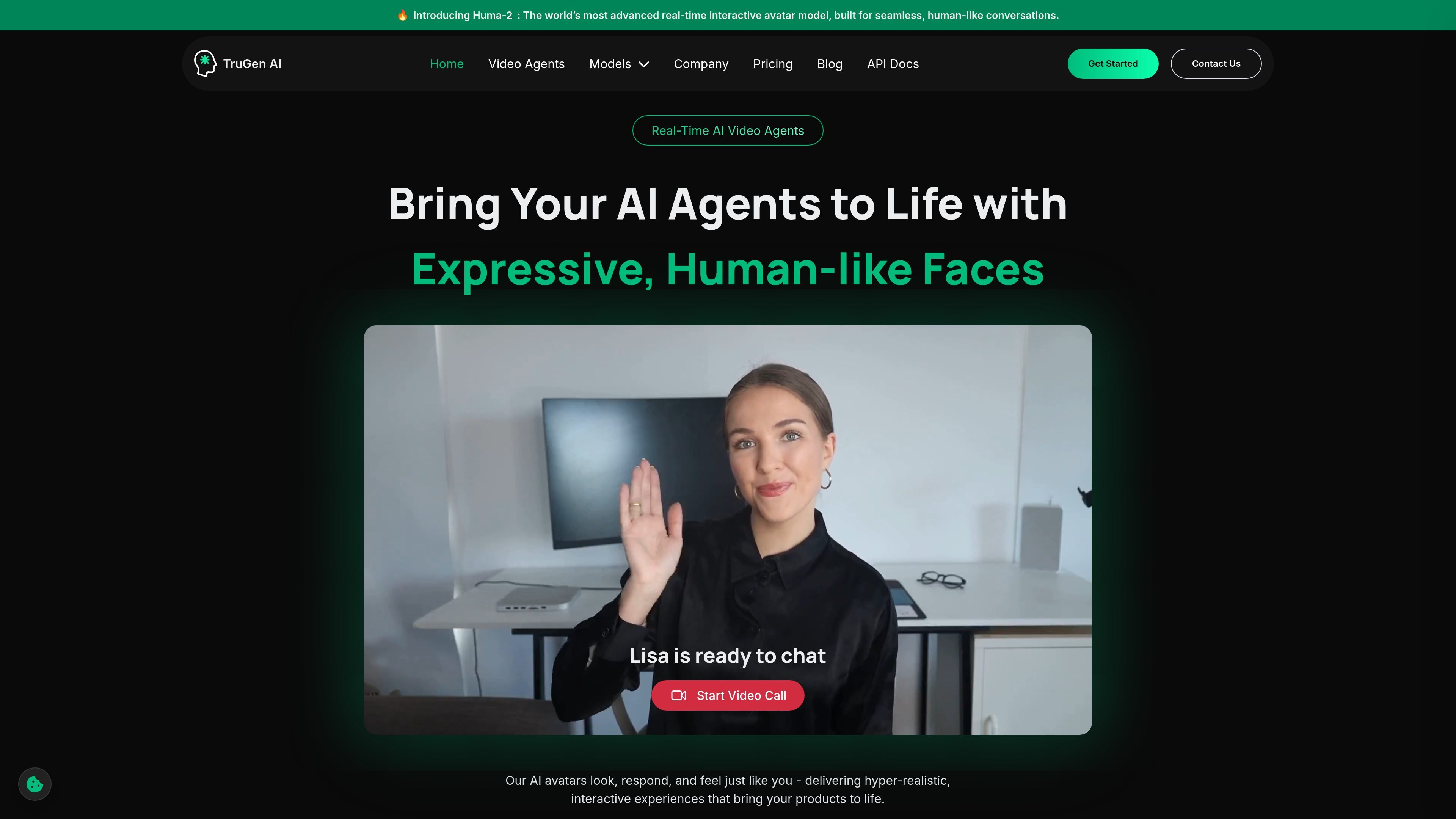
TruGen AI is a platform for building conversational AI video agents that speak, react, and act in real time. The site positions it for teams that want lifelike, branded video agents rather than text-only chatbots or voice agents.
The product combines avatar generation, vision-based context recognition, and API-driven workflows. TruGen says its agents can be launched through white-label APIs, connected to company knowledge and external systems, and used across self-serve plans or custom enterprise deployments.
The website also highlights two foundation models that underpin the system: Huma-2 for avatar generation and Hawkeye-1 for vision and action recognition. Together, they support real-time interactions designed to feel natural, context-aware, and visually expressive.
Build end-to-end, voice-to-video, or voice-only agent flows through the published API options, depending on whether you need a full video conversation or a narrower audio-first experience.
Generate expressive avatars with Huma-2, which the site describes as a real-time avatar model with full-face rendering and emotional control.
Use Hawkeye-1 for vision-based context and action recognition so agents can respond to what they see, not only what they hear.
Connect agents to company data, docs, and APIs so responses can be grounded in existing knowledge rather than generic text.
Deploy with built-in integrations for LiveKit Agent, n8n, and Make to fit existing communication and automation workflows.
Teams can create branded video agents that answer questions and interact with customers in a face-to-face style, using white-label APIs to keep the experience aligned with the product brand.
Product and support teams can connect agents to internal docs, data, and APIs so replies stay grounded in company knowledge instead of generic responses.
Businesses that need more than speech can use vision-based recognition to trigger interactions from what the agent sees through a webcam or other real-time visual input.
Operations teams can connect TruGen workflows to n8n or Make to automate downstream actions after an agent conversation.
Organizations that need higher-touch deployments can use the enterprise plan for custom support, white-labeling, scaling discounts, and dedicated integration help.
TruGen AI provides APIs and models for building conversational video agents. The site shows an end-to-end agent API as well as voice-to-video and voice-only API options, so teams can choose the workflow that fits their application.
The pricing page shows Free, Starter, Pro, Scale, and Enterprise plans. The lower tiers are self-serve, while Enterprise is custom and includes contact-sales support, scaling discounts, white-labeling, and dedicated integration help.
The site presents TruGen AI as a fit for real-time conversational experiences, including branded customer-facing agents, automated video interactions, and virtual meeting workflows through integrations and the higher-tier meeting add-on.
Huma-2 focuses on avatar generation and expressive conversation, while Hawkeye-1 focuses on vision-based context and action recognition. The product pages describe them as complementary models used together in TruGen’s video-agent stack.
Yes. The site lists built-in support for LiveKit Agent, n8n, and Make, and also shows an API endpoint for conversations along with documentation links.

Orca is an Agent Development Environment for shipping with coding agents, running multiple CLI agents in parallel across isolated worktrees, with desktop and mobile workflows.

Rizzle turns articles into editorial-grade video and distributes it across major channels with AI-assisted, human-reviewed workflows for publishers.

AI Magicx is a unified AI workspace for chat, image, video, voice, music, email and developer tasks, helping teams and creators manage multiple models in one place.

Paper is a design tool that connects canvas, code, and AI agents so teams can create, share, and ship work in one workflow. Includes desktop app and MCP access.

CREAO is an AI agent platform for turning recurring business work into reusable workflows, with schedules, approvals, and tool integrations.

blop is a QA agent that writes browser tests as code in your repo, runs them in CI, clusters repeated failures, and can open PRs to fix broken tests.