

Private EU-based inference
Serve open-weight coding models from EU infrastructure with zero request retention and no training on customer data.

Zro is a private inference endpoint for coding agents on EU infrastructure, with OpenAI-compatible and Anthropic-compatible requests plus launcher setup.
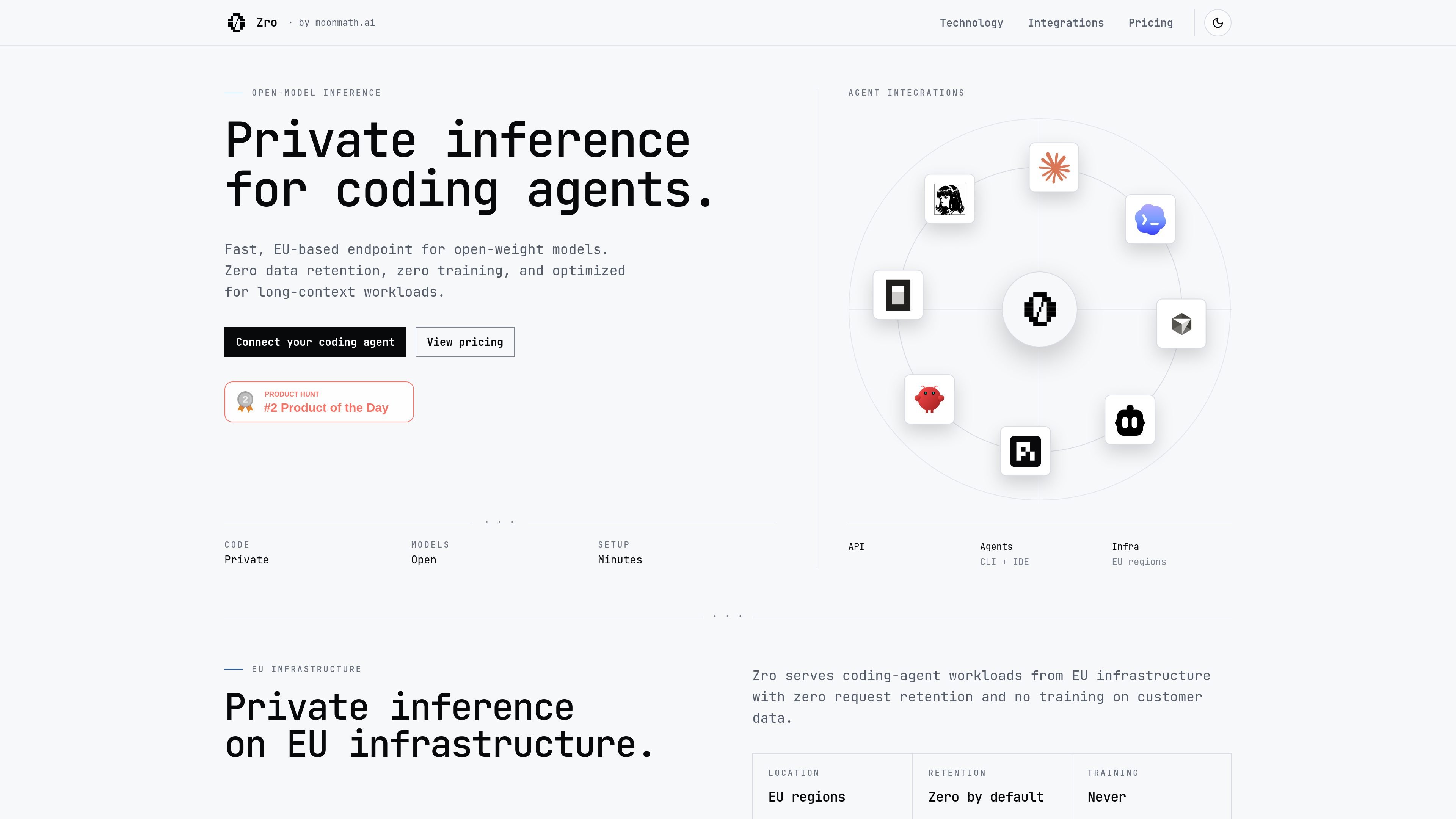
Zro is a private inference endpoint for coding agents. It serves open-weight coding models on EU infrastructure and is positioned for developer tools that need responsive inference without retaining request bodies.
The product combines an API layer and a launcher layer. Developers can point compatible clients at Zro directly, or use the @moonmath-ai/zro package to launch supported tools such as Claude Code and Codex CLI with temporary session configuration. The site emphasizes zero request retention, no training on customer data, and support for long-context, multi-turn coding workflows.
Serve open-weight coding models from EU infrastructure with zero request retention and no training on customer data.
Use the endpoint as OpenAI-compatible chat completions or Anthropic-compatible Messages requests, which lets existing tools connect without a new API shape.
Launch supported tools through the @moonmath-ai/zro npm package with session-scoped configuration, so the launcher can set up the provider and then clean up after exit.
Work with long-context coding sessions using models that advertise large context windows, including MiniMax M3 and GLM-5.2.
Route requests through Zro's own launcher setup, which disables vendor telemetry and analytics for launcher-supported tools and only sends web-search queries when search is used.
Choose from a small set of live models now, with additional open coding models listed as coming soon.
Point an existing OpenAI-compatible or Anthropic-compatible client at Zro when you want private inference without rewriting your agent stack.
Use the launcher to start Claude Code, Codex CLI, OpenCode, Hermes, OpenClaw, Pi, or Codex App with temporary session configuration and no persistent vendor telemetry.
Choose MiniMax M3 for long-context chat-style coding sessions or GLM-5.2 for agentic coding and tool-heavy workflows, depending on the task shape.
Set up Cursor or Cline manually when you want those tools to call Zro directly through the OpenAI-compatible base URL.
Use usage packs when you need a one-time budget for experiments, prompt tuning, evals, or bursty agent runs without committing to a subscription.
Zro provides private inference for coding agents through an endpoint that supports OpenAI-compatible chat completions and Anthropic-compatible Messages requests. The integrations page also describes launch paths for supported tools through the Zro CLI launcher.
Yes. The source says Zro exposes OpenAI-compatible access for chat completions and Anthropic-compatible Messages requests at /v1/messages, so existing clients can point to the Zro base URL where supported.
The integrations page documents launcher support for Claude Code, Codex CLI, OpenCode, Hermes, OpenClaw, Pi, and Codex App. Cursor and Cline are shown with manual OpenAI-compatible setup instructions.
Zro does not retain prompt or completion bodies by default after inference is processed, and customer prompts and completions are not used for training, fine-tuning, evaluations, analytics, or dataset creation.
Zro runs inference on privacy-forward EU infrastructure. The site names Finland and France as current regions.

Orca is an Agent Development Environment for shipping with coding agents, running multiple CLI agents in parallel across isolated worktrees, with desktop and mobile workflows.

Firebase Studio is a web-based workspace for full-stack app development with Gemini-assisted coding, app previews, cloud emulators, collaboration, and browser deployment.

RLAMA is a local AI platform for building RAG systems and intelligent agents on macOS, Linux, and Windows, with HTTP API support.

AakarDev AI helps teams manage AI provider access, project setups, logs, and analytics in one dashboard with BYOK support.

AI Magicx is a unified AI workspace for chat, image, video, voice, music, email and developer tasks, helping teams and creators manage multiple models in one place.

Paper is a design tool that connects canvas, code, and AI agents so teams can create, share, and ship work in one workflow. Includes desktop app and MCP access.