


Multi-source ingestion
Ingests files, text, URLs, feeds, and connected accounts, including PDFs, audio, video, web pages, Slack messages, email, and knowledge base sources.
Graphlit is a context layer for AI agents and applications that need to work with organizational knowledge instead of isolated chat memory. It combines ingestion, extraction, search, chat, and knowledge graph workflows behind a single API.
The product is designed to bring content from files, web pages, messages, storage systems, and business tools into a searchable context layer. The site emphasizes real-time or continuous sync, provenance, and grounded answers so agents can use source-backed information rather than static prompts or ad hoc glue code.
Ingests files, text, URLs, feeds, and connected accounts, including PDFs, audio, video, web pages, Slack messages, email, and knowledge base sources.
Supports preparation, extraction, and enrichment workflows, with built-in transcription, OCR, embeddings, and completions.
Provides semantic search, keyword search, and hybrid search, plus source-grounded conversations with citations for retrieval-augmented use cases.
Extracts entities, observables, relationships, and temporal state to build organizational knowledge graphs rather than simple document indexes.
Connects to tools such as Slack, GitHub, Jira, Notion, Google Drive, S3, Gmail, Dropbox, and more, with continuous sync mentioned in the product messaging.
Offers SDKs and an MCP server for developer workflows, including TypeScript, Python, and .NET support and access from tools such as Claude, Cursor, and ChatGPT on higher plans.
Build assistants that answer from company knowledge with source citations, multi-turn memory, and retrieval over documents, messages, and connected apps.
Sync and search operational content from tools like Slack, GitHub, Jira, Notion, and email so teams can find context without manual ETL.
Extract people, companies, relationships, events, and ownership from content to support graph queries and relationship-aware applications.
Process PDFs, web pages, audio, video, and office files through ingestion, transcription, OCR, and enrichment pipelines for downstream AI use.
Connect external data sources to AI agents through MCP and SDKs so apps can retrieve context and trigger actions from familiar developer tools.
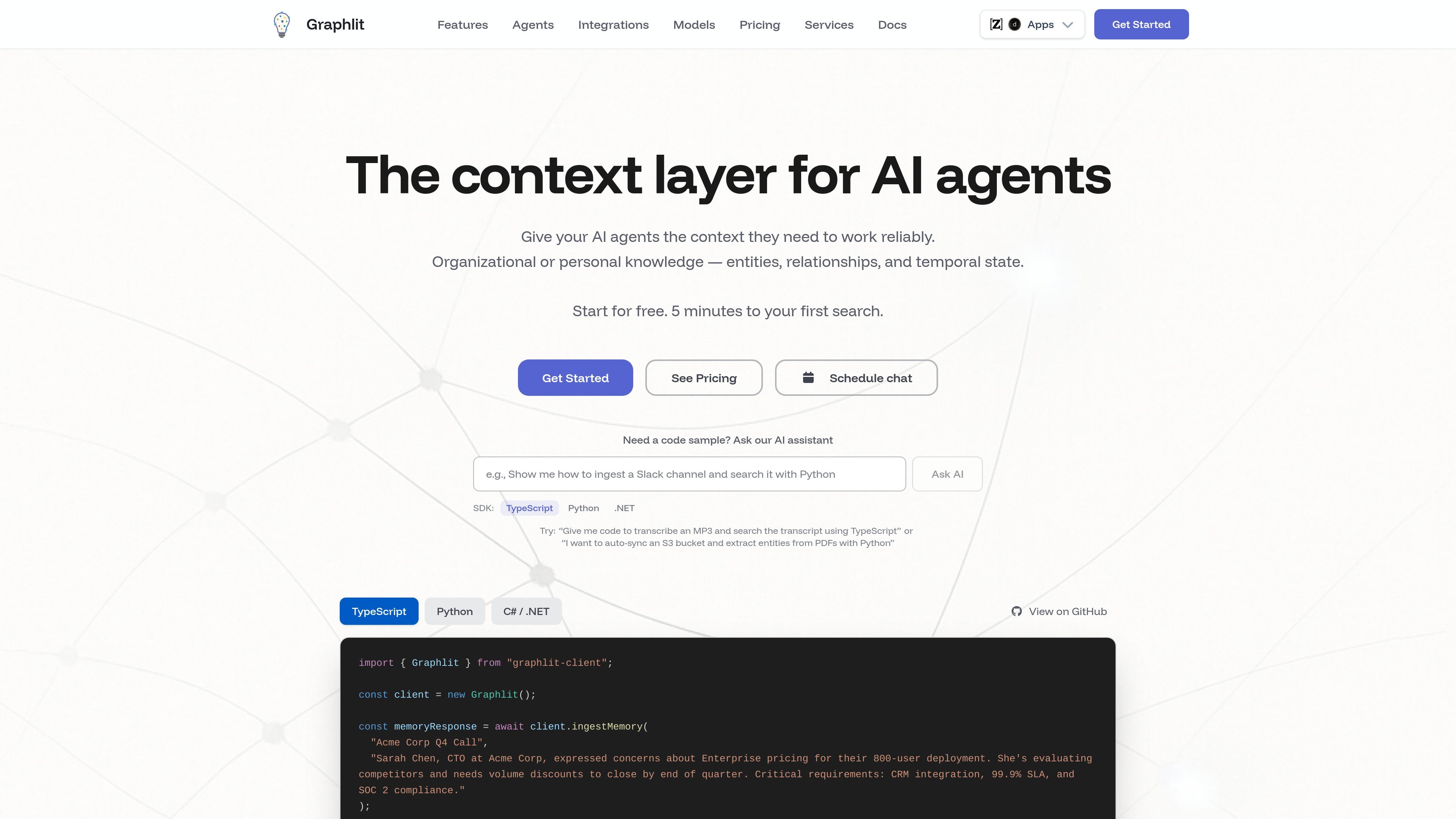
Graphlit is used to ingest content, extract structure, and make it searchable for AI applications that need grounded context. The site positions it as a context layer for AI agents, with support for search, RAG, chat, and knowledge graphs.
The pricing page shows a Free tier with limited usage and paid plans for Hobby, Starter, and Growth, plus a Custom option for larger integration and agent work. The site also says there is a free project to get started and that no credit card is required for the free tier.
Yes. The site references SDKs for TypeScript, Python, and .NET, and the home page shows example code in TypeScript.
Graphlit’s integrations page describes ingestion, preparation, and delivery across connected tools. The site highlights sources such as Slack, GitHub, Jira, Notion, Gmail, Google Drive, S3, Dropbox, and similar systems.
The pricing page says Graphlit includes ingestion and extraction, search and RAG, knowledge graphs, and agent context in one platform price. It also calls out citations, configurable workflows, and content feeds.

Dokkio is a cloud content organization and search platform for teams and individuals working across services like Google Drive, Dropbox, Gmail, Box, Slack, and OneDrive. It helps users search, tag, organize, and understand files, attachments, pages, and screenshots from one place.

Obsidian 是一款私密笔记与知识管理应用,笔记以本地 Markdown 文件保存,支持链接、图谱视图、Canvas、插件和主题。可选服务提供端到端加密同步与笔记网页发布。

Rayyan 是一款用于系统综述和文献综述的 AI 平台,帮助研究人员和审查团队在共享工作流中完成筛选、数据提取、偏倚风险评估和报告。

Anara 是一款用于研究的 AI 工作区,可搜索你的资料库和网络,并帮助你撰写带来源引用的内容。适合需要基于来源的答案、文档分析和一站式研究流程的用户。

Quenti 是一款在线学习平台,支持闪卡、练习测试、配对游戏和 AI 辅助评分,适合学生、教师、学校及机构集中创建、整理和复习学习资料。

IDWise 是一体化身份验证平台,支持证件核验、人脸验证、地址证明及合规流程,提供按次验证定价与免费集成选项。