


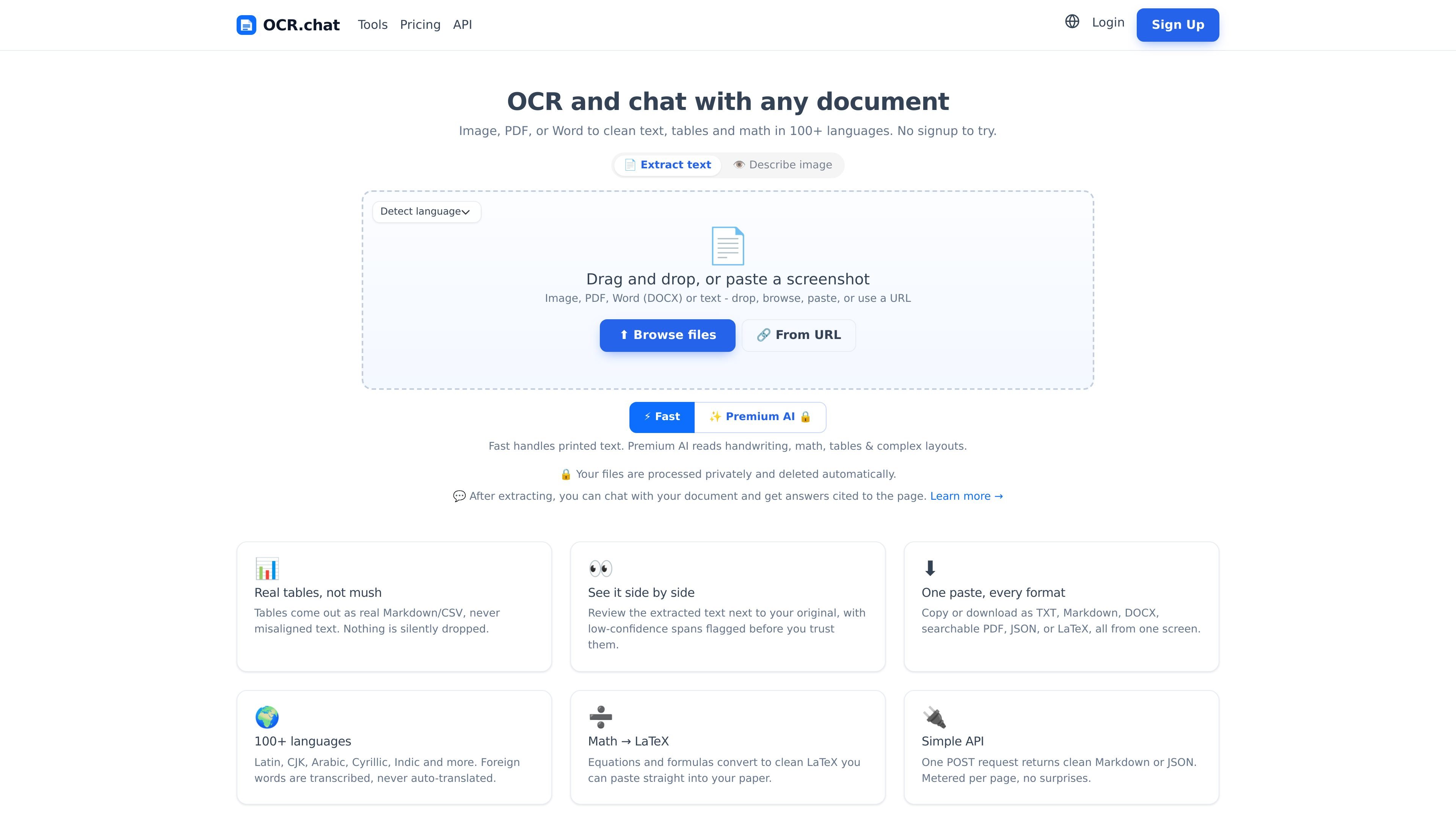
Browser-based upload and paste workflow
Upload an image, PDF, Word document, screenshot, or pasted text in the browser. The site also accepts files from a URL and supports multi-page PDFs and batches.
OCR.chat is a browser-based OCR and document chat tool for turning images, PDFs, Word files, and pasted screenshots into editable text. It is built for extracting clean text from printed documents and for handling more complex documents through a premium AI engine.
The product supports more than 100 languages and emphasizes outputs that stay useful after extraction: real tables in Markdown or CSV, equations converted to LaTeX, and side-by-side review with low-confidence spans flagged. After OCR, users can ask questions about the finished document and get answers cited back to the source page.
The site also offers a REST API for programmatic OCR and document chat. The API returns job objects, supports inline results for files of five pages or fewer, and allows downloading the finished output in several formats.
Pricing includes a no-signup free start, paid monthly plans, and one-time page packs that never expire. Paid tiers add access to the premium AI engine, higher page limits, batch processing, and API use depending on plan.
Upload an image, PDF, Word document, screenshot, or pasted text in the browser. The site also accepts files from a URL and supports multi-page PDFs and batches.
A fast engine handles printed text, while the premium AI engine is used for handwriting, tables, math, and complex layouts. The site also flags low-confidence spans for review.
Extract tables as structured Markdown or CSV rather than flattened text. OCR.chat says nothing is silently dropped during table extraction.
Convert equations and formulas into LaTeX, making the output easier to reuse in papers and notes. The product also describes foreign words as transcribed rather than auto-translated.
After extraction, you can chat with the document and get answers cited back to the page. The product positions this as grounded Q&A over the extracted content.
Export results as TXT, Markdown, DOCX, searchable PDF, CSV, or JSON, or copy them to the clipboard from one screen.
Upload printed documents or screenshots to turn them into editable text quickly in the browser, especially when you do not want to install software or create an account first.
Use the premium AI engine when a file contains handwriting, formulas, tables, or a complex layout that needs more than plain text extraction.
Extract structured table data into Markdown or CSV so it can be reviewed, copied, or moved into downstream tools without manual reformatting.
Ask follow-up questions about a finished scan or PDF and receive answers grounded in the extracted document with page citations.
Send files through the REST API when OCR needs to be automated, downloaded in a chosen format, or integrated into a broader workflow.
Yes. OCR.chat lets you extract text with no signup, and a free account adds more pages each month.
The site says it supports PNG, JPG, WEBP, GIF, BMP, TIFF, and multi-page PDF, with 100+ languages including CJK, Arabic, Cyrillic, and Indic scripts.
It supports plain text, Markdown, Word (DOCX), searchable PDF, CSV, JSON, and copy to clipboard.
Yes. The API documentation describes a REST endpoint that accepts a file upload and returns OCR results, with download and chat endpoints for finished jobs.
Files are processed for OCR and deleted automatically, and the site says it does not sell, share, or train on documents.

小艺是华为自主研发的 AI 智慧助手,支持知识问答、AI 写作、文档阅读、代码辅助与识图,适合日常查询、内容处理和鸿蒙开发场景,并支持文件拖放输入。

书生是通用大模型体系,覆盖语言、多模态、气象海洋、工业设计、三维空间、金融与科学发现等场景,提供模型与平台能力;官网未公开价格、部署步骤或接入文档。

AI Magicx 是一体化 AI 工作区,集聊天、图片、视频、语音、音乐、邮件和开发任务于一处,帮助创作者、团队和开发者集中使用多种模型,无需在多个工具和订阅间切换。

Rayyan 是一款用于系统综述和文献综述的 AI 平台,帮助研究人员和审查团队在共享工作流中完成筛选、数据提取、偏倚风险评估和报告。

Arcwise 是一款 AI 产品,可检测关键指标变化并用数据支撑的分析解释原因。帮助团队在应用、文档或幻灯片中,将数仓和业务上下文数据转化为可直接决策的报告。

Bible.ai is a Christian AI app for scripture-based conversations, faith questions, and biblical guidance through voice or text. It is positioned for believers and the Christian community rather than general-purpose AI use.