


Multi-source ingestion
Ingests files, text, URLs, feeds, and connected accounts, including PDFs, audio, video, web pages, Slack messages, email, and knowledge base sources.
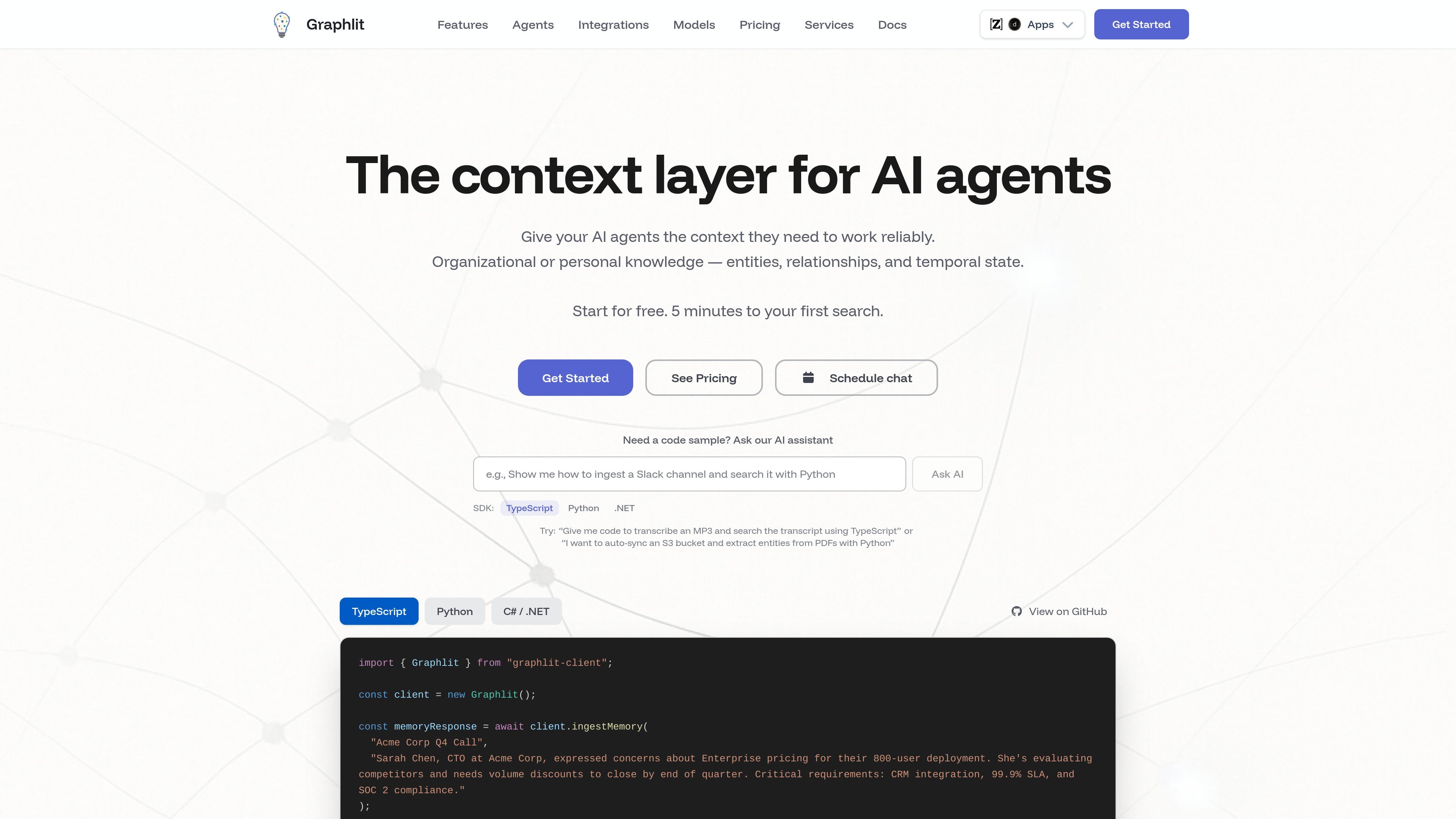
Graphlit is a context layer for AI agents and applications that need to work with organizational knowledge instead of isolated chat memory. It combines ingestion, extraction, search, chat, and knowledge graph workflows behind a single API.
The product is designed to bring content from files, web pages, messages, storage systems, and business tools into a searchable context layer. The site emphasizes real-time or continuous sync, provenance, and grounded answers so agents can use source-backed information rather than static prompts or ad hoc glue code.
Ingests files, text, URLs, feeds, and connected accounts, including PDFs, audio, video, web pages, Slack messages, email, and knowledge base sources.
Supports preparation, extraction, and enrichment workflows, with built-in transcription, OCR, embeddings, and completions.
Provides semantic search, keyword search, and hybrid search, plus source-grounded conversations with citations for retrieval-augmented use cases.
Extracts entities, observables, relationships, and temporal state to build organizational knowledge graphs rather than simple document indexes.
Connects to tools such as Slack, GitHub, Jira, Notion, Google Drive, S3, Gmail, Dropbox, and more, with continuous sync mentioned in the product messaging.
Offers SDKs and an MCP server for developer workflows, including TypeScript, Python, and .NET support and access from tools such as Claude, Cursor, and ChatGPT on higher plans.
Build assistants that answer from company knowledge with source citations, multi-turn memory, and retrieval over documents, messages, and connected apps.
Sync and search operational content from tools like Slack, GitHub, Jira, Notion, and email so teams can find context without manual ETL.
Extract people, companies, relationships, events, and ownership from content to support graph queries and relationship-aware applications.
Process PDFs, web pages, audio, video, and office files through ingestion, transcription, OCR, and enrichment pipelines for downstream AI use.
Connect external data sources to AI agents through MCP and SDKs so apps can retrieve context and trigger actions from familiar developer tools.
Graphlit is used to ingest content, extract structure, and make it searchable for AI applications that need grounded context. The site positions it as a context layer for AI agents, with support for search, RAG, chat, and knowledge graphs.
The pricing page shows a Free tier with limited usage and paid plans for Hobby, Starter, and Growth, plus a Custom option for larger integration and agent work. The site also says there is a free project to get started and that no credit card is required for the free tier.
Yes. The site references SDKs for TypeScript, Python, and .NET, and the home page shows example code in TypeScript.
Graphlit’s integrations page describes ingestion, preparation, and delivery across connected tools. The site highlights sources such as Slack, GitHub, Jira, Notion, Gmail, Google Drive, S3, Dropbox, and similar systems.
The pricing page says Graphlit includes ingestion and extraction, search and RAG, knowledge graphs, and agent context in one platform price. It also calls out citations, configurable workflows, and content feeds.
Dokkio is a cloud content organization and search platform for teams and individuals working across services like Google Drive, Dropbox, Gmail, Box, Slack, and OneDrive. It helps users search, tag, organize, and understand files, attachments, pages, and screenshots from one place.

Obsidian 是一款私密筆記與知識管理應用程式,筆記儲存在本機 Markdown 檔案中,支援連結、圖譜檢視、Canvas、外掛與主題,並提供加密同步與網頁發布服務。

Rayyan 是一個 AI 驅動的系統性文獻回顧與文獻回顧平台,協助研究者與團隊在同一工作流程中完成篩選、資料擷取、偏倚風險評估與報告。

Anara 是專為研究打造的 AI workspace,可搜尋你的資料庫與網路,並以附引用依據的內容協助寫作。適合需要來源可追溯答案、文件分析與研究流程整合的人。

Quenti 是線上學習平台,提供抽認卡、練習測驗、配對遊戲與 AI 輔助評分,適合學生、教師、學校與組織集中建立、整理與複習學習內容。

IDWise 是身分驗證平台,提供文件檢查、人臉驗證、住址證明等合規流程,並支援按次驗證計價與免費整合選項。