

Research-led AI infrastructure
Sparkco presents itself as an open-source research project on the post-AGI stack, focused on runtime containers, harnessing, and messaging for AI agents.

Sparkco is an open-source research project and product site for AI agent infrastructure, terminal-first tooling, and prediction-market-focused workflows. Its pricing page also offers usage-based voice-agent plans with a free starting credit, SMS updates, transcripts, and higher-tier integrations.
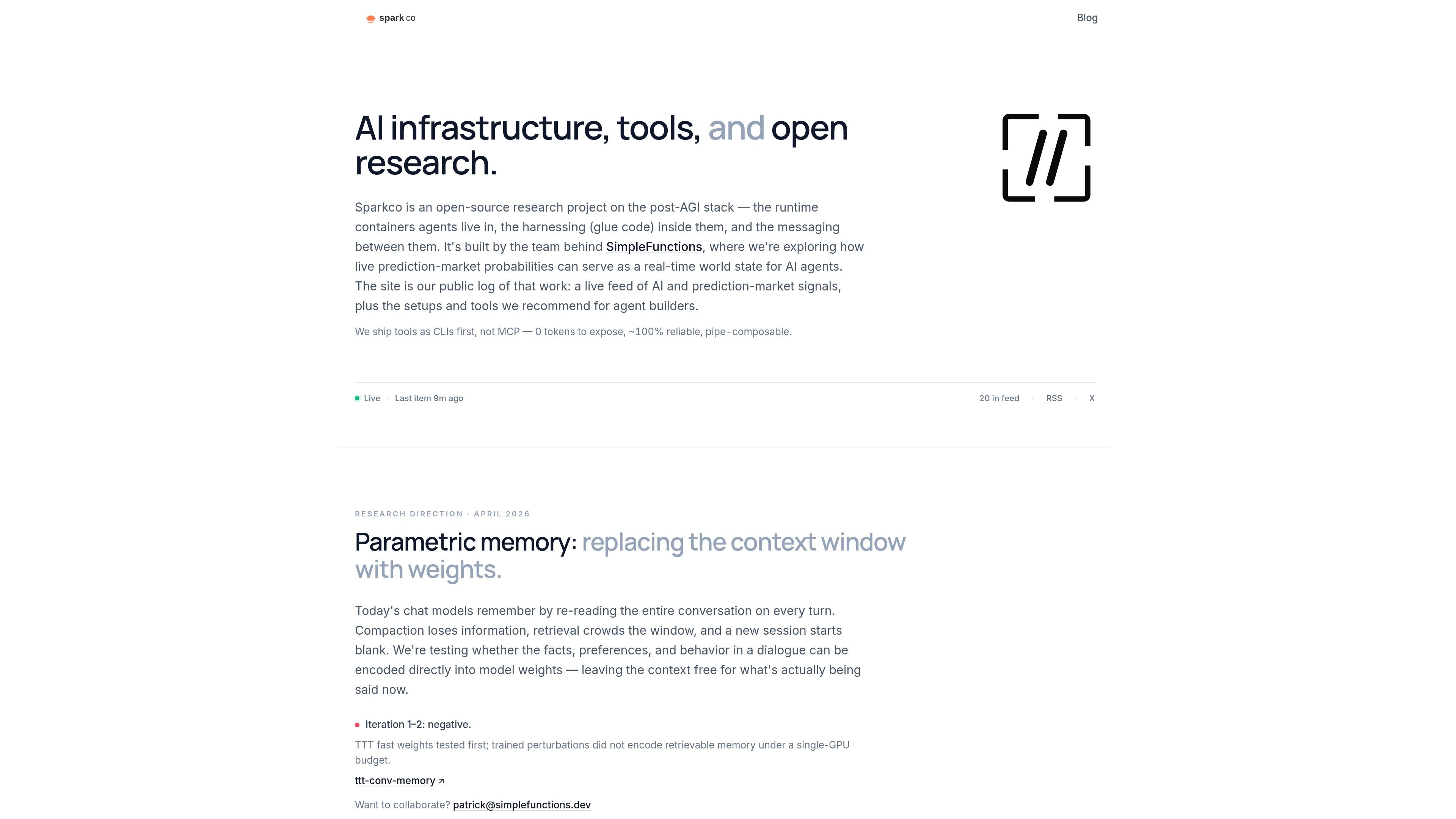
Sparkco is an open-source research project and product site focused on the infrastructure layer for AI agents. The homepage describes three core areas: runtime containers that agents live in, the harnessing or glue code inside them, and the messaging between them.
The site also frames Sparkco as a public log of active research and tooling, with live AI and prediction-market signals, curated recommendations for agent builders, and open code. Its blog content and open-source listings show a strong emphasis on terminal-based workflows, especially around prediction-market monitoring and trading.
The pricing page shows a separate commercial offering built around voice handling, with minute-based plans, SMS updates, dashboards, transcripts, and API/webhook access on higher tiers. Together, the site positions Sparkco as both a research publication and an operational product for teams that need agent infrastructure or call-handling automation.
Sparkco presents itself as an open-source research project on the post-AGI stack, focused on runtime containers, harnessing, and messaging for AI agents.
The site says the team ships tools as CLIs first, with a stated preference for terminal workflows over MCP exposure.
The public site acts as a live log of AI and prediction-market signals, along with setups and tools recommended for agent builders.
The open-source section lists public projects such as harness/agent runtimes, memory testing, autonomous agent arenas, and trading tools.
The pricing page offers voice-agent plans with minute-based billing, SMS updates, live analytics, transcripts, API and webhooks, and custom integrations on higher tiers.
The pricing page includes add-ons such as analytics and transcript search, warm-transfer minutes, and a dedicated success engineer for larger deployments.
Teams building AI agents can use Sparkco’s public framing and tooling examples to think about runtime containers, harnessing loops, and agent-to-agent messaging.
Operators running voice workflows can compare usage-based plans, SMS updates, dashboards, transcripts, and support tiers before starting a pilot.
Developers who prefer terminal workflows can use the CLI-first material and open-source projects as references for building deterministic harnesses and shell-based workflows.
Prediction-market traders and builders can follow the blog’s terminal dashboard and mispricing examples to monitor markets and structure command-line workflows.
You can create an account without a credit card and receive $20 of voice credit to start. The pricing page says that is enough for roughly 40 minutes of calls at the Starter rate or a mix of calls and SMS.
Only live agent-to-caller time is metered. Hold music, warm-transfer time, and outbound texts are not counted, and billing is by the second.
The pricing page describes Starter, Growth, and Scale tiers, plus add-ons such as analytics and transcript search, warm-transfer minutes, and a dedicated success engineer. The home page also positions Sparkco as an open-source research project with CLI-first tools and public code.
The site lists HIPAA, TLS 1.2+ encryption, and SOC 2 in progress. It also offers a HIPAA policy white paper for download.
The homepage says Sparkco ships tools as CLIs first rather than MCP, and the blog examples show terminal-style workflows for prediction market monitoring and trading.

Kastra 是 AI 系統的授權基礎架構,可在提示詞、工具呼叫、Shell 指令、API 請求與瀏覽器操作執行前先行檢查,協助團隊落實政策、保留簽章稽核軌跡並治理本地與企業 AI 工作流程。

Termo 是一個 AI agent 平台,每個 agent 都在專屬虛擬機器上執行,可瀏覽網頁、執行程式碼、記住上下文並依排程運作,適合處理重複研究、自動化與小型建置任務。

Orca 是一款 Agent 開發環境,專為搭配 coding agents 發佈軟體而設計。可在隔離的 worktrees 中平行執行多個 CLI agents,並提供桌面與行動裝置輔助工作流程。

Firebase Studio 是一個以瀏覽器為基礎的全端應用開發工作區,提供 Gemini 輔助編碼、應用預覽、雲端模擬器,可匯入既有專案、原型設計、協作與瀏覽器部署。

AI Magicx 是整合式 AI 工作區,將聊天、圖片、影片、語音、音樂、電子郵件與開發任務集中於一處,方便創作者、團隊與開發者整合多模型,免切換工具與訂閱。

Paper 是一款設計工具,串連畫布、程式碼與 AI agent,讓團隊可在同一工作流程中建立、分享並交付作品。支援桌面應用程式、MCP agent 存取,以及真實內容與設計 token 工作流。