

Fresh workers each cycle
Sends a bounded goal to fresh Codex workers so each cycle starts with clean context instead of continuing from a long, tangled chat thread.

AgentLoop is a local coding loop tool for unattended work in a local repository, with fresh workers, an independent critic, and project standards.
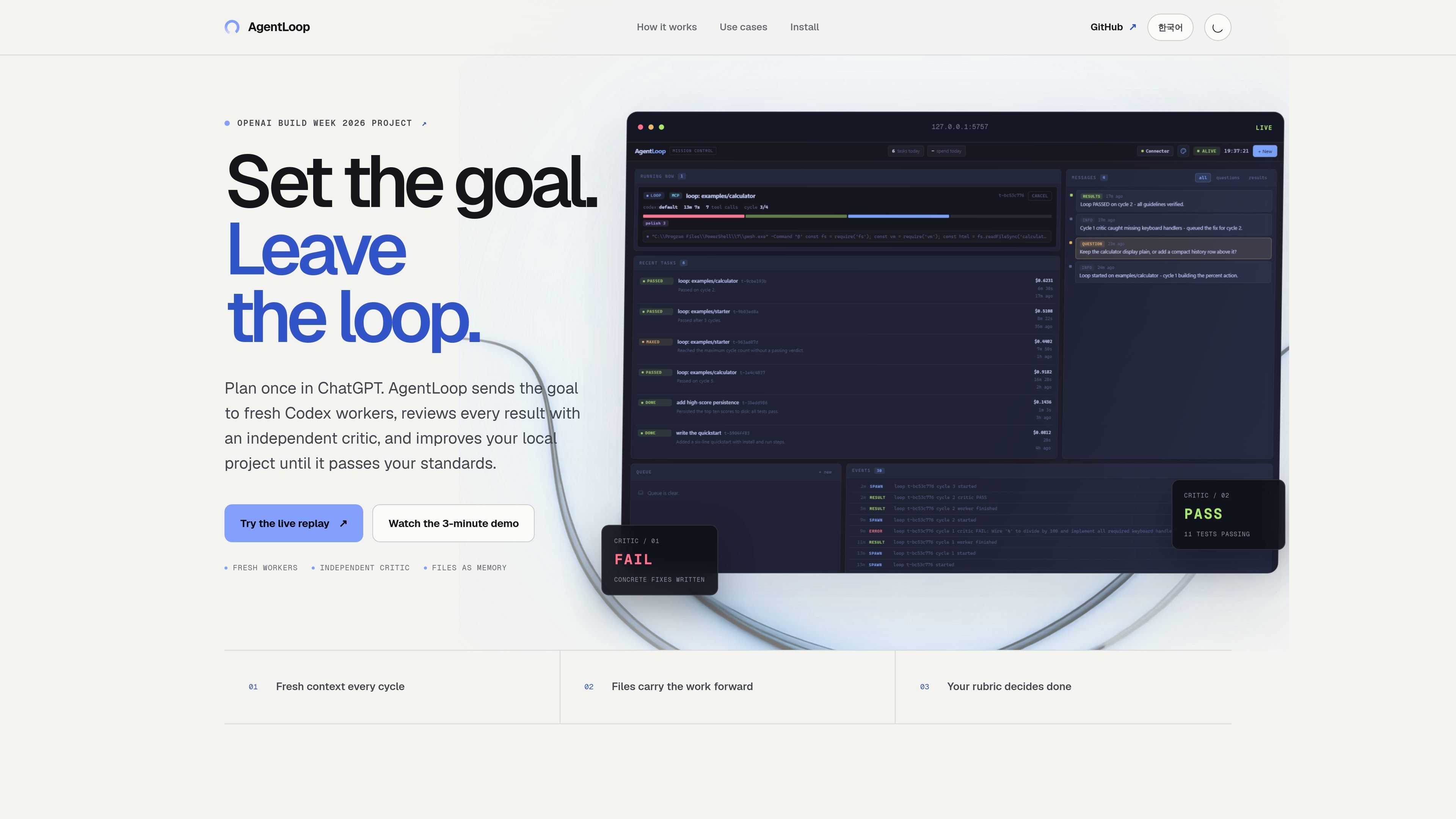
AgentLoop is a local coding loop tool that automates handoffs between planning, implementation, and review. The homepage describes it as “unattended local coding loops” with fresh workers, an independent critic, and standards applied on every cycle.
The intended workflow is to set the goal once, keep the rubric in GUIDELINES.md, and let the system keep iterating on the local project until the critic and your standards agree the work is done. It is presented as a local-first engine that runs in the repository where the code lives.
Sends a bounded goal to fresh Codex workers so each cycle starts with clean context instead of continuing from a long, tangled chat thread.
Uses a separate critic process to review results independently, so passing tests are treated as evidence rather than the only stopping condition.
Carries project files, logs, and feedback forward between cycles so the work can continue in the local repository without the user relaying every message.
Loads the definition of done from GUIDELINES.md, letting the project’s standards persist across iterations instead of living only in prompts.
Runs locally with Node.js 18+, Git, and an authenticated Codex CLI, and the source says it does not require an npm install or hosted workspace.
Provides observability through cycle logs, verdicts, transcripts, cost, file handoffs, and an interactive replay/dashboard view.
Assign a scoped feature and let the loop build, review, and refine it against acceptance criteria stored in your project files.
Use the worker/critic cycle for code changes that must preserve existing behavior while updating data handling, routes, or file formats.
Run an unattended pass on brittle areas of the codebase to add fixes, regression coverage, and documentation alignment.
Hand off a UI, copy, or developer-experience cleanup task when you want iterative polishing without staying in the loop for each step.
AgentLoop is described as running unattended local coding loops: you set a goal and standards once, then it sends work to fresh Codex workers, has an independent critic review the result, and carries evidence forward into the next cycle.
The source says it runs where your code lives and requires Node.js 18+, Git, and an authenticated Codex CLI. It also says there is no npm install and no hosted workspace.
The homepage describes a workflow where you define the finish line in ChatGPT, put your rubric in GUIDELINES.md, and let AgentLoop handle the worker/critic loop until the work passes your standards.
The site positions it for bounded coding work such as feature work, migrations, hardening passes, and product polish, especially when you want to avoid manually babysitting each handoff.
The pricing URL in the provided source returns a 404, so the collected pages do not confirm any pricing details.

Orca is an Agent Development Environment for shipping with coding agents, running multiple CLI agents in parallel across isolated worktrees, with desktop and mobile workflows.

Firebase Studio is a web-based workspace for full-stack app development with Gemini-assisted coding, app previews, cloud emulators, collaboration, and browser deployment.

AI Magicx is a unified AI workspace for chat, image, video, voice, music, email and developer tasks, helping teams and creators manage multiple models in one place.

Paper is a design tool that connects canvas, code, and AI agents so teams can create, share, and ship work in one workflow. Includes desktop app and MCP access.

blop is a QA agent that writes browser tests as code in your repo, runs them in CI, clusters repeated failures, and can open PRs to fix broken tests.

RLAMA is a local AI platform for building RAG systems and intelligent agents on macOS, Linux, and Windows, with HTTP API support.