

Team-wide agent system
Hyperagent is described as a system of agents that can do real work, learn how an organization operates, and deploy across a team.

Hyperagent is an AI agent platform from Gradient.ai that turns a brief into deliverables such as websites, dashboards, documents, slides, and video. It is designed to keep work current and deliver outputs into team workflows like Slack, inboxes, Telegram, and webhooks.
Hyperagent is an agent system from Gradient.ai that is positioned to do real work rather than one-off chat. The source describes it as software that learns how an organization operates and deploys across an entire team, with agents that can research, build, deliver, and keep outputs current.
The product appears to be aimed at teams that want assigned work to turn into durable deliverables such as websites, dashboards, documents, video, slides, and briefs. It emphasizes that agents can use real browsers, shells, and access to connected tools, then deliver work into places like Slack, inboxes, Telegram, or scheduled workflows.
Hyperagent is described as a system of agents that can do real work, learn how an organization operates, and deploy across a team.
You can brief the fleet once and have it research, build, deliver, and keep outputs current as conditions change.
The agents use real browsers, real shells, and access to your stack, so they can search, code, decide, and build with working tools.
Outputs can be delivered to Slack, inboxes, and other surfaces, and the source says they stay up to date after delivery.
Hyperagent supports multiple output formats, including websites, video, slides, documents, and dashboards.
The product exposes transparent execution, showing searches, decisions, and artifacts as they are built.
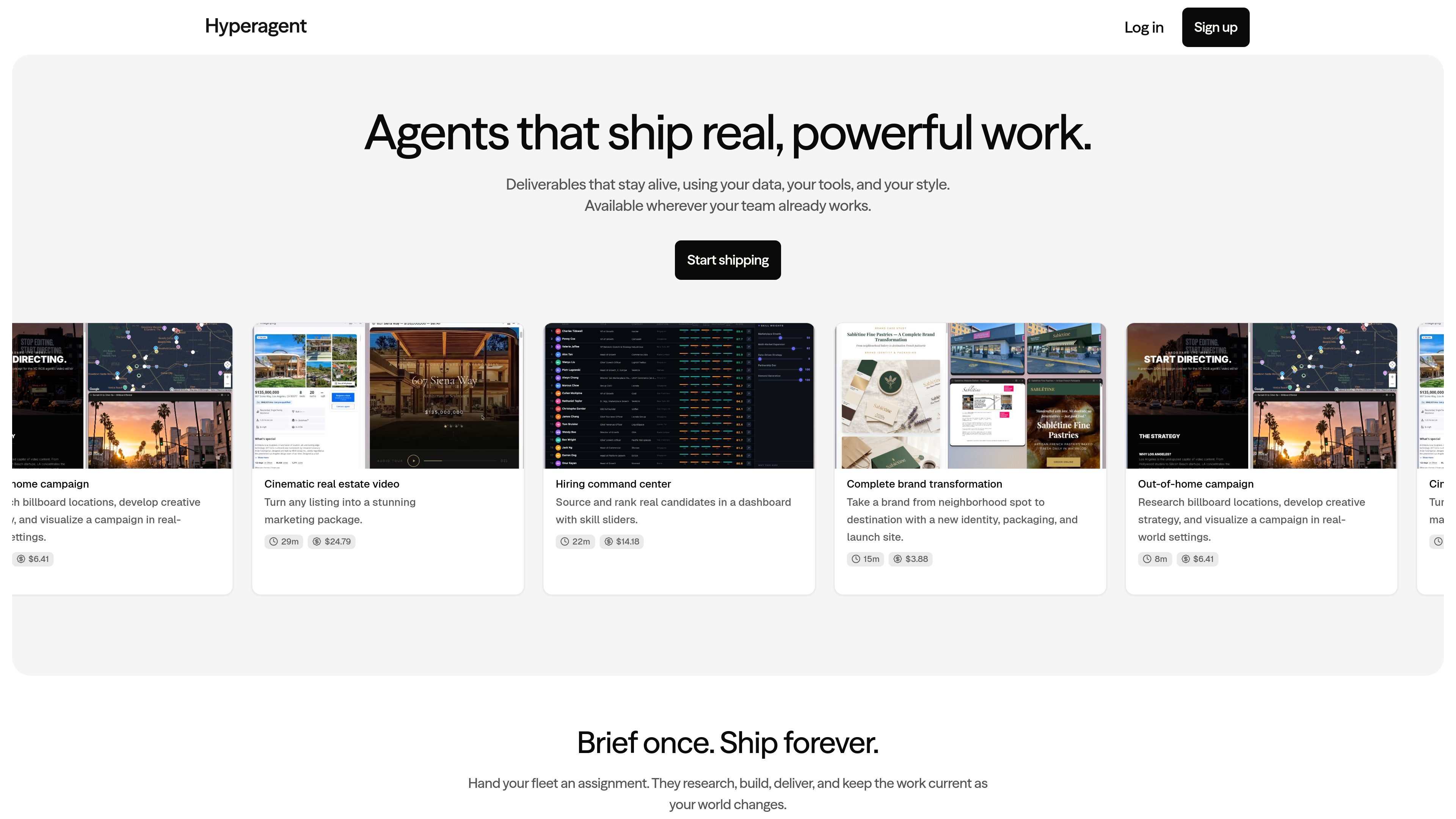
Use Hyperagent to research billboard locations, develop creative strategy, and visualize a campaign in real-world settings. The source presents this as an out-of-home campaign artifact.
Turn a property listing into a marketing package that includes video and presentation-ready assets. The source specifically calls out a cinematic real estate video example.
Build a hiring dashboard that sources and ranks candidates using skill sliders and other review tools. The example suggests a structured recruiting workflow rather than a static summary.
Create a brand refresh that moves from a local business identity to a broader launch package, including identity, packaging, and a site. The source frames this as a complete brand transformation.
Generate living deliverables that can be updated over time instead of disappearing after first delivery. This fits teams that want briefs, reports, or artifacts kept in sync as inputs change.
Hyperagent is presented as a system of agents that can be told what to build, then research, draft, share, polish, and keep the work current over time. The source does not describe a separate setup flow, but it does mention that agents can be deployed, connected, and managed from one command center.
The site says Hyperagent can deliver work wherever a team already works, including Slack, inboxes, Telegram, and webhooks. It also says agents can run on a schedule.
The homepage shows examples such as campaign research, a real estate video, a hiring dashboard, and a brand transformation package. It also says Hyperagent can produce websites, video, slides, documents, and dashboards.
The pricing page confirms there is a dedicated pricing page, but the provided source text does not expose plan names, prices, or usage limits.
The source does not list named integrations beyond Slack, Telegram, webhooks, and the statement that Hyperagent uses your data and tools. More specific app or data-source integrations are not shown in the supplied text.

AI Magicx is a unified AI workspace for chat, image, video, voice, music, email and developer tasks, helping teams and creators manage multiple models in one place.

CREAO is an AI agent platform for turning recurring business work into reusable workflows, with schedules, approvals, and tool integrations.
Twine AI Launcher is an Android launcher with AI assistant access, bringing ChatGPT-style help to your homescreen for quick answers, notes, tasks, reminders, and people memory.

Orca is an Agent Development Environment for shipping with coding agents, running multiple CLI agents in parallel across isolated worktrees, with desktop and mobile workflows.

Paper is a design tool that connects canvas, code, and AI agents so teams can create, share, and ship work in one workflow. Includes desktop app and MCP access.

Superside is an AI-powered creative service for enterprise and in-house teams, with global talent, AI-first workflows, and subscription-based support.