

Persistent memory across sessions
Mem0 stores useful information from prior interactions so agents can recall it later instead of rebuilding context each time.

Mem0 is an AI memory layer for agents and apps that retains context across sessions, retrieves relevant memories, and personalizes responses for developers.
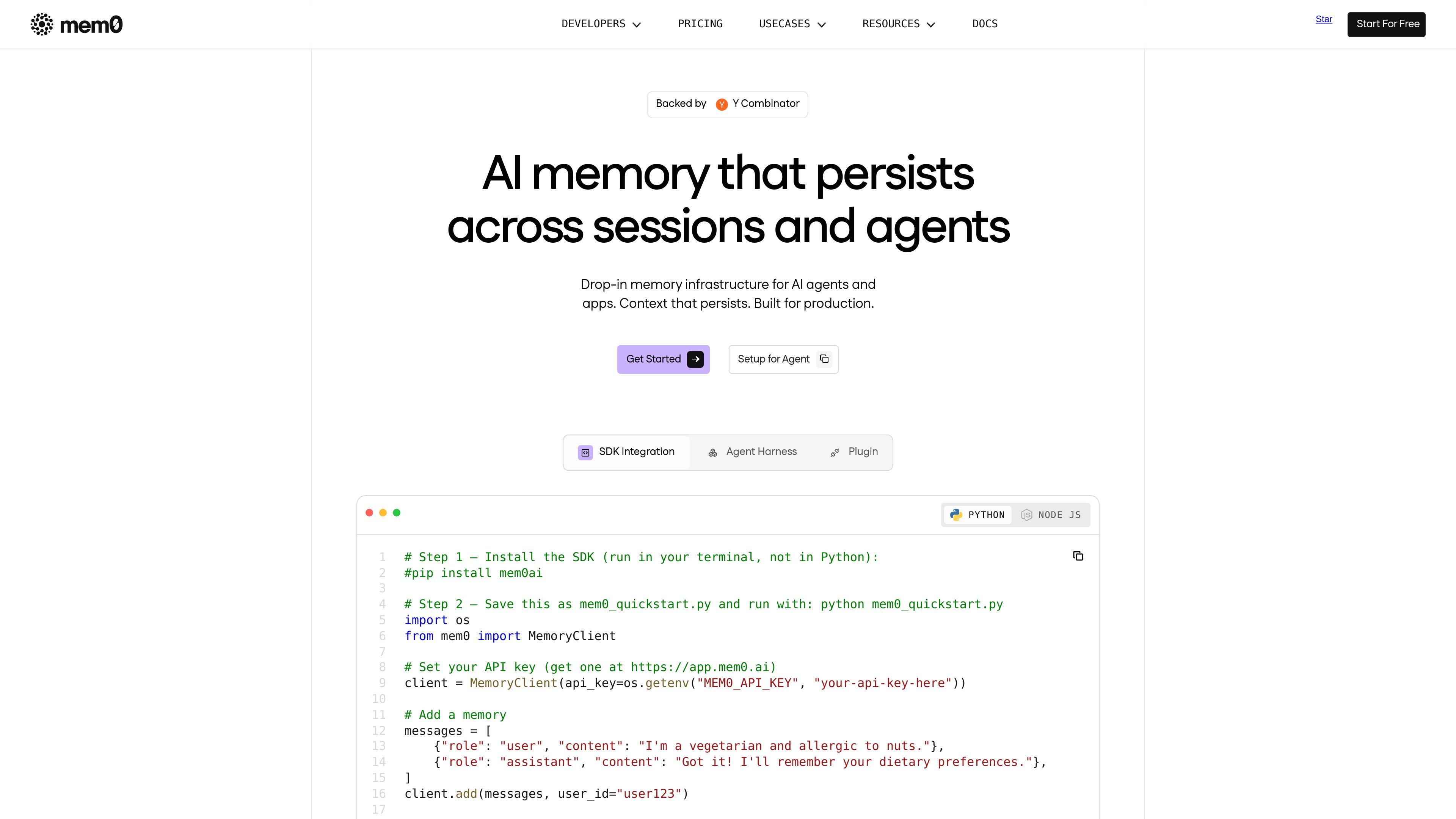
Mem0 is an AI memory layer for agents and applications that need persistent context. The site describes it as drop-in memory infrastructure that helps systems remember past user interactions across sessions and agents.
The core workflow shown on the homepage is straightforward: install the SDK, add conversation messages, and retrieve relevant memories later. Mem0 is presented as a production-oriented layer for developers who want AI systems to personalize responses, reduce repeated context, and preserve useful user details over time.
Mem0 stores useful information from prior interactions so agents can recall it later instead of rebuilding context each time.
The product shows a simple add-and-search workflow: ingest messages, extract memories, then retrieve them when a user asks a related question.
The homepage describes a memory compression engine that condenses chat history into compact memories to reduce token usage and latency.
The quickstart presents an SDK-based setup with Python and Node.js tabs, plus a MemoryClient interface for adding and searching memories.
The site says Mem0 works as drop-in memory infrastructure without pipeline changes, which suggests it is intended to fit into existing agent and app stacks.
The enterprise section highlights governance, portability, and auditability, including logging reads and writes and support for Kubernetes, private cloud, or air-gapped environments.
Customer support systems can remember prior issues, preferences, and account details so follow-up responses do not start from scratch.
E-commerce assistants can keep track of recurring preferences and earlier interactions to make later conversations more relevant.
Healthcare assistants can retain patient history, allergies, and treatment preferences across visits, supporting more consistent conversations.
Education products can adapt to a learner’s pace and style by remembering what works best over time.
Sales and CRM tools can preserve interactions, objections, and milestones across longer deal cycles for faster recall at each touchpoint.
Mem0 is set up as an SDK-based memory layer. The homepage shows a quickstart that installs `mem0ai`, creates a `MemoryClient`, adds conversation messages, and then searches stored memories for a user.
The site presents Mem0 as a memory layer for AI agents and apps that need persistent context across sessions. It is positioned for developers building production systems rather than a consumer chat app.
The rendered examples show two core workflows: adding memory from messages and retrieving relevant memories later with `client.search(...)`. The product also describes a memory compression engine that condenses chat history into compact memories.
The pricing page includes a `Start For Free` call to action, but the provided page text does not expose plan names, limits, or pricing numbers.
The site positions Mem0 for agents and apps, and shows use cases in healthcare, education, customer support, sales and CRM, and e-commerce. It does not provide enough evidence here to confirm every deployment pattern or integration beyond the shown SDK and language tabs.

Orca is an Agent Development Environment for shipping with coding agents, running multiple CLI agents in parallel across isolated worktrees, with desktop and mobile workflows.

AI Magicx is a unified AI workspace for chat, image, video, voice, music, email and developer tasks, helping teams and creators manage multiple models in one place.

Paper is a design tool that connects canvas, code, and AI agents so teams can create, share, and ship work in one workflow. Includes desktop app and MCP access.

blop is a QA agent that writes browser tests as code in your repo, runs them in CI, clusters repeated failures, and can open PRs to fix broken tests.

RLAMA is a local AI platform for building RAG systems and intelligent agents on macOS, Linux, and Windows, with HTTP API support.

Kastra authorization infrastructure for AI systems checks prompts, tool calls, shell commands, API requests, and browser actions before execution.