

Model and database selection
Vanna works with multiple LLM providers and databases. The homepage lists Anthropic, OpenAI, Gemini, and Ollama, along with SQLite, PostgreSQL, MySQL, Snowflake, BigQuery, and other databases.

Vanna is an AI SQL agent framework for production-ready database assistants with natural-language querying, multi-LLM and database support, and hosted admin features.
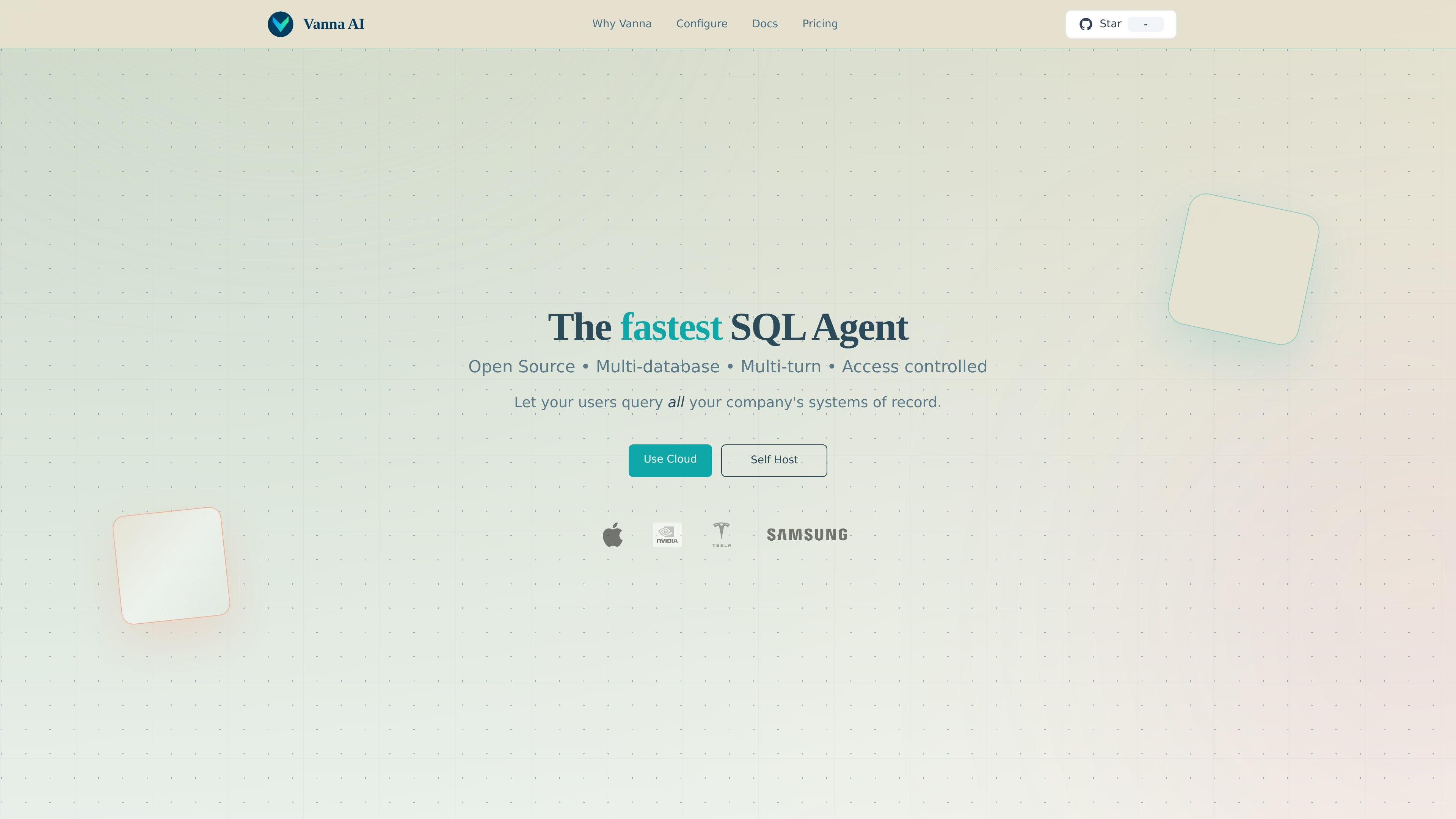
Vanna is an AI SQL agent and agent-building framework for letting users query company data through natural language. The homepage positions it as a way to build agents that ship to production, with user-scoped execution, rich UI components, and quota management built in.
The product supports multiple LLM providers and databases, and the docs show a configuration flow that generates ready-to-use code for a chosen stack. Users can start with a sample notebook or self-hosted setup, then connect the framework to their own database, agent memory, authentication logic, and server runtime.
Vanna works with multiple LLM providers and databases. The homepage lists Anthropic, OpenAI, Gemini, and Ollama, along with SQLite, PostgreSQL, MySQL, Snowflake, BigQuery, and other databases.
The product supports natural-language querying over databases and is presented as an AI SQL agent that helps users ask questions without writing SQL directly.
Docs show agent memory that stores successful question-to-tool-argument examples so later queries can reuse prior interactions and improve accuracy.
The configuration docs include user authentication and access groups, letting different users be assigned different permissions before the agent runs a tool.
The homepage describes optional hosted admin features such as observability, audit logs, file storage, data retention, and hosted agent memory.
The docs include ready-to-run server examples and generated configuration code, including FastAPI-based execution.
Let business or operations users ask questions against a company database in plain language instead of writing SQL manually.
Build a production agent that uses access groups, user resolution, and tool registration so different users see different capabilities.
Start with the sample notebook or generated configuration code to test Vanna on SQLite or other supported databases before wiring it into a larger app.
Add hosted admin capabilities such as audit logs, observability, and data retention when a team needs more control over usage and records.
Vanna’s docs show copy-paste-ready setup code for a chosen LLM provider and database. The quick start also offers a sample notebook on Google Colab to try Vanna with sample data.
The source shows Vanna working with multiple LLM providers and databases, and it supports self-hosting, Vanna Cloud, and enterprise deployment options.
The pricing page says the tiers use the same core framework, so you can start self-hosting with the open source version and later move to managed cloud or enterprise deployment without rewriting code.
The docs and homepage show outputs that can include ready-to-use code, SQL execution, and data visualization through registered tools, depending on your configuration.

Orca is an Agent Development Environment for shipping with coding agents, running multiple CLI agents in parallel across isolated worktrees, with desktop and mobile workflows.

AI Magicx is a unified AI workspace for chat, image, video, voice, music, email and developer tasks, helping teams and creators manage multiple models in one place.

Paper is a design tool that connects canvas, code, and AI agents so teams can create, share, and ship work in one workflow. Includes desktop app and MCP access.

blop is a QA agent that writes browser tests as code in your repo, runs them in CI, clusters repeated failures, and can open PRs to fix broken tests.

RLAMA is a local AI platform for building RAG systems and intelligent agents on macOS, Linux, and Windows, with HTTP API support.

Kastra authorization infrastructure for AI systems checks prompts, tool calls, shell commands, API requests, and browser actions before execution.