

Plagiarism and AI rate detection
The page highlights paper plagiarism checks, AI rate detection, rewriting, and AI reduction, covering the main process from risk identification to text revision.

学术猹 is a Youdao paper processing platform for plagiarism checks, AIGC/AI rate detection, rewriting, and AI reduction before submission.
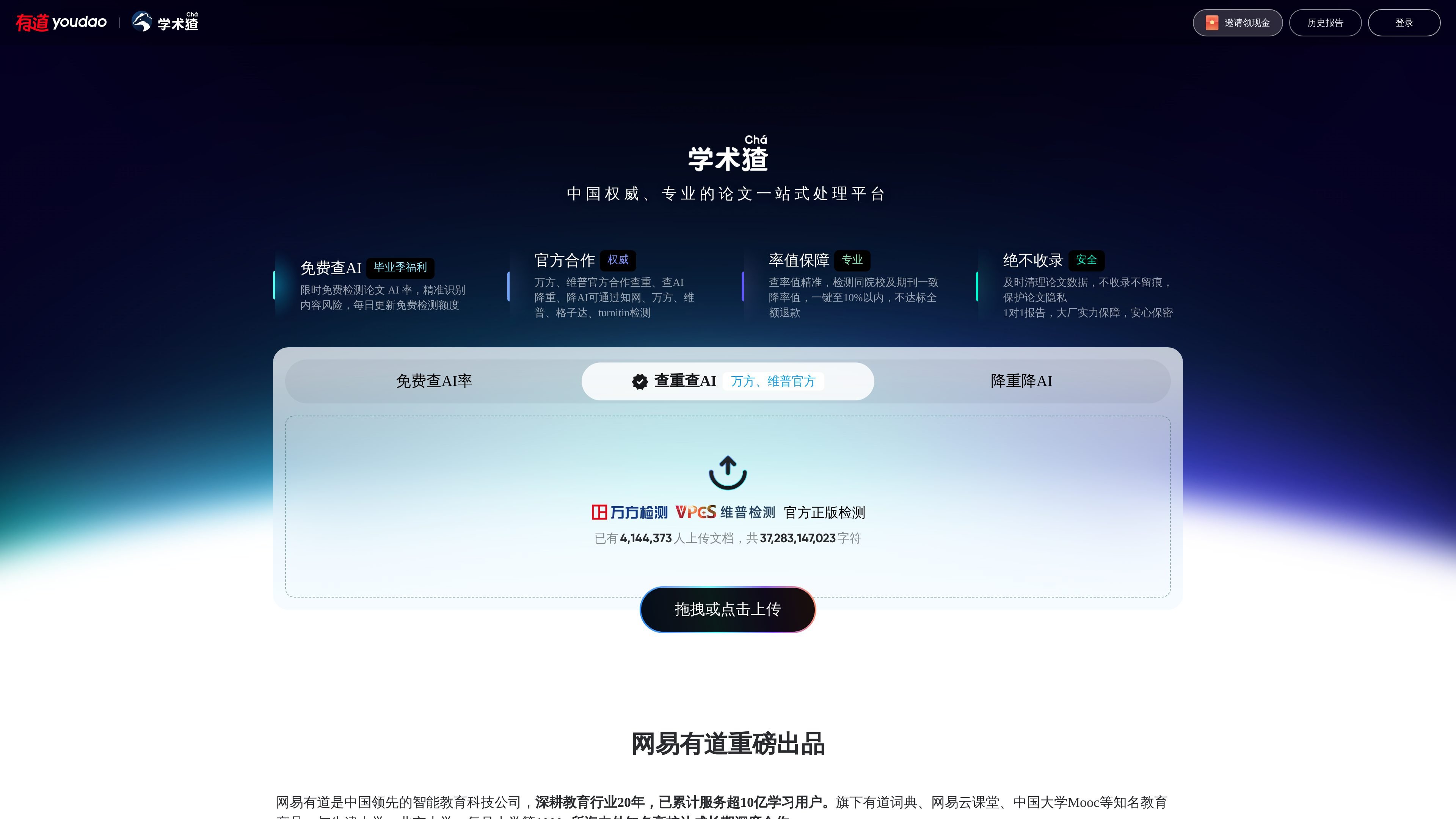
学术猹 is an all-in-one paper processing platform launched by NetEase Youdao, designed for plagiarism checks, AIGC/AI rate detection, rewriting, and AI reduction needs. The page information shows that it integrates Youdao’s professional academic rewriting model and the DeepSeek large model, and supports common detection scenarios such as CNKI, Wanfang, VIP, GeZida, and Turnitin.
From the public website content, the product’s main role is not just detection, but completing the entire process of “identify issues — process the text — output a report” in one workflow. The page also offers free checking quota, supports multiple document formats, and includes privacy statements such as “not included” and “timely data cleanup,” making it suitable for users who need to quickly process course papers, graduation theses, or submission texts.
The page highlights paper plagiarism checks, AI rate detection, rewriting, and AI reduction, covering the main process from risk identification to text revision.
The product uses Youdao’s professional academic rewriting model and the DeepSeek large model for rewriting and AI reduction of paper text.
The page explicitly says it supports CNKI, Wanfang, VIP, GeZida, and Turnitin detection scenarios, adapting to common university and journal requirements.
Supports `docx`, `doc`, `pdf`, and `txt` formats, with up to 5 files uploaded at once, making batch processing of assignments or papers easier.
The page emphasizes “reduce to within 10% with one click” and “rate guarantee,” and notes a full refund if the target is not met, indicating the service aims to lower repetition and AI rates significantly.
The page states “not included,” “no trace left,” and “timely cleanup,” and provides a one-to-one report, emphasizing privacy and visible processing results.
Suitable for undergraduate, master’s, or doctoral thesis authors who need to check plagiarism and AI rates before submission, using one platform for both detection and revision.
Suitable for writers preparing submissions for universities, journals, or institutions, who want to run plagiarism and AIGC checks first and then adjust the text based on the report.
Suitable for users who have already been told by their school that their plagiarism or AI rate is too high, and want to use rewriting or AI reduction services to lower the text further.
Suitable for users with multiple course assignments or chapter drafts on hand, who want to process them together by uploading several files at once.
Suitable for users who are sensitive to privacy and worry that their papers may be included in a database, and who prefer services that clearly state no inclusion and timely cleanup.
Based on the page information, 学术猹 provides paper plagiarism checks, AIGC/AI rate detection, and rewriting and AI reduction processing. The page does not provide a complete user manual, but it clearly supports uploading documents for detection and processing.
The page shows support for `docx`, `doc`, `pdf`, and `txt` files, and up to 5 files can be uploaded at once. The homepage also notes one free check per day.
The page mentions use cases for CNKI, Wanfang, VIP, GeZida, Turnitin, and other detection scenarios, and emphasizes compatibility with common university and journal checking standards.
The page clearly states that papers are not included in the database, that paper data is cleaned up in a timely manner, and that no trace is left behind, along with other privacy protection statements such as automatic deletion after checking. However, it does not provide more detailed data retention policy information.
The page shows free checking quota, official cooperation, and rewriting services, but does not disclose a complete price list or all plan details, so it is best understood as a paid paper processing platform with a free allowance.

OneClickHuman AI content humanizer rewrites machine text into natural copy while preserving formatting. Free trial, two modes, 10+ languages.

Walter Writes AI rewrites AI-generated text to sound more natural and checks for AI signals—ideal for writers, students, marketers, and teams.

讯飞写作 is an AI writing assistant for office, news, marketing and official content. Import audio, video, Word, images and PPT to draft faster.

小艺 is Huawei’s AI smart assistant for Q&A, writing, document reading, code help, image recognition, and file drag-and-drop.

Arcwise is an AI product for detecting meaningful metric changes and explaining them with data-grounded analysis. It turns warehouse and business-context data into decision-ready reports in app, docs, or slides.

LexWorkplace is a cloud-based document and email management system for law firms, helping teams organize matters, search documents and email, and manage legal workflows from Outlook.