

Clean, agent-ready JSON
ZooData returns structured JSON that is pre-processed for LLM consumption, so agents do not need to parse raw HTML or build their own extraction layer first.

ZooData is a commerce intelligence API for AI agents, with structured JSON for product search, competitor lookup, market analysis, and real-time data.
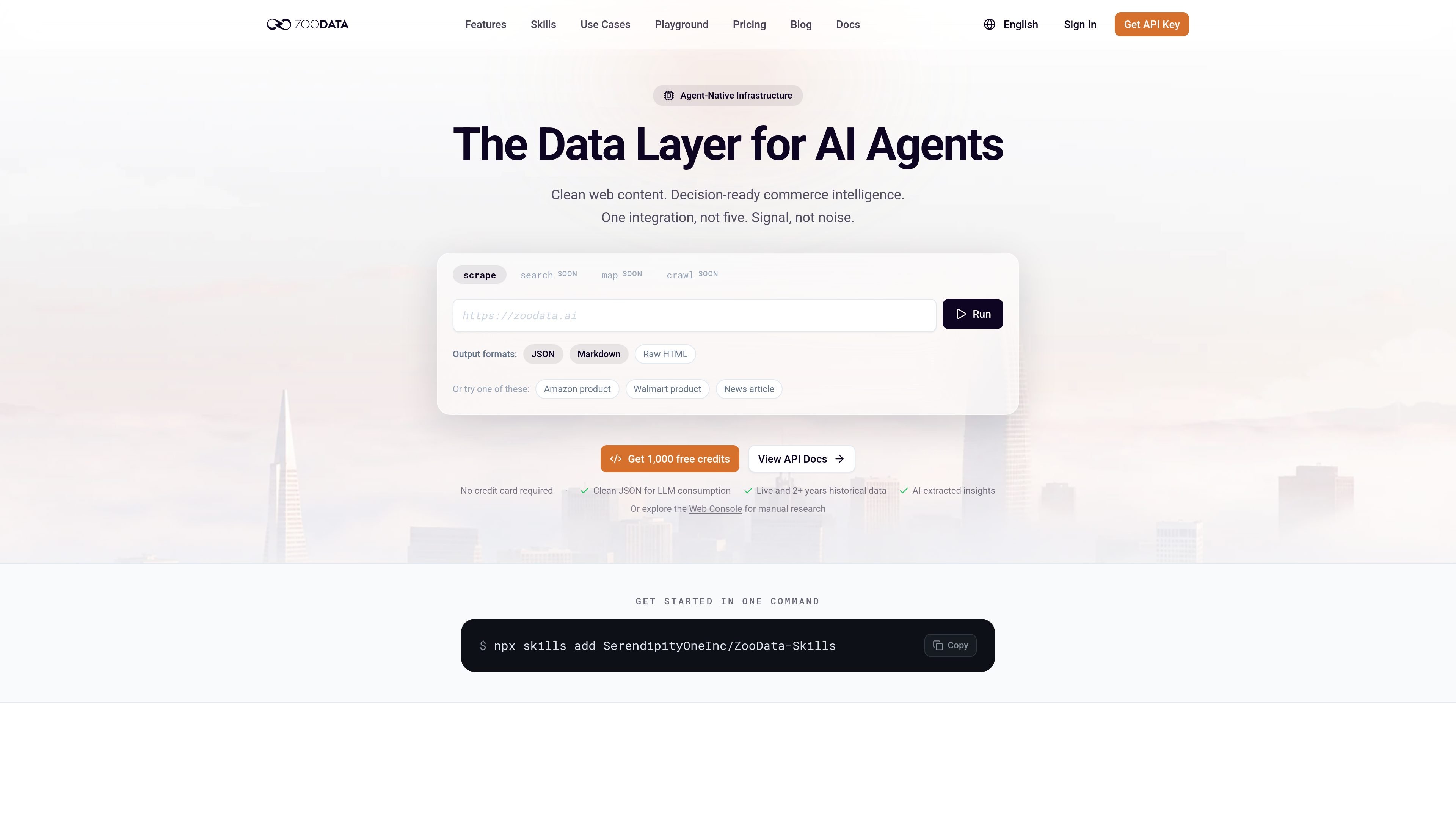
ZooData is an agent-native commerce intelligence API that gives AI agents structured data for product research, market analysis, competitor lookup, and pricing workflows. The site positions it as a data layer built for tool-calling rather than a human-facing dashboard.
Its documented endpoints return clean JSON and cover market search, product search, competitors, real-time product data, historical trends, and category taxonomy. The product is described as suitable for autonomous research, continuous monitoring, and end-to-end listing automation, with integrations for frameworks such as LangChain, CrewAI, AutoGen, and Claude MCP.
ZooData returns structured JSON that is pre-processed for LLM consumption, so agents do not need to parse raw HTML or build their own extraction layer first.
The platform exposes OpenAPI 3.0 and V2 endpoints for product search, competitor intelligence, market analysis, real-time product data, and historical trends.
Users can query category-level demand, competition density, and margin benchmarks to understand a market before acting on it.
The product search layer supports large-scale discovery across Amazon and TikTok Shop, with 40+ filters and batch-style querying mentioned on the site.
Competitor lookup can be performed across multiple dimensions such as brand, ASIN, seller, and keyword, which helps agents compare products from different angles.
The site documents live product data and historical depth, including live price, inventory, BSR, and more than two years of price, sales, rating, and BSR history.
Continuously scan a large product universe for opportunities using search filters, preset modes, and batch processing. The source pages describe autonomous selection agents that can review far more products than a human could manually cover.
Watch competitors for price changes, new listings, and review shifts. The product pages describe real-time lookup plus second-level alerts for monitoring competitor moves.
Combine live price, market price, and competitor data to help a pricing agent decide what to do next. The site frames ZooData as the data layer feeding pricing decisions rather than a pricing tool itself.
Track category demand, BSR movement, and emerging signals over time to identify what is trending now. The market analysis and historical endpoints support this kind of continuous radar workflow.
Use product discovery, real-time validation, and listing generation in a chained workflow for automated commerce operations. The site explicitly describes an end-to-end listing automation pipeline with discovery, validation, generation, and publish steps.
ZooData provides an API-first commerce data layer for AI agents, with OpenAPI 3.0 documentation and agent-friendly outputs such as clean JSON. The site also mentions a web console for manual research if you want to try it before integrating.
The site presents ZooData as a fit for autonomous research, competitor monitoring, market validation, pricing workflows, and listing automation. It is positioned for agents and developer-led integrations rather than a human dashboard workflow.
The documented endpoints return structured outputs for market analysis, product search, competitor lookup, real-time product data, historical product data, and category taxonomy. The site also says the data is pre-processed for direct LLM consumption.
The pricing page shows both prepaid credit packages for API usage and a separate monthly web plan. The page also states there is a free web tier for exploration, and the homepage offers 1,000 free credits with no credit card required.
The product pages mention several agent frameworks and integrations, including LangChain, CrewAI, AutoGen, Claude MCP, and OpenAI Functions. The API docs also show an MCP endpoint and an OpenAPI import path.

Predictice is a legal research and analysis platform for legal professionals, with jurisprudence search, litigation analysis, assistant tools and document audit workflows.

Orca is an Agent Development Environment for shipping with coding agents, running multiple CLI agents in parallel across isolated worktrees, with desktop and mobile workflows.

GetESP analyzes CSV email lists to identify recipient ESPs and spam protection tools, helping segment lists and choose the right provider for better deliverability.

Photoroom is an AI visual editing platform for e-commerce that removes backgrounds, creates product images, and prepares listings from phone, web app, or API workflows.

Firebase Studio is a web-based workspace for full-stack app development with Gemini-assisted coding, app previews, cloud emulators, collaboration, and browser deployment.

EZsite AI is an AI website builder that turns a URL into a fullstack React or Vue.js app with hosting, custom domains, code export, and backend features.